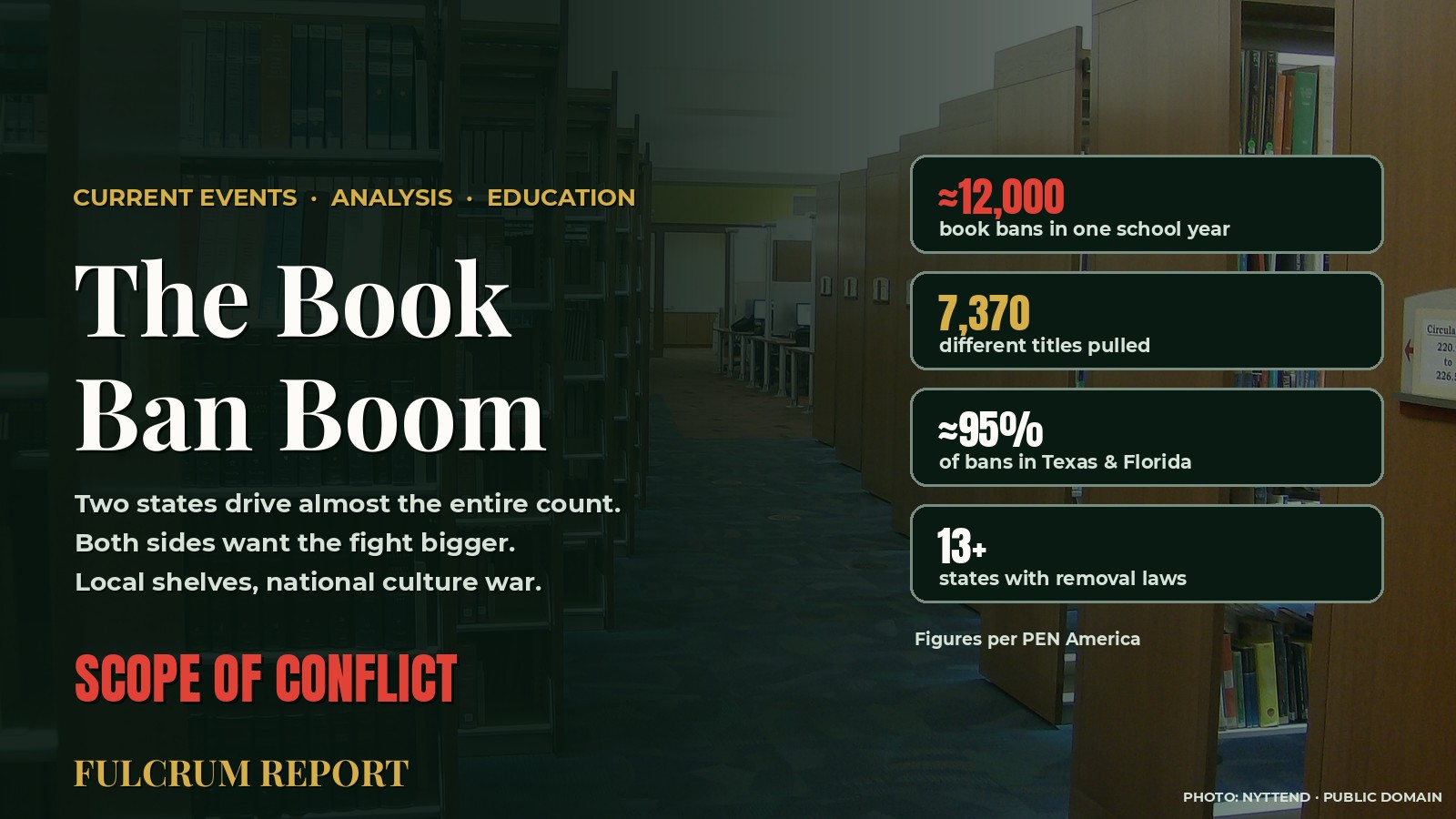
U.S. public schools recorded nearly 12,000 book bans in a single school year. That's a new record, according to PEN America, the free-expression nonprofit that has been tracking school book removals since 2021. The headline number is big. The more interesting story is how few places it actually comes from.
What the numbers count
Two numbers get mixed up a lot, so here's the difference. The roughly 12,000 figure counts ban instances, meaning each time a book was pulled in a district. The same title pulled in ten districts counts ten times. PEN America's study also counts 7,370 different titles pulled, which is the number of individual books affected. That's the highest since it started keeping track.
It's worth saying that PEN America is an advocacy group with a clear position on this issue. Its definition of a "ban" is broader than some critics would use, and it includes books removed while they're under review. I think the data is still useful, but I'd read it as a count from one side of the argument, not a neutral government statistic.
The laws behind it
Since 2021, more than a dozen states have passed laws that require or encourage schools to remove books flagged as explicit or profane. Some set up review processes. Some make it easier for parents to file challenges. Some put librarians and teachers at legal risk if they get it wrong, which tends to make schools pull first and review later.
The books removed most often deal with race, sexuality and gender identity. Supporters of the laws say that's because those books contain sexual content that isn't appropriate for kids. Critics say the topics themselves are the target. You can find examples that support each reading, which is part of why the fight never settles.
The twist
Texas and Florida alone account for about 95% of all recorded bans. Let that sit for a second. A record national number turns out to be mostly the story of two states, and within them, a set of specific districts. In most of the country, the shelves look pretty much the way they did a few years ago.
Both sides
Supporters say parents have the right to control what their kids read, and that a school library isn't a public bookstore. A school chooses what to buy, and parents have a say in what their children are exposed to.
Opponents say removing books because of the ideas in them violates the First Amendment, and that one parent's objection shouldn't decide what every other family's kids can borrow. Courts have been split on how far school boards can go, and some of those cases are still working their way up.
I'm not taking a side here. I do think both arguments are more serious than the other side usually admits.
The scope of conflict
The political scientist E.E. Schattschneider wrote in The Semisovereign People (1960) that whoever controls the scope of a conflict controls its outcome. His point was that a fight looks different depending on how many people are involved. The side that's losing a small fight tries to make it bigger and pull in new allies. The side that's winning tries to keep it contained.
This is my analysis, but I think it explains the book fight better than the raw numbers do. Two states drive almost the entire count. But the fight is national. And both sides want it bigger.
One side uses it to rally parents. The message is that schools are pushing material on kids without asking families. That works in school board races and statewide campaigns well beyond Texas and Florida.
The other side uses it to rally free-speech voters. The message is that books are being banned across America. That works too, even though the bans themselves are concentrated in a few places.
So a fight that's mostly happening in two states has turned into a national story that both parties find useful. Local library shelves have become a national culture war.
The Stephen King footnote
The most banned author for the second year running is Stephen King. His new novel, Other Worlds Than These, comes out today, October 6. I don't think that changes the argument, but it says something that the country's most challenged writer is also one of its best-selling ones.
What I'm watching
First, whether the numbers outside Texas and Florida start to rise, which would mean the fight is spreading and not just being talked about nationally. Second, how the courts rule on school boards' authority over library books, since a clear ruling would reset the rules everywhere. Third, how much the issue shows up in campaign ads this cycle. That's the best measure of whether both sides really are trying to make the conflict bigger.
Where do you stand: parents' rights, free speech, or somewhere in between?
About the author
Fulcrum Report
Independent Middle East analyst holding a PhD in Political Science. Fulcrum Report offers rigorous, framework-driven coverage of politics and geopolitics across the Levant and the wider region — analysis without agenda.
Related reading
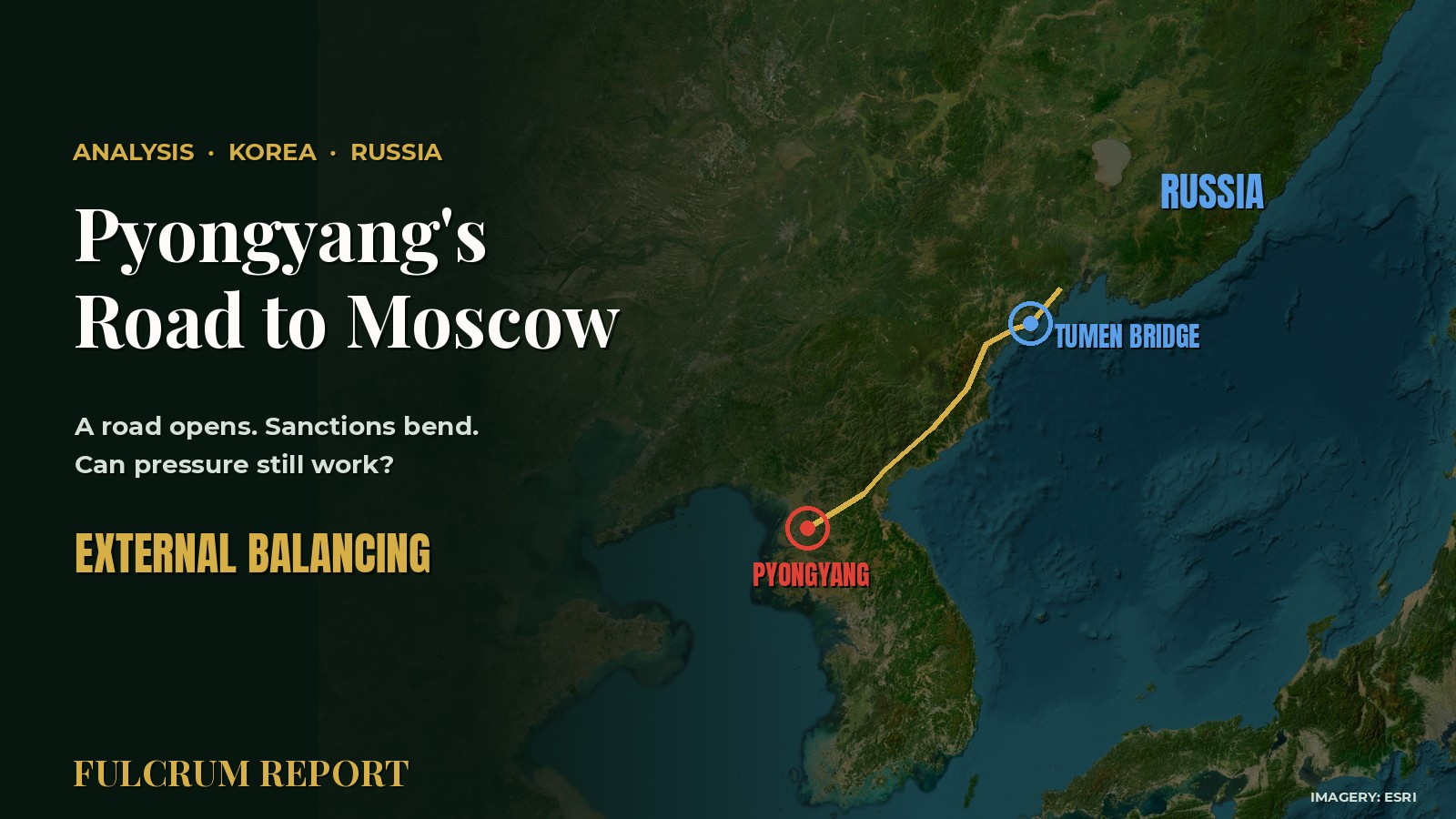
Pyongyang's Road to Moscow: Can Sanctions Still Work?
A second enrichment facility is reportedly going up at Yongbyon, and the Tumen River road bridge to Russia reportedly opened on September 8. When a major power offers a way around sanctions, how much pressure is left? An explainer on external balancing.

Takaichi's New Partner: Why Cabinet Seats Are a Trade
Sanae Takaichi reportedly reshuffled her cabinet on September 16 and 17, bringing in the Japan Innovation Party (Ishin) for the first time. Her camp holds two-thirds of the lower house but lacks an upper-house majority. A look at coalition bargaining and who gets the leverage.
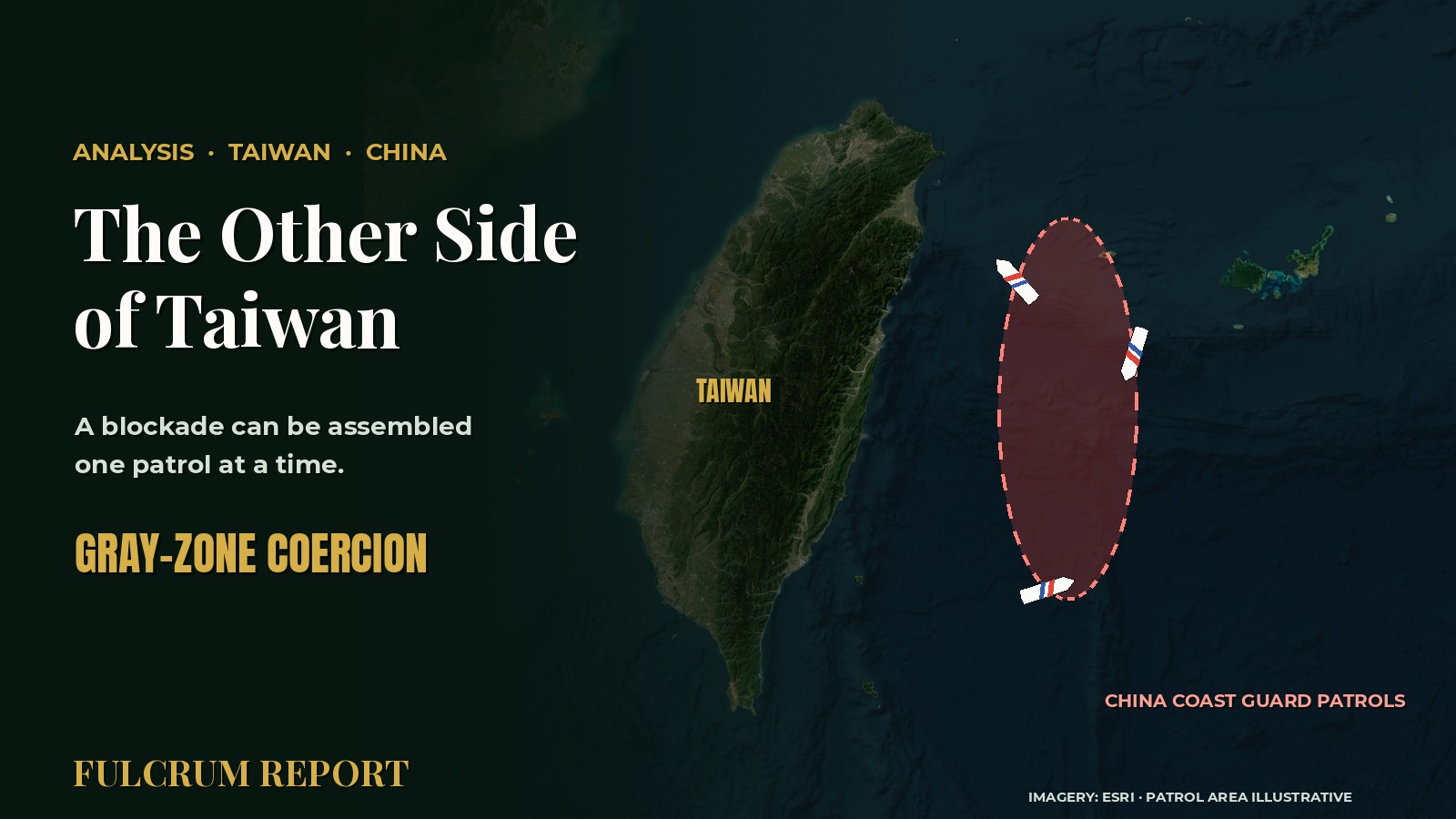
The Other Side of Taiwan: How a Blockade Gets Built Without Being Declared
China's Coast Guard has reportedly set up a regular presence east of Taiwan, framed as law enforcement, while a $14 billion U.S. arms package is pending. A look at gray-zone coercion, salami tactics and escalation control.