Pyongyang's Road to Moscow: Can Sanctions Still Work?
North Korea is reportedly expanding enrichment at Yongbyon while a new road bridge to Russia opens. A look at external balancing and why sanctions lose their bite.
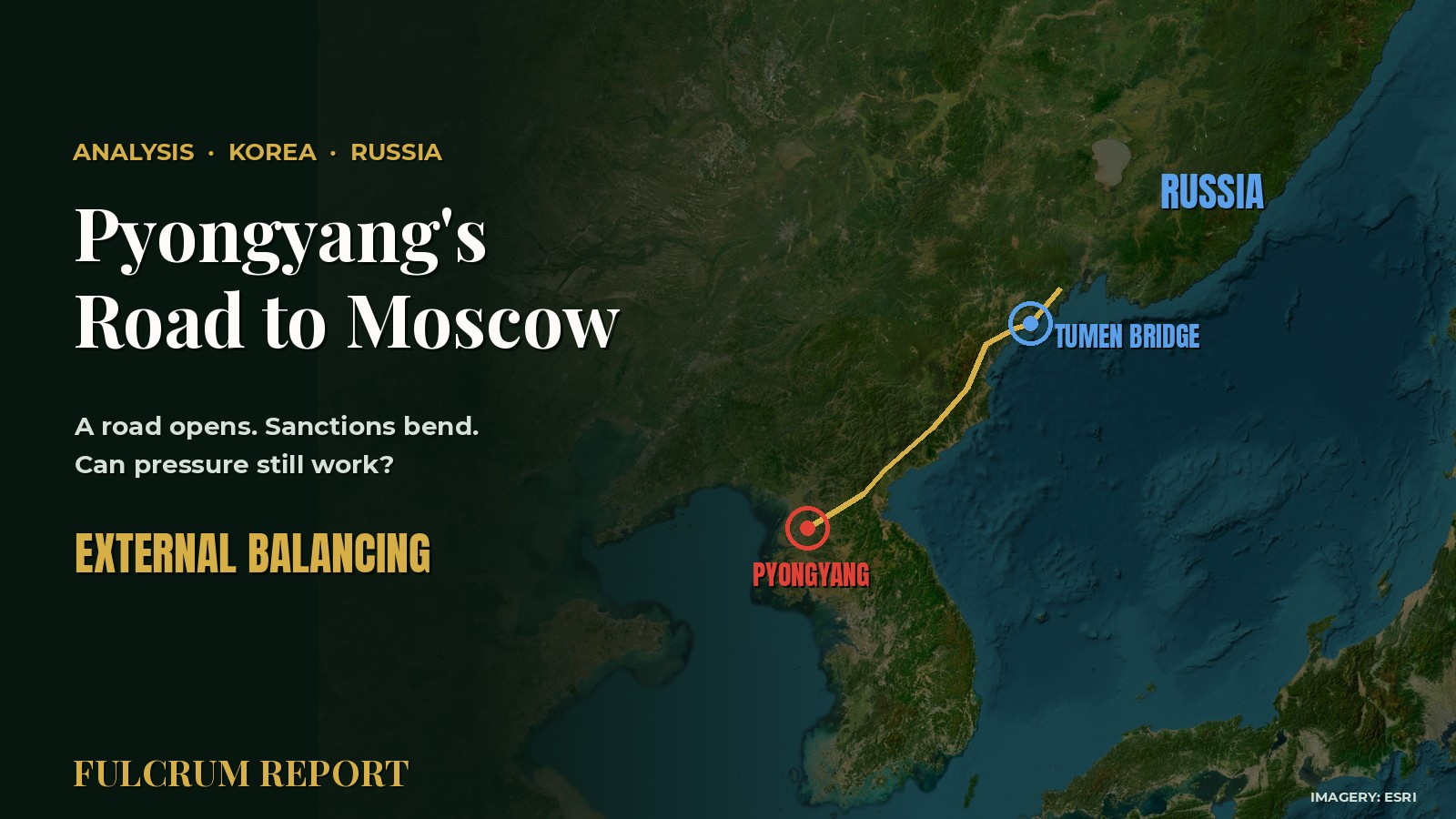
North Korea is doing two things at once right now. It's expanding its nuclear program, and it's opening a road to Russia. Either story on its own would be worth a look. Together, they raise a question I think matters more than any single launch or headline.
How much pressure can sanctions really apply when the border opens?
What's been reported
A few developments came close together, and I'm treating all of them as reported rather than confirmed. A second uranium enrichment facility is said to be going up at Yongbyon, North Korea's main nuclear complex north of Pyongyang. On September 8, the road bridge across the Tumen River, the short stretch of border North Korea shares with Russia, reportedly opened to traffic. Until now the main fixed link there was an old rail bridge from 1959. And on September 20, Pyongyang reportedly launched a projectile, while Kim Yo Jong, Kim Jong Un's sister and one of the regime's sharpest public voices, denounced the Pacific Vanguard exercises, the naval drills the United States runs with Japan and South Korea.
None of these is shocking by itself. North Korea builds, launches and condemns drills on a fairly regular rhythm. What caught my attention is that the road and the enrichment work are moving at the same time.
Why the road matters more than it looks
Sanctions on North Korea are some of the broadest the UN has ever imposed. They started with Security Council Resolution 1718 in 2006, after the first nuclear test, and tightened step by step until Resolution 2397 in December 2017 capped refined petroleum imports and ordered North Korean workers abroad to be sent home.
But a sanctions regime is only as tight as its weakest border. For years, the main gap was China. Now Russia is becoming one too. In March 2024, Russia vetoed the renewal of the UN panel of experts that monitored sanctions enforcement, so the body that tracked violations no longer exists. In June 2024, Moscow and Pyongyang signed a Comprehensive Strategic Partnership treaty that includes a mutual defense clause. A new road bridge is the physical version of that political shift. Trucks are harder to count than ships, and a permanent road says a lot about how long both sides expect this relationship to last.
The idea in the reel
The concept I used to explain this is external balancing. It's an old idea in international relations, and it's simpler than the name suggests.
Kenneth Waltz laid it out in Theory of International Politics in 1979. States facing pressure have two ways to push back. They can build up their own strength, which he called internal balancing, or they can lean on a stronger partner, which is external balancing. Stephen Walt added an important twist in The Origins of Alliances in 1987: states don't just balance against raw power, they balance against whoever they see as the biggest threat. From Pyongyang's point of view, that's the United States, Japan and South Korea, plus the sanctions the UN keeps on the books.
Here's the part I find interesting. North Korea is doing both at once. The enrichment work at Yongbyon is internal balancing, building more of its own capability. The road to Russia is external balancing, borrowing the weight of a major power to offset pressure from everyone else.
How the two work together
This is where it gets uncomfortable for anyone who believes in sanctions as a tool. Expanding fissile material production costs money, materials and imports that sanctions are supposed to choke off. If Russian support eases that economic squeeze, the arsenal can keep growing while the price Pyongyang pays for it falls.
That's the core of my argument. Russia doesn't need to tear up the sanctions to make them weaker. It just has to provide a way around them, through trade, fuel, payment for munitions or simple political cover at the Security Council. The sanctions stay on paper. Their bite gets smaller.
What I'm not claiming
I want to be careful here. A bridge isn't proof of large-scale sanctions-busting, and I haven't seen trade figures yet that would show how much actually crosses it. Russia also has its own limits. It's at war, and its economy is under heavy sanctions of its own, so it may not be able to give as much as Pyongyang would like. And China still matters more to North Korea's economy than Russia does.
So I wouldn't say sanctions have failed. I'd say the conditions that made them work, isolation and a united Security Council, are eroding.
Where this leaves us
For decades, the working assumption was that North Korea was isolated and that pressure would eventually force a choice. That assumption is getting harder to hold. North Korea isn't isolated anymore. It's connected, and it's expanding.
I asked in the reel whether sanctions can still work. My honest answer is that they can still raise costs, but on their own they probably can't stop the program while a major power keeps a door open. I'd like to hear where you come down on that.
Further reading: Kenneth N. Waltz, Theory of International Politics (1979); Stephen M. Walt, The Origins of Alliances (1987); UN Security Council Resolutions 1718 (2006) and 2397 (2017); the Russia–DPRK Treaty on Comprehensive Strategic Partnership (June 2024); the March 2024 Russian veto ending the UN Panel of Experts on North Korea.

About the author
Fulcrum Report
Independent Middle East analyst holding a PhD in Political Science. Fulcrum Report offers rigorous, framework-driven coverage of politics and geopolitics across the Levant and the wider region — analysis without agenda.
Related reading
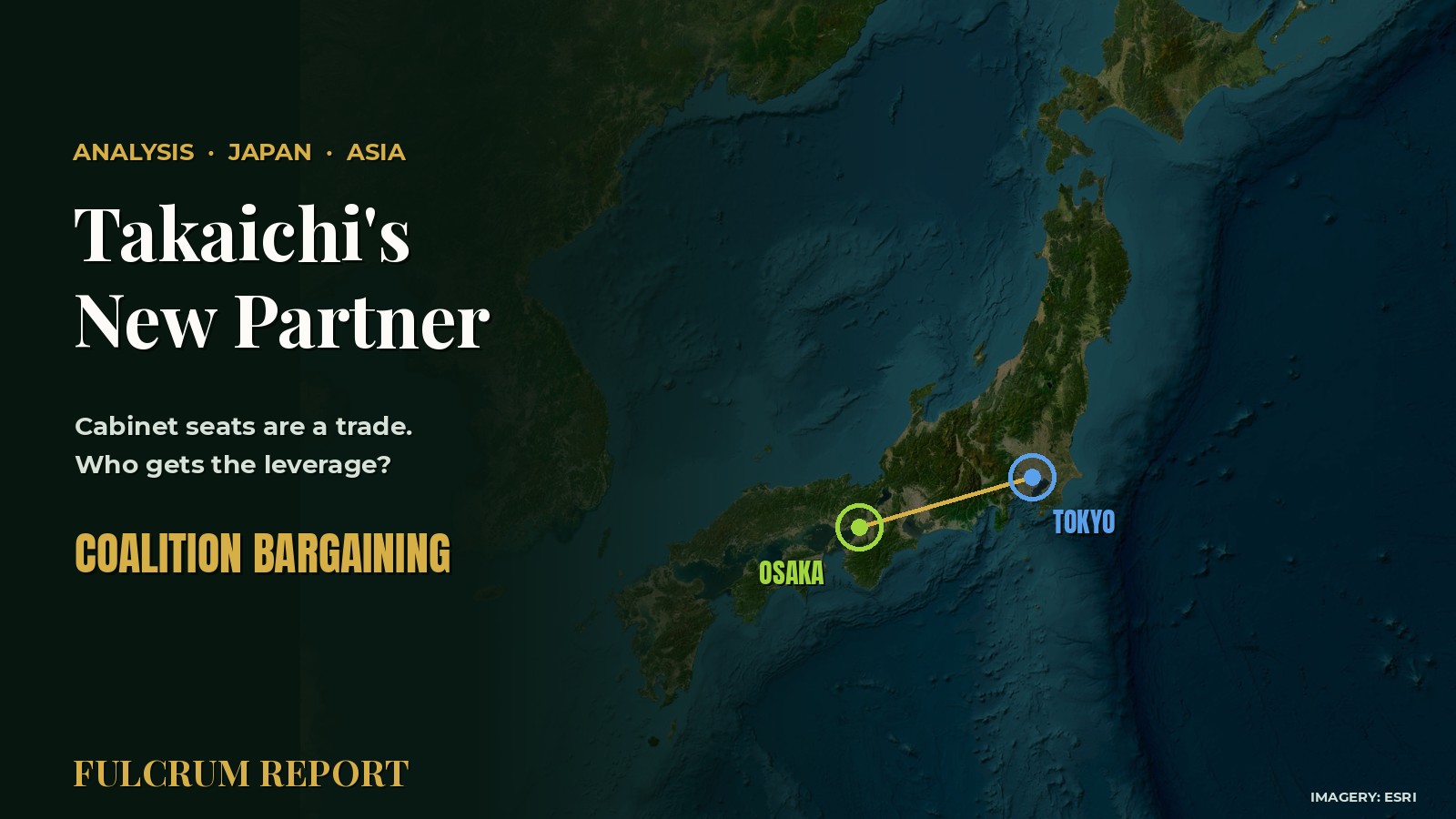
Takaichi's New Partner: Why Cabinet Seats Are a Trade
Sanae Takaichi reportedly reshuffled her cabinet on September 16 and 17, bringing in the Japan Innovation Party (Ishin) for the first time. Her camp holds two-thirds of the lower house but lacks an upper-house majority. A look at coalition bargaining and who gets the leverage.
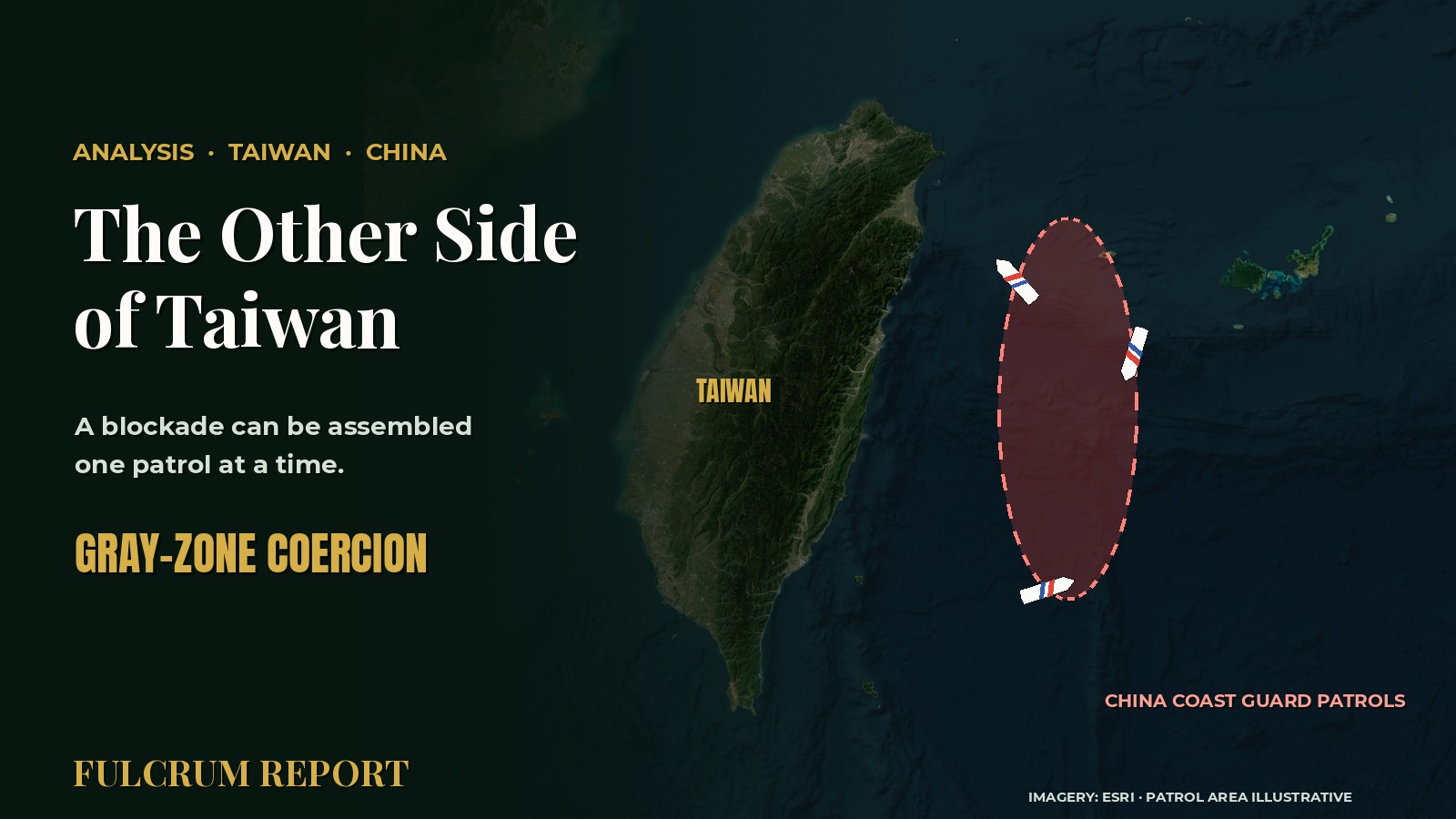
The Other Side of Taiwan: How a Blockade Gets Built Without Being Declared
China's Coast Guard has reportedly set up a regular presence east of Taiwan, framed as law enforcement, while a $14 billion U.S. arms package is pending. A look at gray-zone coercion, salami tactics and escalation control.

The Last Gate Jesus Walked Through?
The Threshold of the Judgment Gate, the "Eye of the Needle" and Constantine’s lost front door, inside Jerusalem’s Alexander Nevsky Church.