Takaichi's New Partner: Why Cabinet Seats Are a Trade
Japan's prime minister has reportedly brought the Japan Innovation Party into her cabinet for the first time. An ally, or leverage over her agenda?
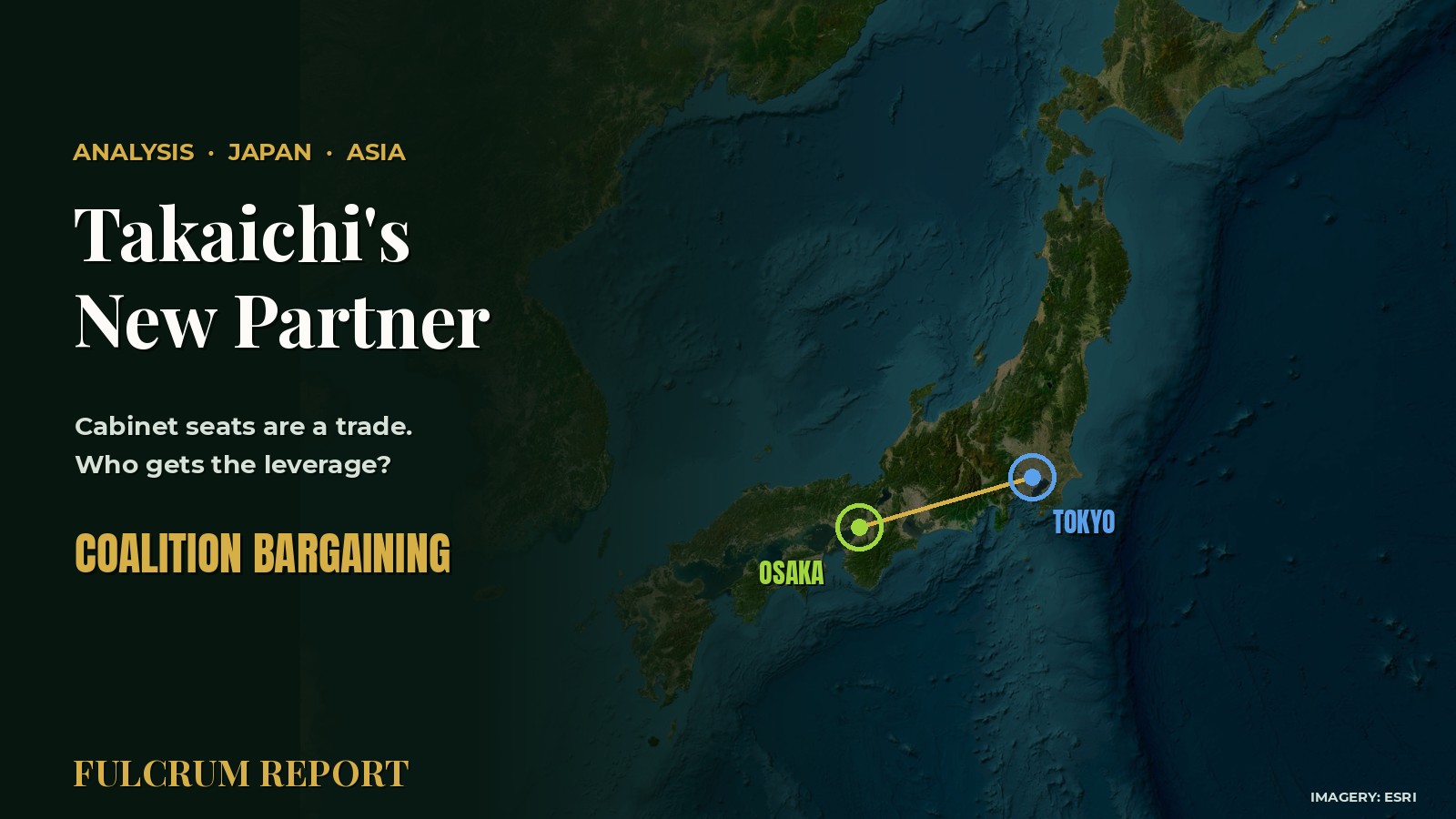
Japan's first female prime minister has just given a new party its first seats in a Japanese cabinet. That sounds like a small procedural story. I don't think it is. Who sits at the cabinet table decides a lot about what a government can actually get done, and Sanae Takaichi has an ambitious list.
So the question I kept coming back to was simple. Is she gaining an ally, or is she handing that ally leverage over her agenda?
What's been reported
Takaichi reportedly reshuffled her cabinet on September 16 and 17 and, for the first time, brought in ministers from the Japan Innovation Party, better known in Japan as Nippon Ishin no Kai. Ishin is an Osaka-based reform party. Since the autumn of 2025 it had backed Takaichi's government in the Diet without taking any cabinet posts, a kind of support-from-outside arrangement. Taking seats at the table is a different level of commitment.
The numbers behind the move are reported, and I'm treating them that way. Her camp is said to hold about two-thirds of the House of Representatives, the lower house, but it still lacks a majority in the House of Councillors, the upper house. Meanwhile, relations with China remain strained after her November 2025 remarks in the Diet that a Taiwan contingency could become a survival-threatening situation for Japan. And Japan is reportedly building a new central intelligence agency.
Put those together and you get a government that wants to move fast on defense and security, facing a chamber it doesn't control.
Why two-thirds isn't enough
At first glance, two-thirds of the lower house sounds like it settles everything. Under Article 59 of Japan's constitution, if the House of Councillors rejects a bill, the House of Representatives can pass it again by a two-thirds majority of members present and it becomes law anyway. So in theory a government with a lower-house supermajority can override the upper house.
In practice, it's a tool governments reach for rarely. The best-known recent case was in January 2008, when Prime Minister Yasuo Fukuda used it to restore the Indian Ocean refueling mission. It worked, but it was slow and politically costly, and it read as a government forcing things through. It also doesn't help on everything. Budgets and treaties follow their own rules, and some business needs both chambers' cooperation day to day, from committee schedules to appointments.
There's a good precedent for how much the upper house matters on security. The 2015 security legislation, which allowed limited collective self-defense, was a big fight. It cleared both houses only because the Abe government controlled both. Without the upper house, every major defense bill becomes a negotiation.
The idea in the reel
The concept I used to explain this is coalition bargaining. The short version: cabinet seats are a trade.
Political scientists have argued about why parties join governments for decades. William Riker's 1962 book, The Theory of Political Coalitions, predicted that parties would form minimal winning coalitions, just big enough to win and no bigger, so the rewards of office get split among as few players as possible. Later work pushed back on how mechanical that sounds. Kaare Strøm's 1990 article on party behavior, and the 1999 volume he edited with Wolfgang Müller, Policy, Office, or Votes?, frames parties as trading off three goals: getting into office, shaping policy, and winning future elections. Michael Laver and Norman Schofield's work on multiparty government in Europe adds that parties care about where they sit on policy, not just how many seats they bring.
Read through that lens, the Takaichi-Ishin deal looks like a fairly clean exchange. Ishin gets office and, more importantly, a say over policy from inside the cabinet rather than from the sidelines. Takaichi gets steadier backing for the defense and security reforms she has made the center of her government.
Where the leverage goes
Here's the part that's easy to miss. Bringing a partner into the cabinet doesn't just add votes. It changes who holds the veto.
When Ishin supported the government from outside, it could pick and choose. Now it's tied more closely to the government's success, which is good for Takaichi. But a partner that is necessary for passage also gets more say over what actually passes. That's what I mean by leverage. If the upper house is where bills live or die, the party that can help carry them through has influence well beyond its seat count.
Ishin also has its own priorities. It has long pushed for administrative reform, decentralization and its Osaka agenda, and it has sometimes been more hawkish than the LDP on constitutional revision. Those overlaps help. The places where they don't overlap are where the price shows up, in compromises on wording, sequencing and which reforms go first.
The cost of broader support
Broader support always comes at a cost. The cost here is less freedom to set the terms. A prime minister who governs with a partner can't simply announce a security policy and expect it to pass as written. She has to bring the partner along, and the partner knows that.
I don't think that's necessarily bad for Japan's security policy. Measures that pass with a broader coalition can be more durable, because they're harder for the next government to unwind. But they'll probably be slower and more negotiated than Takaichi's own instincts would suggest.
Where this leaves us
Japan's security shift is now a coalition project, not just one leader's. If you want to know where Japanese defense policy goes next, watching Takaichi alone won't be enough. You'll also have to watch what Ishin asks for and what it gets.
I asked in the reel whether this is an ally or leverage. My honest answer is that it's both, and the balance between them will show up in the details of the next few bills. I'd like to hear which way you think it tips.
Further reading: William H. Riker, The Theory of Political Coalitions (1962); Kaare Strøm, "A Behavioral Theory of Competitive Political Parties," American Journal of Political Science (1990); Wolfgang C. Müller and Kaare Strøm, eds., Policy, Office, or Votes? How Political Parties in Western Europe Make Hard Decisions (1999); Michael Laver and Norman Schofield, Multiparty Government (1990); the Constitution of Japan, Article 59; Japan's 2015 Legislation for Peace and Security.

About the author
Fulcrum Report
Independent Middle East analyst holding a PhD in Political Science. Fulcrum Report offers rigorous, framework-driven coverage of politics and geopolitics across the Levant and the wider region — analysis without agenda.
Related reading
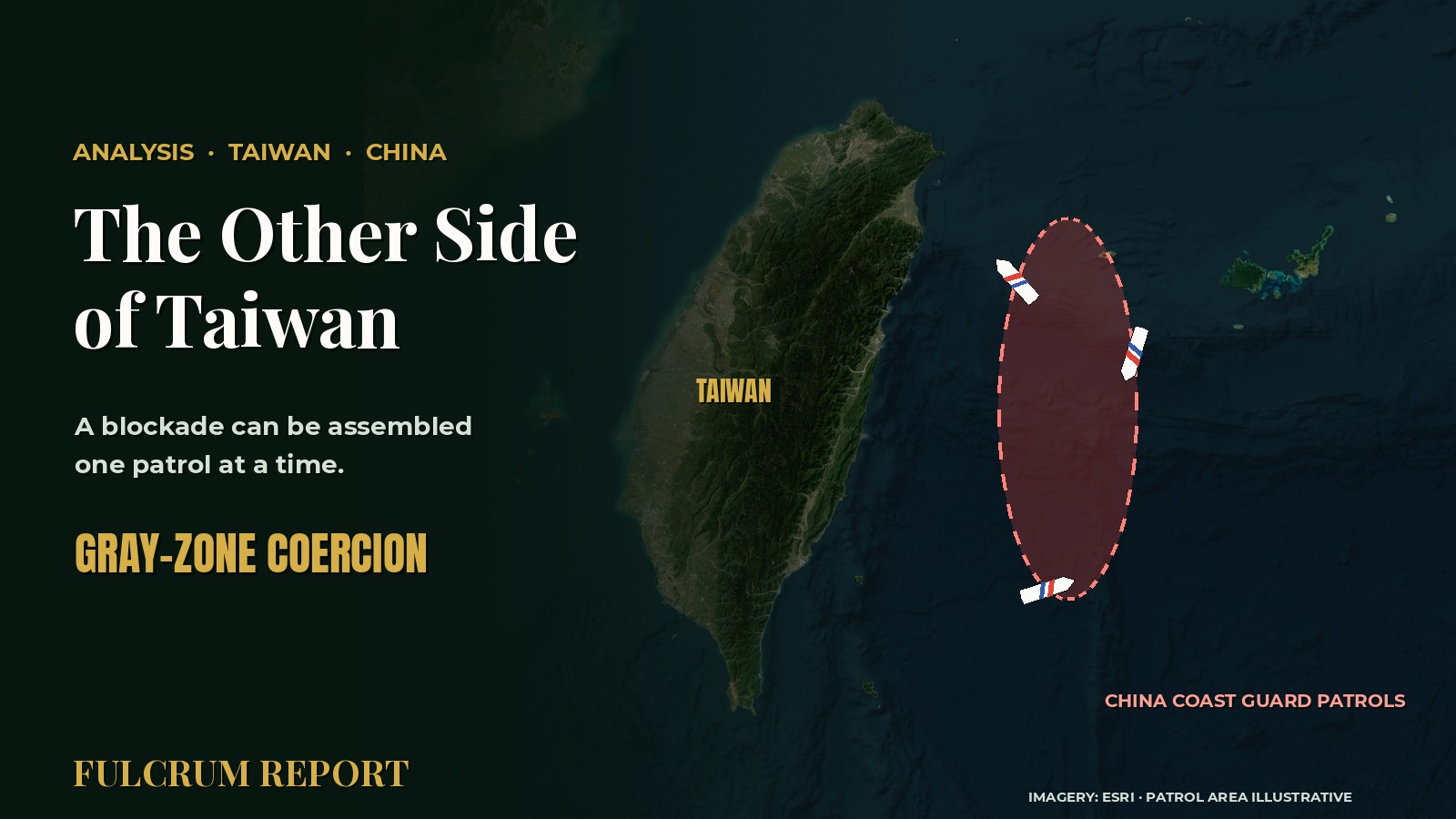
The Other Side of Taiwan: How a Blockade Gets Built Without Being Declared
China's Coast Guard has reportedly set up a regular presence east of Taiwan, framed as law enforcement, while a $14 billion U.S. arms package is pending. A look at gray-zone coercion, salami tactics and escalation control.

The Last Gate Jesus Walked Through?
The Threshold of the Judgment Gate, the "Eye of the Needle" and Constantine’s lost front door, inside Jerusalem’s Alexander Nevsky Church.
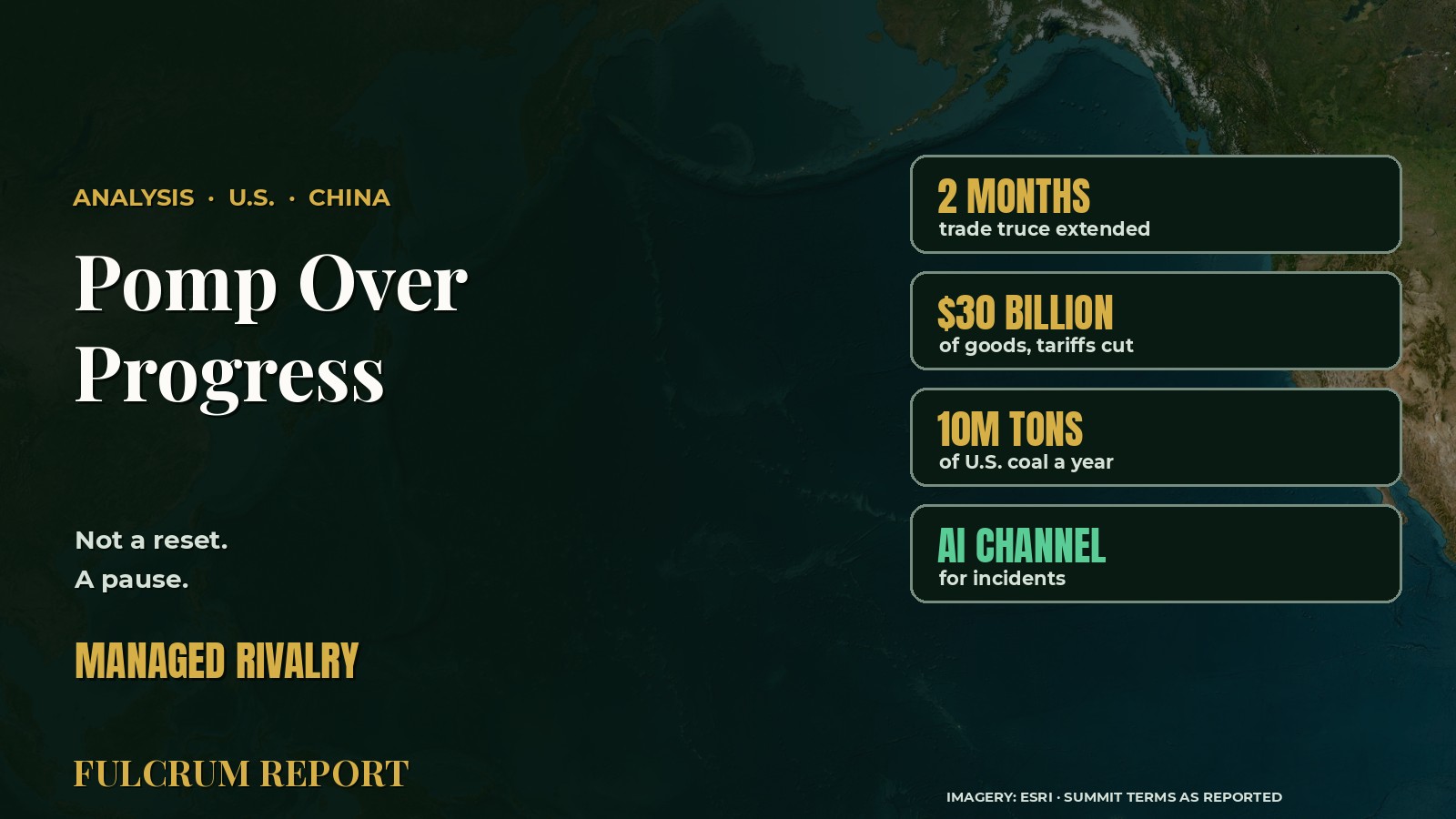
Pomp Over Progress: What Xi's Washington Visit Actually Bought
Xi Jinping's state visit ended with the trade truce extended two months, tariff cuts on $30 billion of goods, a coal deal and an AI incident channel. A look at managed rivalry and why guardrails matter.