China Is Positioning to End the War America Fights
Washington is doing the shooting. Beijing is doing the ending. Watch who gets the phone call when the fighting has to stop — that's where power is actually moving.
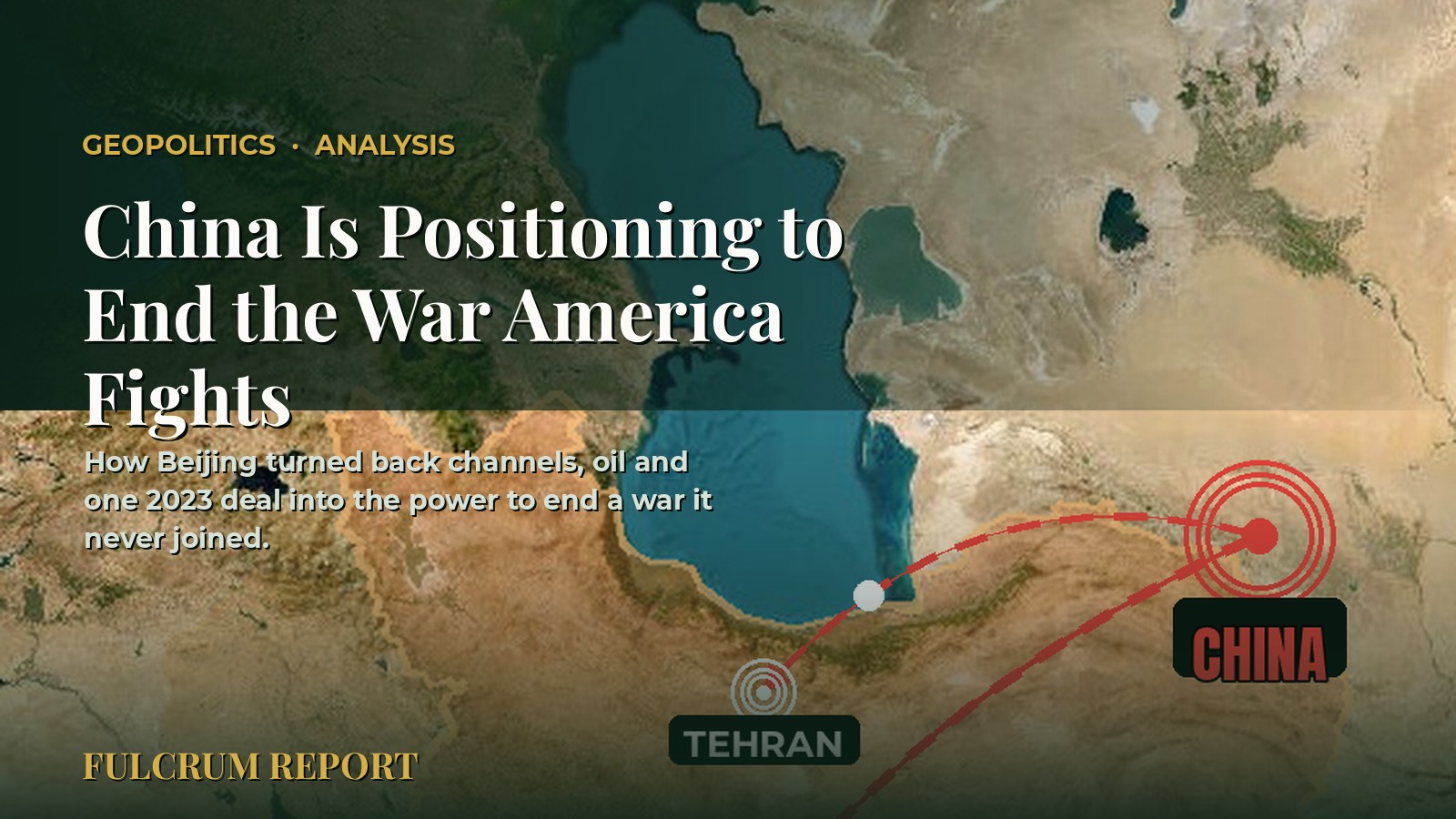
There is a version of this war that leads every broadcast: the strikes, the wreckage, the maps with arrows crashing into targets. America is doing the fighting, and the fighting is loud. But if you want to know where power is actually moving, mute that channel for a moment and ask a quieter question. When the shooting finally has to stop, who gets the phone call? Increasingly, the answer is not Washington. It is Beijing. And that, to me, is the whole story of this century compressed into a single reversal: America is fighting the war, and China is positioning itself to end it.
I don't say that for effect. I say it because the mechanics are visible if you look at the table instead of the battlefield.
## A combatant cannot be the referee
Start with the most basic problem the United States has here, one no amount of firepower solves. Once you enter a war, you cannot credibly umpire it. Washington is a belligerent now — it has hit Iranian targets, it is aligned with one side, its own forces are in the fight. That forecloses the role of neutral mediator no matter how badly anyone in Washington might want to broker the ending. A combatant asking to referee its own match is not a peace plan. It is a contradiction.
And contradictions in geopolitics do not sit empty. They open space. The moment America became a party to the war, it vacated the mediator's chair — and someone was always going to walk over and sit down in it.
## The back channel Beijing and Pakistan quietly run
That someone turned out to be Pakistan, with China standing behind it. Islamabad has the one thing the moment requires: working lines to both Washington and Tehran at the same time. It used them. Pakistani leaders ran the back channel, shaped the sequencing of proposals, and helped carry a ceasefire framework across the gap — the diplomacy that produced the Islamabad Memorandum, a negotiated pause with a clock attached rather than a battlefield outcome.
But look at who was providing the political weight behind that effort. China. Beijing didn't need to be in every room to be decisive; it needed to make the deal sellable to Tehran and to lend the whole process the gravity of a great power that Iran actually trusts. Pakistan was the interlocutor. China was the guarantor standing just off camera. That division of labor is not incidental — it is exactly how influence travels now.
## Leverage on every side
Here is why Iran picks up when Beijing is involved, and why the Gulf does too. China is not a newcomer improvising a role. In March 2023 it brokered the normalization deal between Saudi Arabia and Iran — two rivals who had severed relations, sitting down in Beijing under Chinese mediation to reopen embassies. That was the proof of concept: China could get sworn adversaries in the region to agree to something and make it stick, at a moment when the United States was nowhere in the frame.
Then layer the economics on top. China is the largest buyer of Iranian oil by an enormous margin — the destination for roughly nine in ten barrels Iran manages to export — and a decisive customer for Gulf crude as well. When you are the essential buyer for both Tehran and Riyadh, you are not a bystander to their disputes. You are the actor with a standing incentive from every side to keep the region calm, and the standing leverage to be listened to when you ask for it. Diplomatic credibility plus economic indispensability is a combination the United States simply cannot replicate here right now.
## This is hegemonic transition, in practice
Zoom out and this stops being a story about one ceasefire and becomes a story about how power actually changes hands.
We tend to picture the rise and fall of great powers as something decided on battlefields — the winner of the big war inherits the world. But that is only half of it, and often the less important half. Great powers also accumulate influence by becoming the actor every side trusts to end the fighting. The convener. The one whose invitation everyone accepts. Fighting a war spends power — treasure, attention, legitimacy, the willingness of others to see you as fair. Ending wars, by contrast, banks power. It makes you the indispensable address.
That is the trade playing out in real time. America is spending its power in this war. China is accumulating power around it — not by firing a shot, but by making itself the trusted ender. Watch the two lines cross and you are watching hegemonic transition, not as a theory in a book, but as a thing happening on a Tuesday.
## The shift isn't waiting for a handover
The mistake would be to assume this changes only when someone signs a document declaring it. Power does not transfer by ceremony. There will be no press conference where Washington hands Beijing a certificate of primacy in the Middle East. The shift is already here, and it is legible in the most mundane detail imaginable: who gets called when the shooting has to stop.
That is the tell I keep coming back to. Not the size of anyone's arsenal. Not the volume of the rhetoric. Just the direction of the phone calls when the region needs an off-ramp. Right now those calls are increasingly routing through Beijing and its partners, and each one deepens a dependence that firepower cannot dislodge.
So here is what I would watch, and what I would tell anyone trying to read this century correctly. Do not fixate on who is shooting. Shooting is the visible, expensive, self-depleting part of power. Watch who is in the room when the war has to end — who convenes it, who guarantees it, who everyone quietly agrees they cannot do without. That is the actor writing the new map of power. In this war, more and more, that actor is not the one dropping the bombs.
Watch who's in the room, not who's just shooting.
About the author
Fulcrum Report
Independent Middle East analyst holding a PhD in Political Science. Fulcrum Report offers rigorous, framework-driven coverage of politics and geopolitics across the Levant and the wider region — analysis without agenda.
Related reading
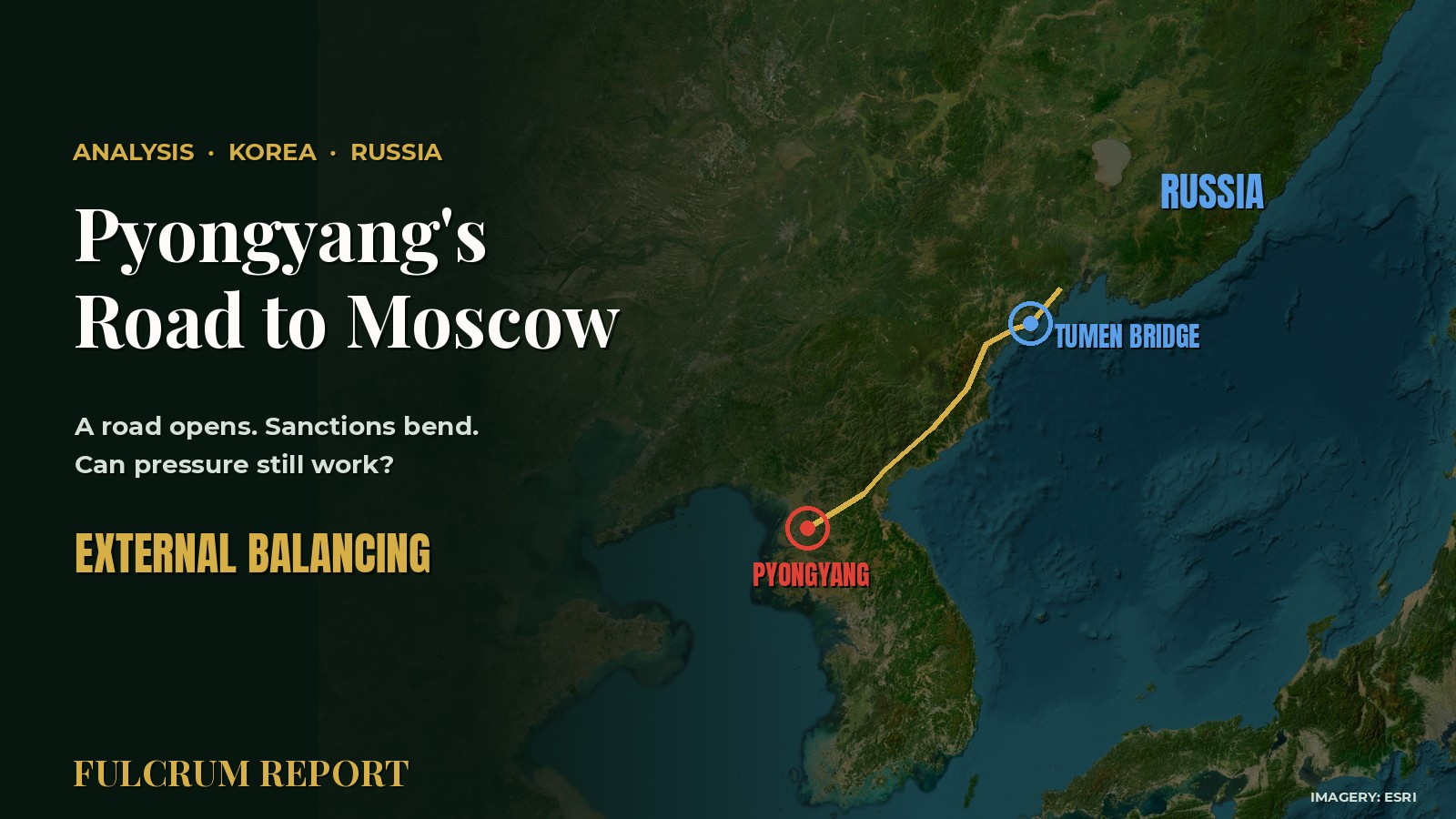
Pyongyang's Road to Moscow: Can Sanctions Still Work?
A second enrichment facility is reportedly going up at Yongbyon, and the Tumen River road bridge to Russia reportedly opened on September 8. When a major power offers a way around sanctions, how much pressure is left? An explainer on external balancing.
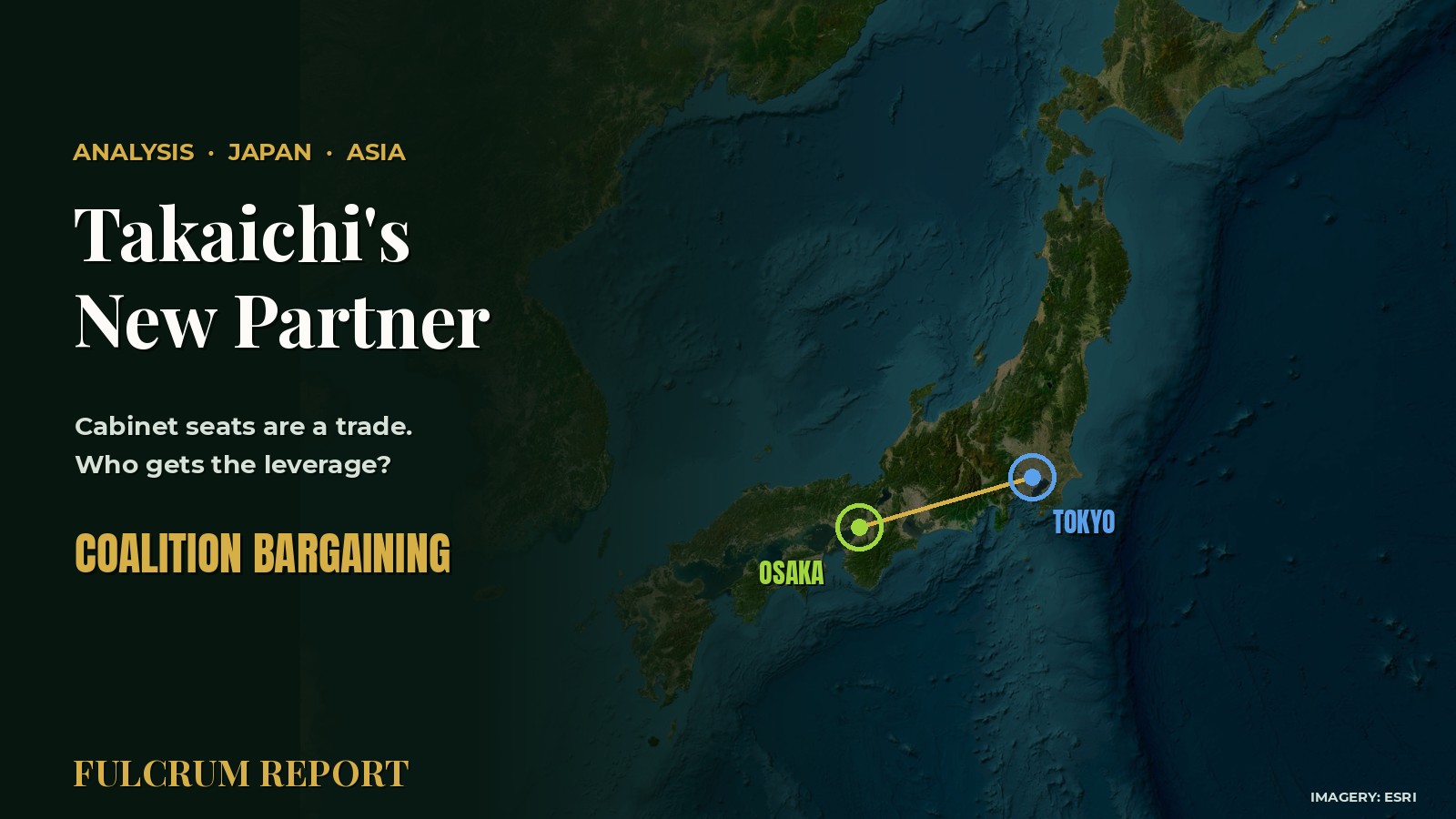
Takaichi's New Partner: Why Cabinet Seats Are a Trade
Sanae Takaichi reportedly reshuffled her cabinet on September 16 and 17, bringing in the Japan Innovation Party (Ishin) for the first time. Her camp holds two-thirds of the lower house but lacks an upper-house majority. A look at coalition bargaining and who gets the leverage.
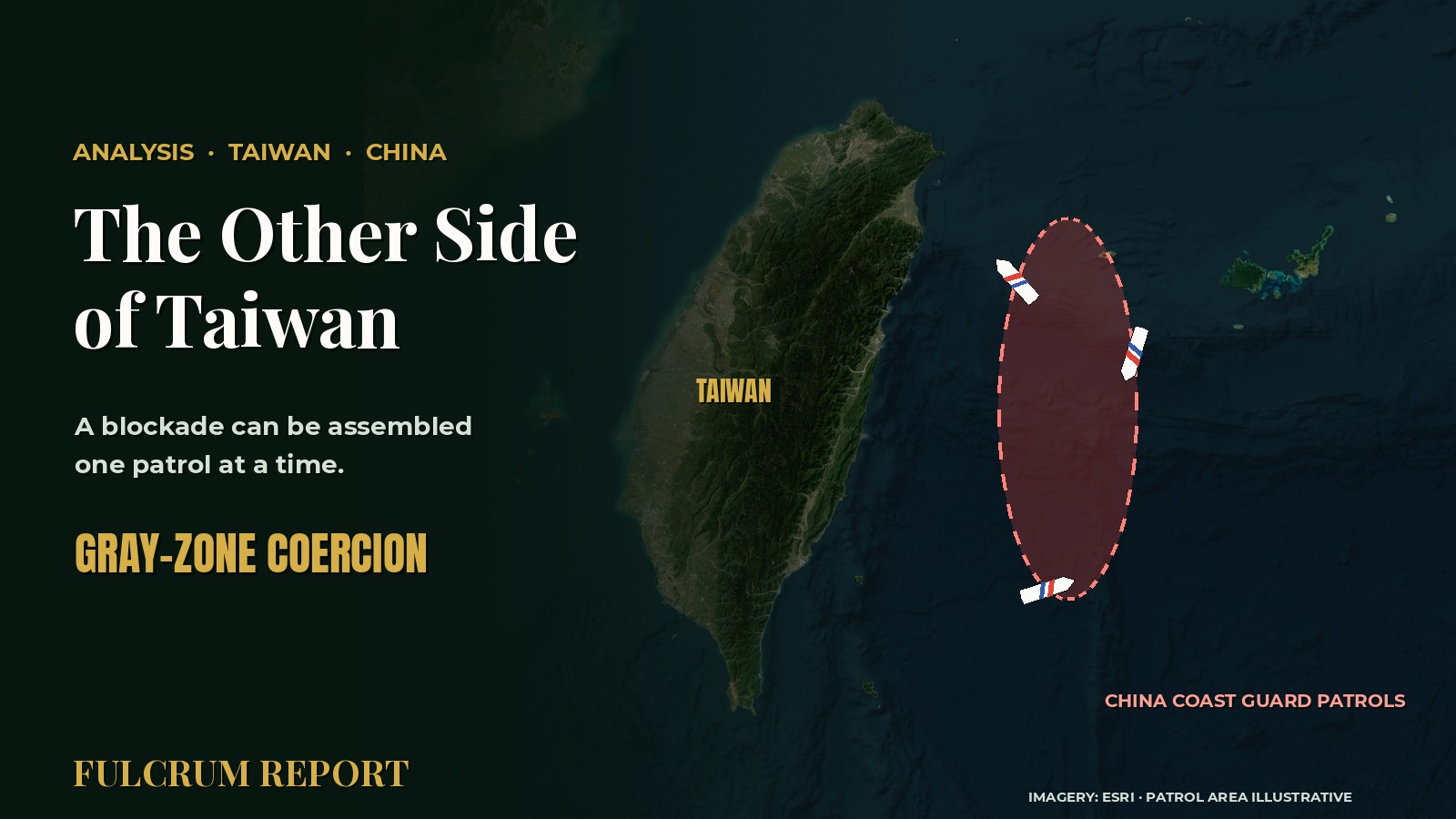
The Other Side of Taiwan: How a Blockade Gets Built Without Being Declared
China's Coast Guard has reportedly set up a regular presence east of Taiwan, framed as law enforcement, while a $14 billion U.S. arms package is pending. A look at gray-zone coercion, salami tactics and escalation control.