Twelve Nations in the Ceiling: The Layered History of the Church of All Nations
On the Mount of Olives, a single sanctuary stacks a Second Temple ritual bath, a Byzantine basilica, a Crusader chapel and a church funded by twelve governments — a section drawing of who has claimed Jerusalem.
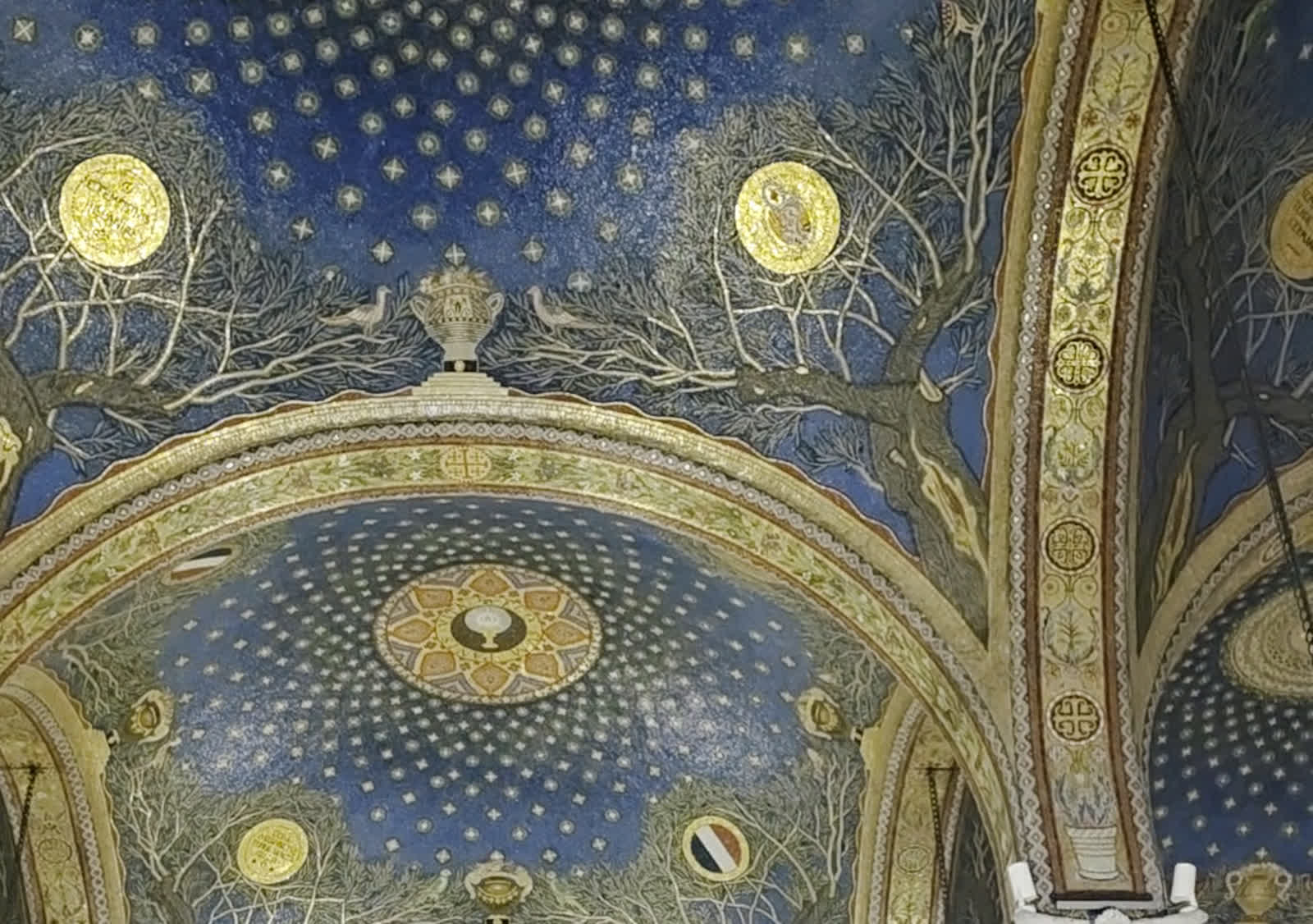
Stand in the Church of All Nations on the Mount of Olives and the first instinct is to look up. Above the nave, twelve small domes carry a deep, star-flecked blue — a painted night sky meant to evoke the darkness of the agony at Gethsemane. Set into that firmament are twelve coats of arms in gold mosaic. They do not belong to bishops or saints. They belong to nation-states.
The church earned its name honestly. When it was built between 1919 and 1924, to the design of the Italian architect Antonio Barluzzi, no single country paid for it. Twelve did — among them Argentina, Brazil, Chile, Mexico, Italy, France, Spain, the United Kingdom, Belgium, Canada, Germany and the United States. Each nation’s emblem was worked into the ceiling above the section its donations funded. The result is a sanctuary that is, quite literally, an international project set in stone and glass.
That is easy to admire and easy to underestimate. A building financed across four continents is not simply a feat of fundraising. It is a statement about who considers Jerusalem their concern. Long before Jerusalem became shorthand for a modern political conflict, its holy places were already internationalized in the most tangible way possible: foreign governments competed to leave their mark on them, and religious orders acted as the on-the-ground custodians of a city that empires kept trading between themselves.
The floor tells the deeper story. Barluzzi’s basilica was not raised on empty ground. During construction in 1920, workers uncovered the mosaic floor of a much older church roughly two metres below. This was a Byzantine basilica of the fourth century, one of the earliest monumental churches in the Holy Land, brought down by the great earthquake that struck the region in 746. Sections of that ancient floor were deliberately left exposed under glass, so that a visitor can stand on the twentieth century and look straight down into the fourth.
Between those two layers sits a third. In the twelfth century, Crusaders built their own chapel on the site, orienting it slightly differently and abandoning it around 1345 as their kingdom collapsed. So within a few square metres the ground holds a Byzantine basilica, a Crusader chapel and a modern international church — three eras of Christian building, each raised by a different power that believed the spot was worth claiming.
The layers kept coming. In December 2020, during work on a visitor tunnel beside the church, Israeli archaeologists announced the discovery of a ritual bath, a mikveh, dating to the Second Temple period — the era in which the Gospels place Jesus in Gethsemane. Alongside it were further Byzantine remains, including a small chapel with a mosaic inscription. The find pushed the site’s documented use back another several centuries and reinforced what the stratigraphy already implied: this was not a plot chosen at random by later pilgrims, but a place worked and inhabited in antiquity.
For a reader interested in politics rather than liturgy, the interest of the Church of All Nations is precisely this stacking. A mikveh from the age of Herod. A Byzantine basilica felled by an earthquake. A Crusader chapel abandoned as an empire receded. A modern church paid for by twelve governments and consecrated in the shadow of the First World War, just as the League of Nations was assigning the Mandate for Palestine. Each layer is a fingerprint left by whoever held, or wanted to hold, a stake in this ground.
That is the quiet argument the building makes. Jerusalem’s contests are usually narrated as a recent story with a clear beginning. The Mount of Olives suggests something more uncomfortable and more useful: the competition to own, fund and interpret this city is centuries deep, and it has always been international. The coats of arms in the ceiling are not decoration. They are an honest admission that no one has ever treated Jerusalem as belonging to itself alone.
You can visit the church for the mosaics, or for the smooth grey Rock of the Agony that lies exposed before the altar, ringed by a wrought-iron crown of thorns donated by Australia. But the most instructive thing about the Basilica of the Agony is not any single object. It is the section drawing you cannot see — the vertical slice through two thousand years, in which every civilization that passed through Jerusalem left one more layer, and none of them was the last.
About the author
Fulcrum Report
Independent Middle East analyst holding a PhD in Political Science. Fulcrum Report offers rigorous, framework-driven coverage of politics and geopolitics across the Levant and the wider region — analysis without agenda.
Related reading

Pyongyang's Road to Moscow: Can Sanctions Still Work?
A second enrichment facility is reportedly going up at Yongbyon, and the Tumen River road bridge to Russia reportedly opened on September 8. When a major power offers a way around sanctions, how much pressure is left? An explainer on external balancing.

Takaichi's New Partner: Why Cabinet Seats Are a Trade
Sanae Takaichi reportedly reshuffled her cabinet on September 16 and 17, bringing in the Japan Innovation Party (Ishin) for the first time. Her camp holds two-thirds of the lower house but lacks an upper-house majority. A look at coalition bargaining and who gets the leverage.
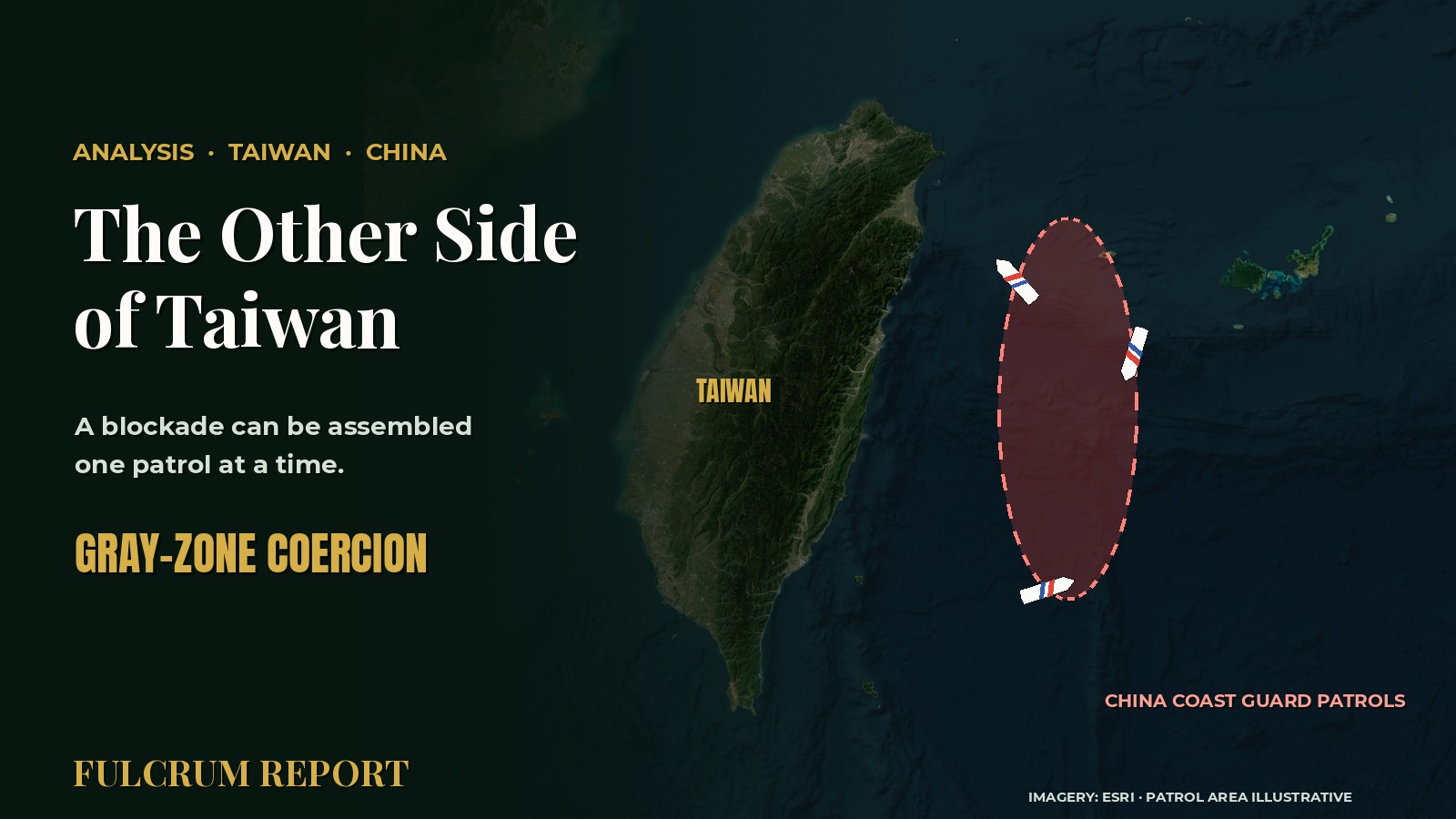
The Other Side of Taiwan: How a Blockade Gets Built Without Being Declared
China's Coast Guard has reportedly set up a regular presence east of Taiwan, framed as law enforcement, while a $14 billion U.S. arms package is pending. A look at gray-zone coercion, salami tactics and escalation control.