A Gate You Control Is a Foreign Policy
Egypt isn't doing the fighting in Gaza. But it holds the one crossing Israel doesn't — and that single gate is doing the work of a national strategy.
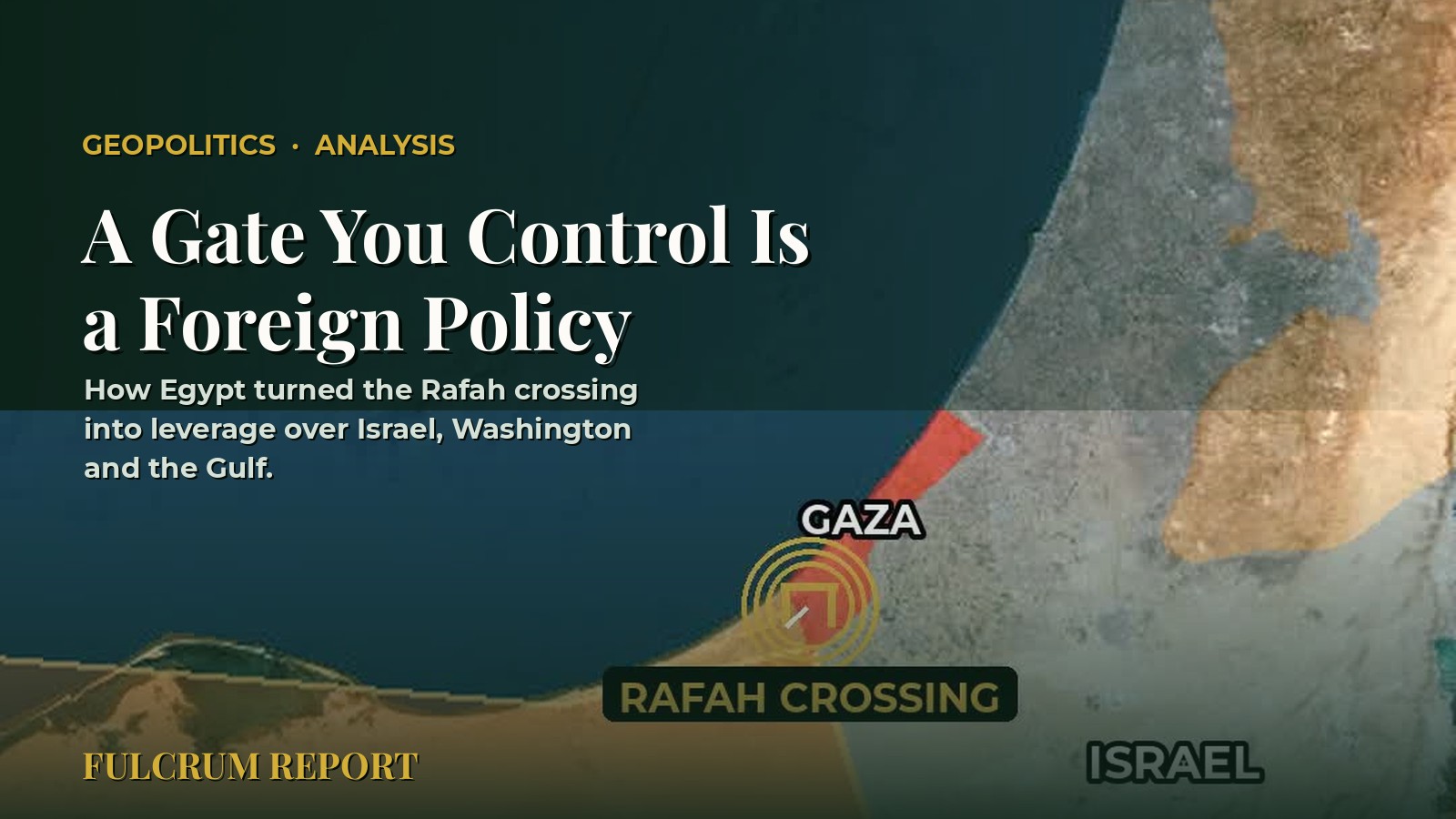
Every time I explain Egypt's role in the Gaza war to people outside the region, I hit the same wall of surprise. They expect the story to be about armies, air strikes, tunnels. And then I tell them that one of the most consequential Egyptian instruments in this whole crisis is a border gate — a single crossing in a dusty corner of the Sinai — and I watch it click. Because once you understand Rafah, you understand something about power that the louder parts of this war keep obscuring: sometimes the decisive actor is not the one with the most firepower. It is the one holding the gate.
So let me walk through why a border crossing is doing the work of a foreign policy.
## The one door Israel doesn't hold
Start with the geography, because geography is the whole argument here. Gaza has a handful of crossings, and Israel controls all of them but one. The exception is Rafah, on Gaza's southern edge, where the Strip meets Egypt. That single fact — that Rafah is the only way in or out of Gaza that does not run through Israeli hands — is what converts Egypt from a bystander into a principal.
Think about what that means in practice. When the world wants to move aid, evacuate the wounded, or let a trickle of people out, the conversation cannot route around Cairo. Egypt sits on the one valve that Israel cannot simply open or shut on its own. You do not need tanks to matter when you own the door everyone else has to knock on.
## "Open," but never really open
Here is the part that gets misread constantly. Rafah being under Egyptian influence does not mean Egypt flings it open. For most of the last two years it has been the opposite. Israeli forces seized the Gaza side of the crossing in May 2024, and for roughly twenty months the gate was, for practical purposes, shut.
When it finally reopened in early February 2026 — as part of the second phase of the ceasefire that took hold in October 2025 — it reopened as the narrowest possible version of itself. We are talking about a tightly capped pilot: a few dozen people permitted in each direction on a given day, medical patients and their relatives, some Gazans who had been stranded abroad allowed back. No commercial goods flowing through. European monitors on site, with both Egypt and Israel vetting names. This is not a border returning to normal. It is a gate cracked open by a hand that is very deliberately keeping most of its weight against the door.
And that restraint is the strategy. Cairo has learned to keep Rafah open just enough to relieve pressure — humanitarian, diplomatic, reputational — while keeping it restricted enough to protect the one outcome it fears most.
## The red line Egypt will not cross
That outcome is the mass movement of Palestinians out of Gaza and into the Sinai.
I cannot overstate how central this is to Egyptian thinking. Cairo has said it plainly and repeatedly: forcing Gazans into Egyptian territory is a red line. Not a talking point — a red line, the kind of phrase states use when they mean it touches sovereignty and survival. The fear is not really about the logistics of a refugee influx, as hard as that would be. It is about permanence.
Egypt has watched, across this region and across the last century, how "temporary" wartime displacement has a way of hardening into a permanent political fact. Refugees who leave under fire are told it is for now; "for now" becomes a generation. If hundreds of thousands of Palestinians were pushed into Sinai, Egyptian planners assume they would not be going back, and that Egypt would have been made — against its will — the address where the Palestinian question was quietly relocated and dissolved. That is a trap Cairo refuses to walk into, and holding Rafah tight is how it refuses.
There is a legal and territorial layer underneath this, too. The Gaza-Egypt border runs along the Philadelphi Corridor, a thin strip governed by the 1979 peace treaty and a 2005 arrangement that kept it demilitarized and policed by a limited Egyptian border force. When Israeli troops moved into that corridor, Cairo read it as an erosion of the very framework that has kept the Egypt-Israel peace functional for four decades. So the gate is not just about people moving. It sits on top of a border regime that Egypt considers close to sacred, and any pressure on it registers in Cairo as a threat to the whole architecture.
## Why Cairo sees Hamas as a domestic problem
There is one more piece that outsiders often miss, and it explains why Egypt's gatekeeping has an edge to it. Hamas grew out of the Muslim Brotherhood. And the Brotherhood, to the current Egyptian government, is not an abstraction or a foreign faction — it is the domestic movement this leadership removed from power and has spent years suppressing at home.
So when Cairo manages Rafah, it is never only managing a humanitarian valve or a diplomatic lever. It is also managing its relationship with a movement it treats as an internal security threat. That is part of why Egypt is comfortable being the gatekeeper rather than the open door: keeping firm control of the crossing is also a way of keeping firm control over an ideology it does not want flowing freely across its own frontier.
## The gate as bargaining power
Put all of this together and you get leverage — real, usable leverage — held by a country that is not doing the fighting.
Because Egypt controls the one crossing outside Israeli hands, it has something everyone wants and no one else can provide. That gives it bargaining power on three fronts at once. With Israel, because coordination at the border is unavoidable and Cairo can make that coordination easier or harder. With Washington, because the United States needs a functioning Egyptian partner to make any ceasefire or aid architecture hold, and Egypt's cooperation is a chip it can price. And with the Gulf states, who are financing reconstruction and stabilization and need Egypt's geography to deliver any of it.
Control the choke point, and you control a surprising share of the choices — not just your own, but everyone else's. That is the quiet mechanism at the heart of this. Egypt turned a physical bottleneck into diplomatic weight.
## The lesson underneath
I keep coming back to Rafah because it is such a clean illustration of something I believe is generally true and generally underrated: in a crisis crowded with maximalist force, the actor who controls a single indispensable node often shapes the outcome more than the actors making the most noise.
Egypt is not winning this war and is not trying to. It is doing something more durable. It is making sure that when the shooting stops and the bargaining starts, it is standing at the one door everyone has to pass through — with a hand on the latch, and a very clear idea of what it will and will not allow through.
A gate you control is a foreign policy. Egypt's Rafah proves it.

About the author
Fulcrum Report
Independent Middle East analyst holding a PhD in Political Science. Fulcrum Report offers rigorous, framework-driven coverage of politics and geopolitics across the Levant and the wider region — analysis without agenda.
Related reading
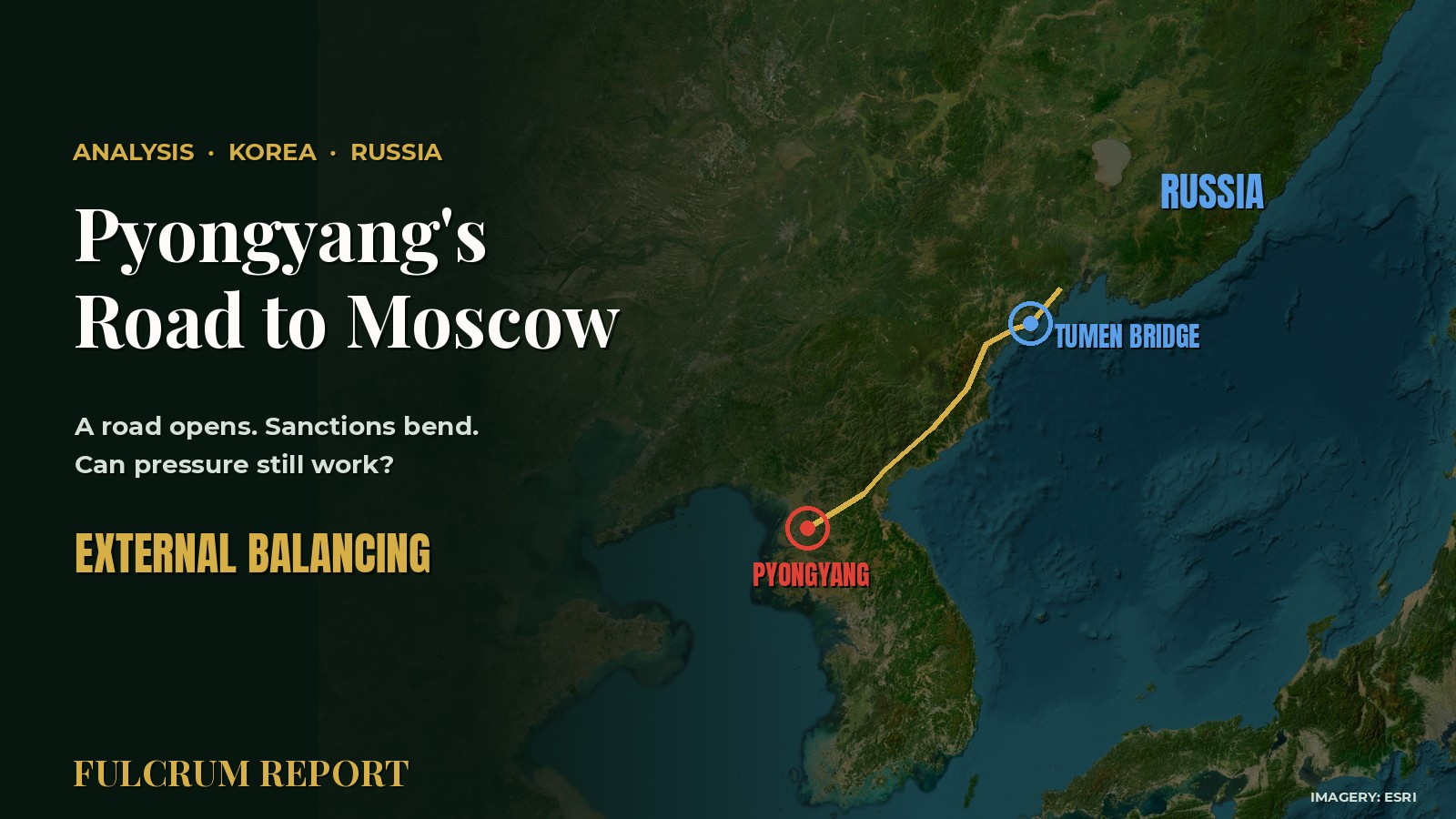
Pyongyang's Road to Moscow: Can Sanctions Still Work?
A second enrichment facility is reportedly going up at Yongbyon, and the Tumen River road bridge to Russia reportedly opened on September 8. When a major power offers a way around sanctions, how much pressure is left? An explainer on external balancing.
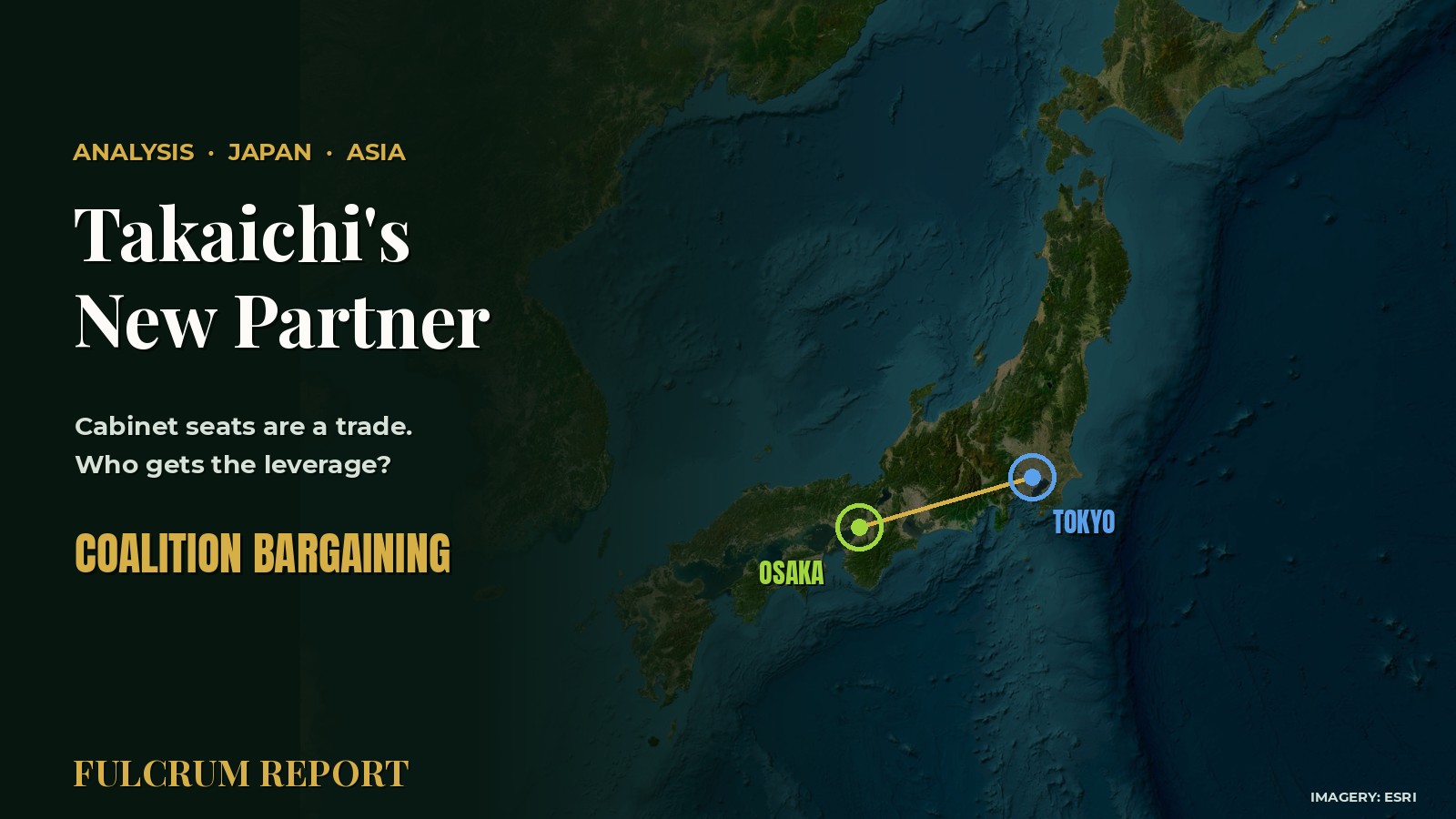
Takaichi's New Partner: Why Cabinet Seats Are a Trade
Sanae Takaichi reportedly reshuffled her cabinet on September 16 and 17, bringing in the Japan Innovation Party (Ishin) for the first time. Her camp holds two-thirds of the lower house but lacks an upper-house majority. A look at coalition bargaining and who gets the leverage.
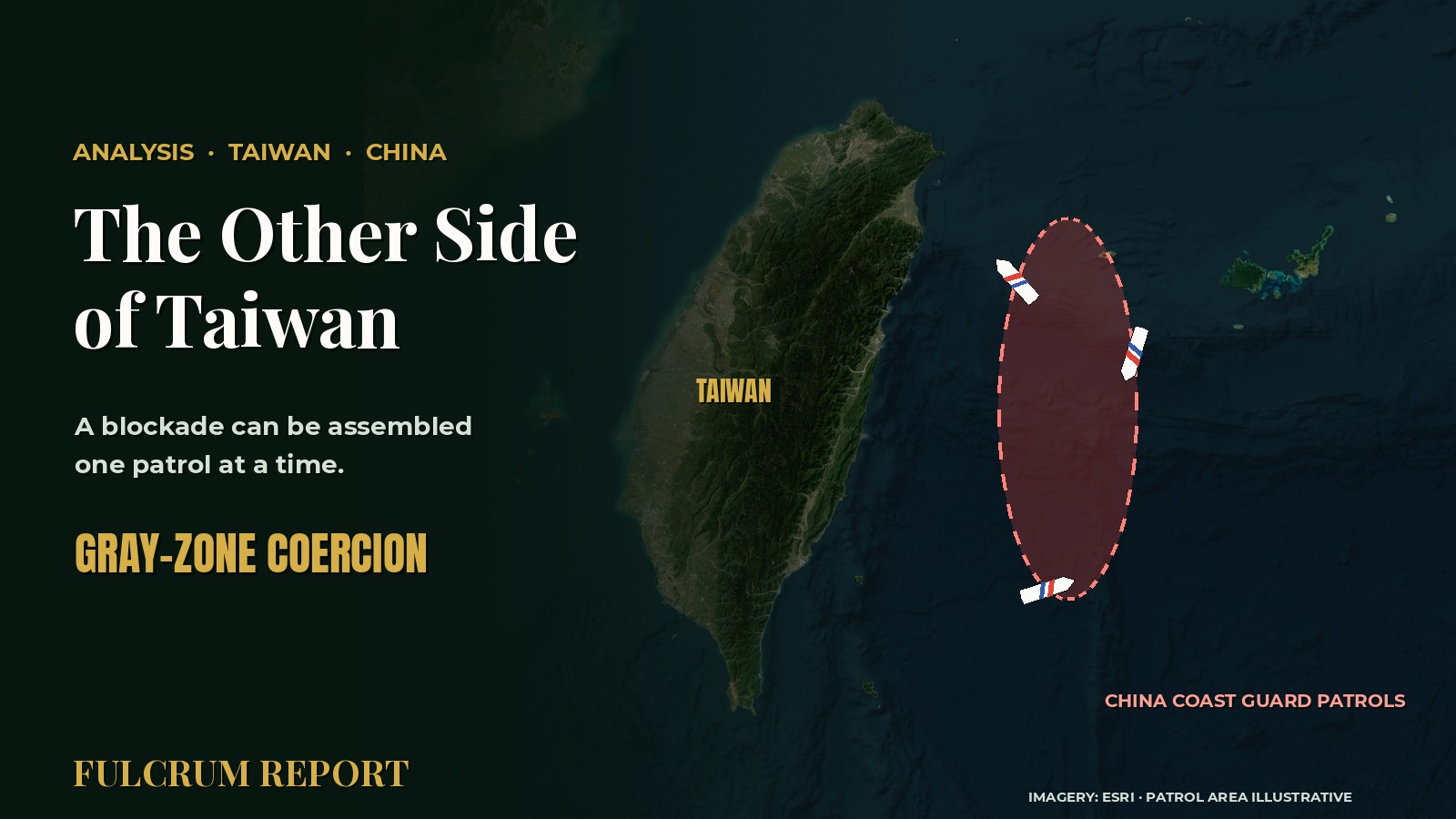
The Other Side of Taiwan: How a Blockade Gets Built Without Being Declared
China's Coast Guard has reportedly set up a regular presence east of Taiwan, framed as law enforcement, while a $14 billion U.S. arms package is pending. A look at gray-zone coercion, salami tactics and escalation control.