Europe's Second Umbrella
Germany is joining French nuclear drills. Why Europe is layering a French nuclear umbrella on top of the American one, and whether a smaller arsenal can make the promise credible.
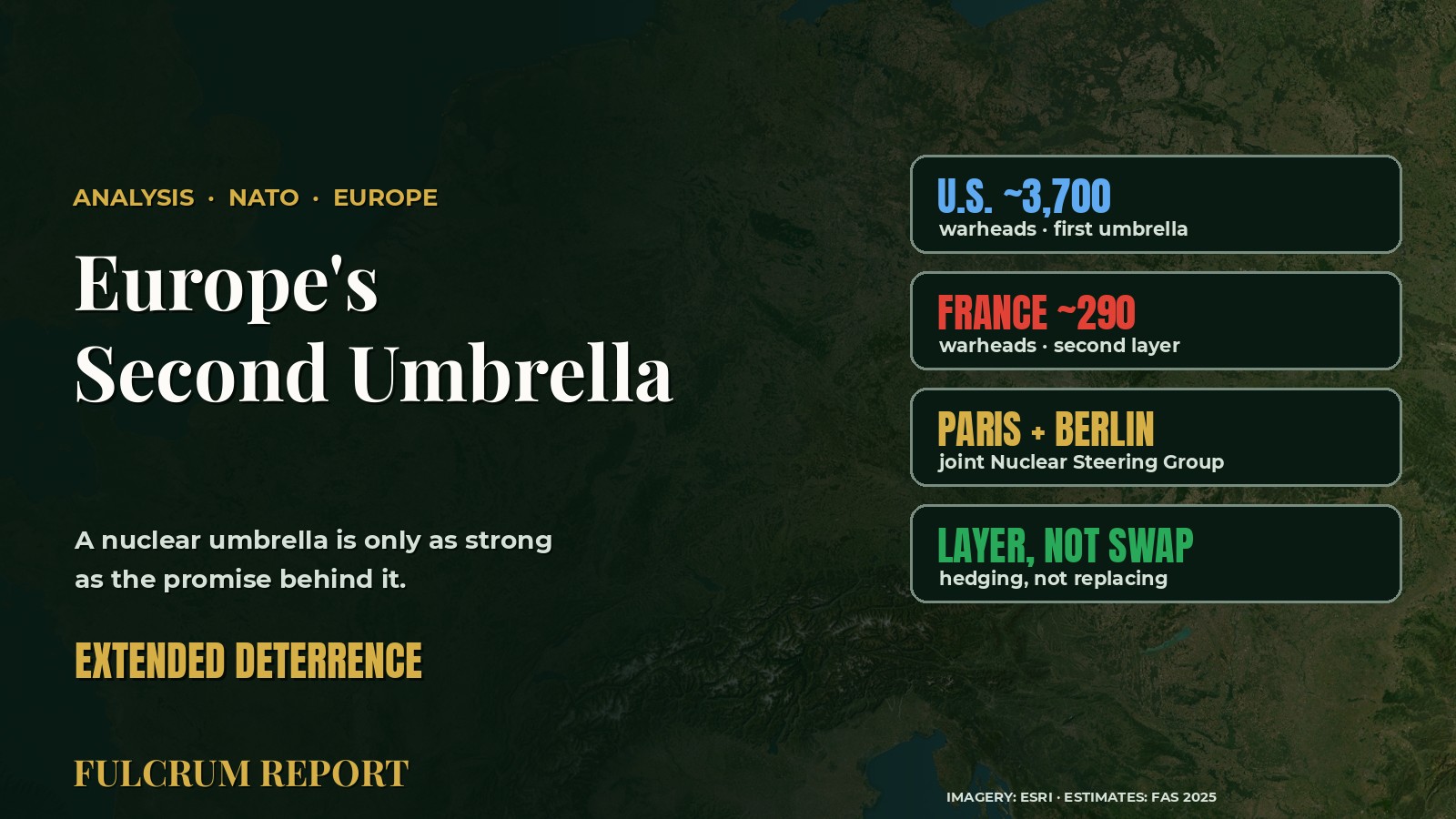
There's a sentence I didn't expect to write this year: Germany is joining French nuclear exercises.
If you grew up with the Cold War map of Europe in your head, that sentence sounds slightly wrong. Germany has spent eighty years keeping as far from nuclear weapons as a NATO member reasonably can. France has spent sixty years insisting its bomb belongs to France and nobody else. And yet here we are.
What's been reported
Paris and Berlin have reportedly set up a joint Nuclear Steering Group, and Germany is set to take part in French nuclear drills. Taken together, it's the deepest Franco-German nuclear cooperation there has ever been.
I want to be careful about what that does and doesn't mean. Nobody is handing Germany French warheads. The decision to use them stays in Paris, with the French president. What's changing is the conversation around them: who gets consulted, who trains alongside whom, and whose territory France is willing to say it cares about.
That last part is the whole story, as far as I'm concerned.
A promise, not a weapon
The concept here is extended deterrence. Ordinary deterrence is simple enough: attack me and I'll hit back. Extended deterrence is stranger. It's me telling you that if someone attacks my friend, I'll respond as if they'd attacked me, possibly with nuclear weapons.
Thomas Schelling put the problem well in Arms and Influence back in 1966. Threatening to defend your own home is easy to believe. Threatening to defend someone else's is not, because carrying out the threat might cost you far more than the thing you're protecting. So the threat only works if the other side believes you'd actually do it.
That's why I think of a nuclear umbrella less as a weapon and more as a promise. And a promise is only as strong as the reasons people have to believe it. Paul Huth's work in the late 1980s, looking at dozens of cases where a big power tried to protect a smaller one, found pretty much what you'd expect: credibility comes from interests, presence and a record of keeping your word, not just from the size of your arsenal.
The question de Gaulle kept asking
This isn't a new worry. During the Cold War, Charles de Gaulle famously doubted that an American president would really trade New York for Paris. If Soviet tanks rolled west, would Washington risk a nuclear strike on its own cities to save a European one? De Gaulle's answer was that you couldn't count on it, and that was a big part of why France built its own force de frappe.
For most of the decades since, the rest of Europe made a different bet. It trusted Washington's answer. American troops in Germany, American weapons stored on European soil and NATO's shared planning were the proof that the promise was real.
What I find interesting is that the de Gaulle question is now being pointed at France itself. Would France risk Paris to defend Berlin?
A second layer, not a replacement
It would be easy to read this as Europe giving up on the United States. I don't think that's what's happening, and I don't think it would make sense if it were.
What Europe seems to be doing is hedging. It's keeping the American umbrella and building a smaller European one underneath it, just in case. Emmanuel Macron opened that door in 2020, when he said France's deterrent had a "European dimension" and invited partners into a strategic dialogue about it. At the time a lot of people treated that as a speech. It looks a lot more concrete now.
The logic of a second layer is straightforward. If an adversary is ever tempted to bet that Washington won't show up, it now has to bet on Paris too. Two promises are harder to discount than one, even if neither is perfect.
The credibility gap
Here's the uncomfortable part. The numbers aren't close.
The Federation of American Scientists estimates that France has roughly 290 nuclear warheads. The United States has around 3,700 in its stockpile. Those are estimates, and raw warhead counts don't decide everything, but the gap matters. France built its arsenal to protect France: enough to do unacceptable damage to any attacker, not enough to cover a whole continent with the same weight the American umbrella carries.
So the real test isn't whether France has the bomb. It obviously does. The test is whether a smaller arsenal, controlled by one country's president, can make a promise that people in Berlin, Warsaw or Vilnius actually believe. Joint planning and shared exercises help with that. They make the commitment visible. But visibility isn't the same thing as certainty, and I'd be skeptical of anyone who claims this closes the gap.
Why I think it still matters
Even with all those limits, I think this is a real shift. A few years ago the idea of German forces training inside France's nuclear framework would have been politically unthinkable in both capitals. That it's happening at all tells you how much European leaders have started to doubt that the old arrangement will last forever, regardless of who's in the White House.
It also changes the arithmetic for anyone planning against Europe. Uncertainty cuts both ways. Europe can't be completely sure France would act, but neither can an adversary be sure it wouldn't. That doubt is itself a kind of deterrence.
My short version is this: Europe isn't replacing America's umbrella. It's adding a second one.
Whether that second umbrella can keep anyone dry is the question I'll be watching.
Further reading: Thomas C. Schelling, Arms and Influence (1966); Paul K. Huth, Extended Deterrence and the Prevention of War (1988); Federation of American Scientists, Status of World Nuclear Forces (2025); Emmanuel Macron, speech on defence and deterrence strategy at the École de Guerre (February 2020).

About the author
Fulcrum Report
Independent Middle East analyst holding a PhD in Political Science. Fulcrum Report offers rigorous, framework-driven coverage of politics and geopolitics across the Levant and the wider region — analysis without agenda.
Related reading
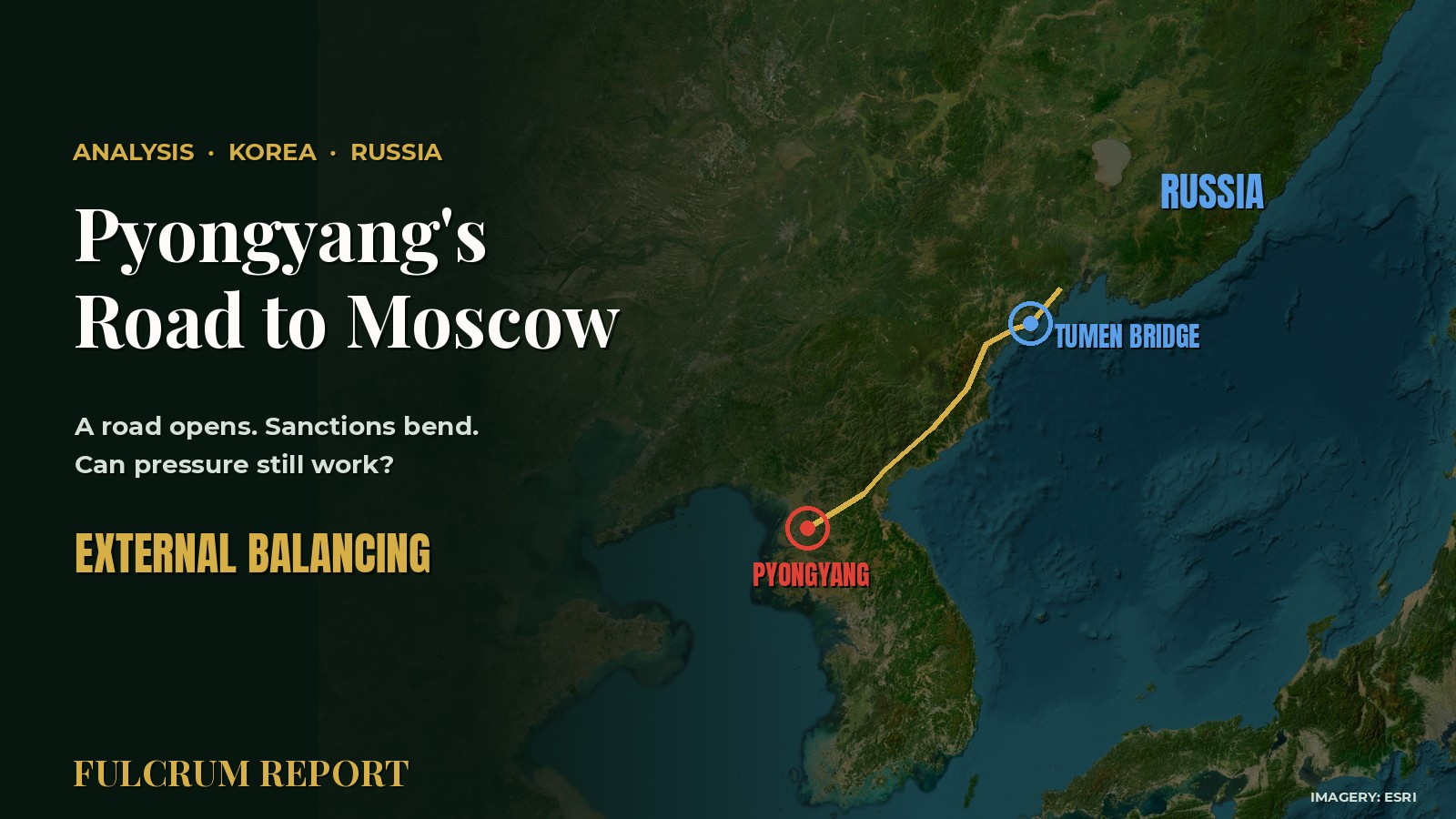
Pyongyang's Road to Moscow: Can Sanctions Still Work?
A second enrichment facility is reportedly going up at Yongbyon, and the Tumen River road bridge to Russia reportedly opened on September 8. When a major power offers a way around sanctions, how much pressure is left? An explainer on external balancing.
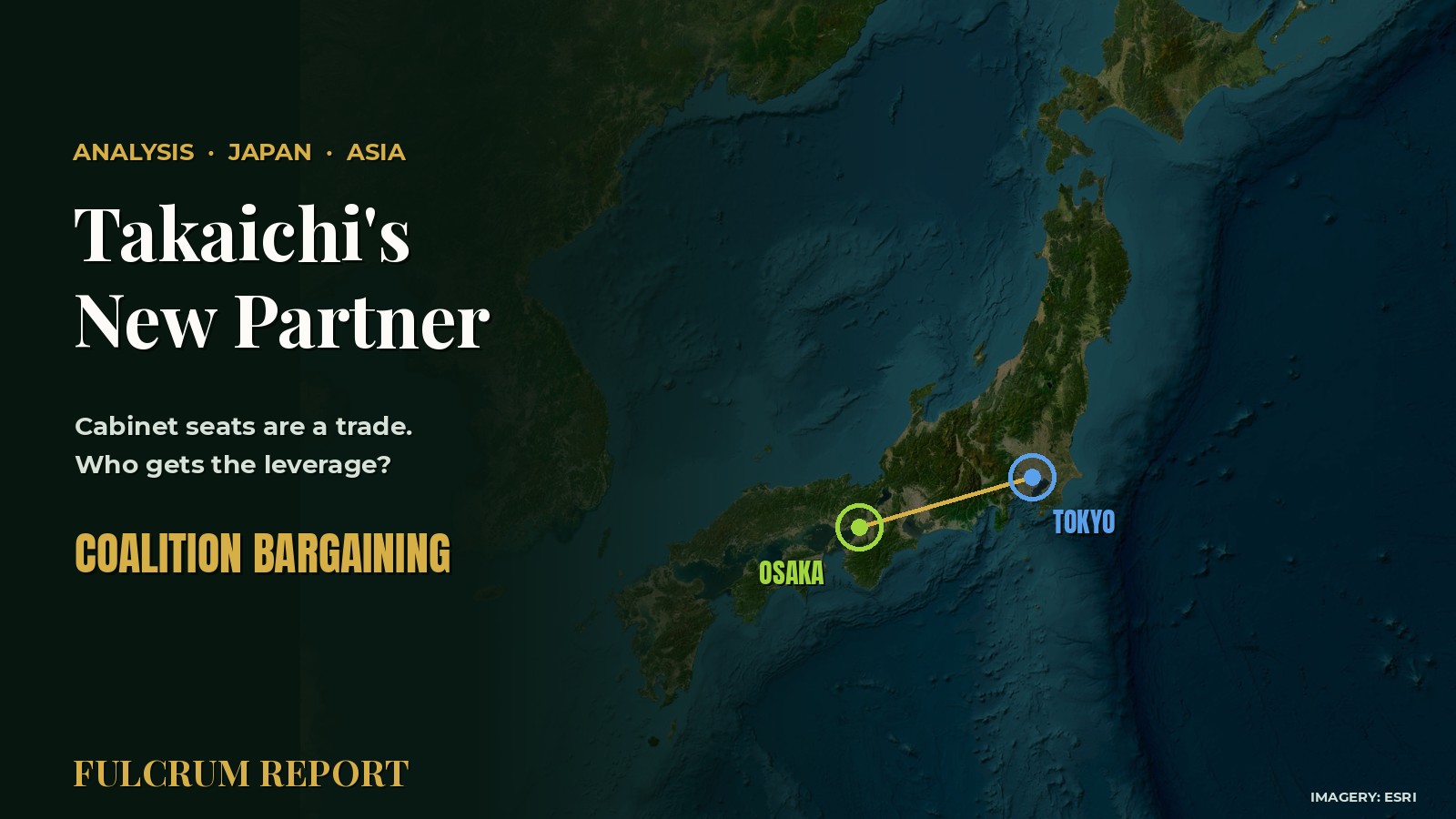
Takaichi's New Partner: Why Cabinet Seats Are a Trade
Sanae Takaichi reportedly reshuffled her cabinet on September 16 and 17, bringing in the Japan Innovation Party (Ishin) for the first time. Her camp holds two-thirds of the lower house but lacks an upper-house majority. A look at coalition bargaining and who gets the leverage.
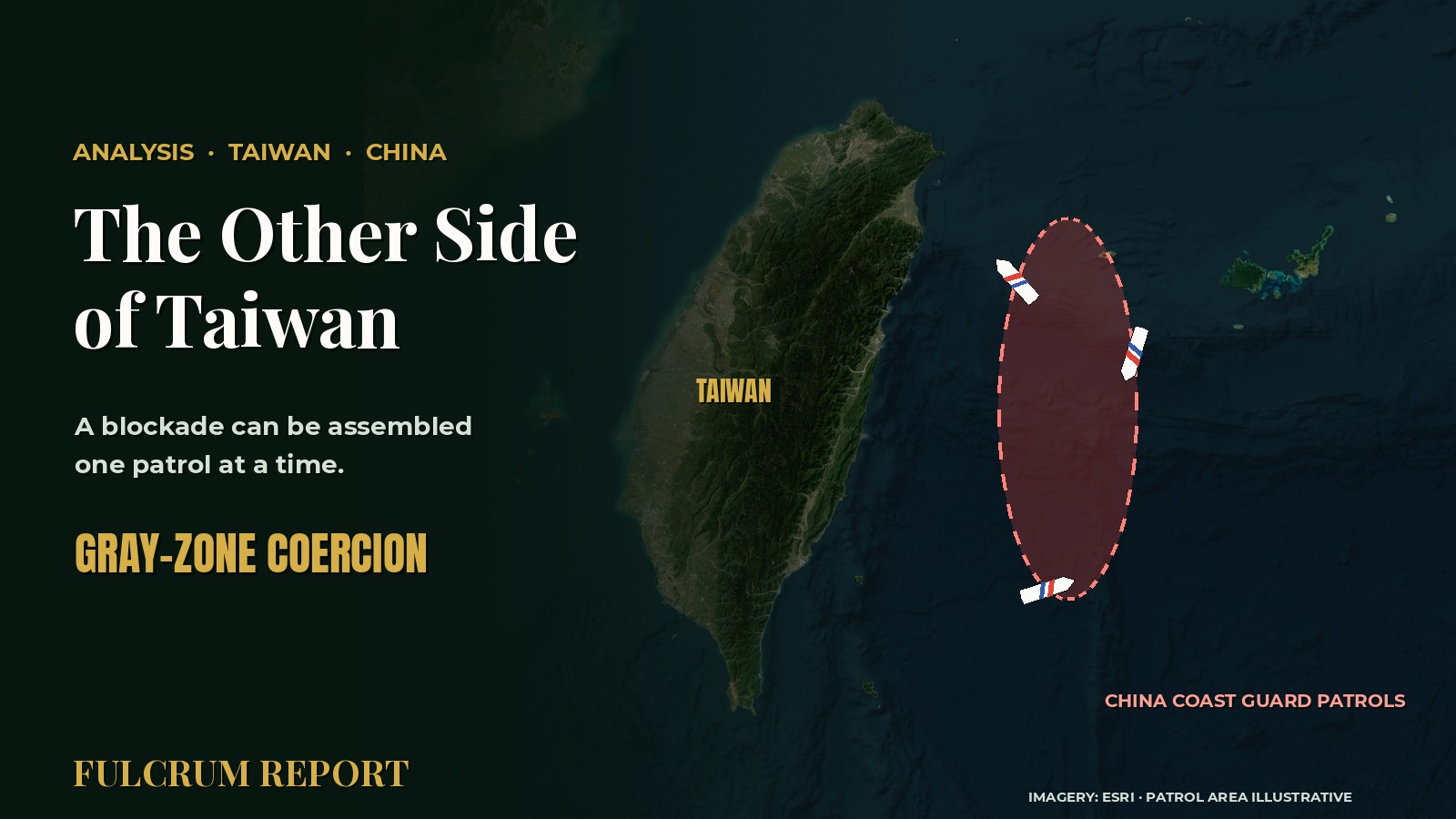
The Other Side of Taiwan: How a Blockade Gets Built Without Being Declared
China's Coast Guard has reportedly set up a regular presence east of Taiwan, framed as law enforcement, while a $14 billion U.S. arms package is pending. A look at gray-zone coercion, salami tactics and escalation control.