Greenland's Win-Win-Win: How a Small Place Bargained With a Superpower
The U.S. wanted Greenland. It got a security deal instead. Why geography, the GIUK gap and small-state bargaining explain how Greenland turned great-power interest into leverage.
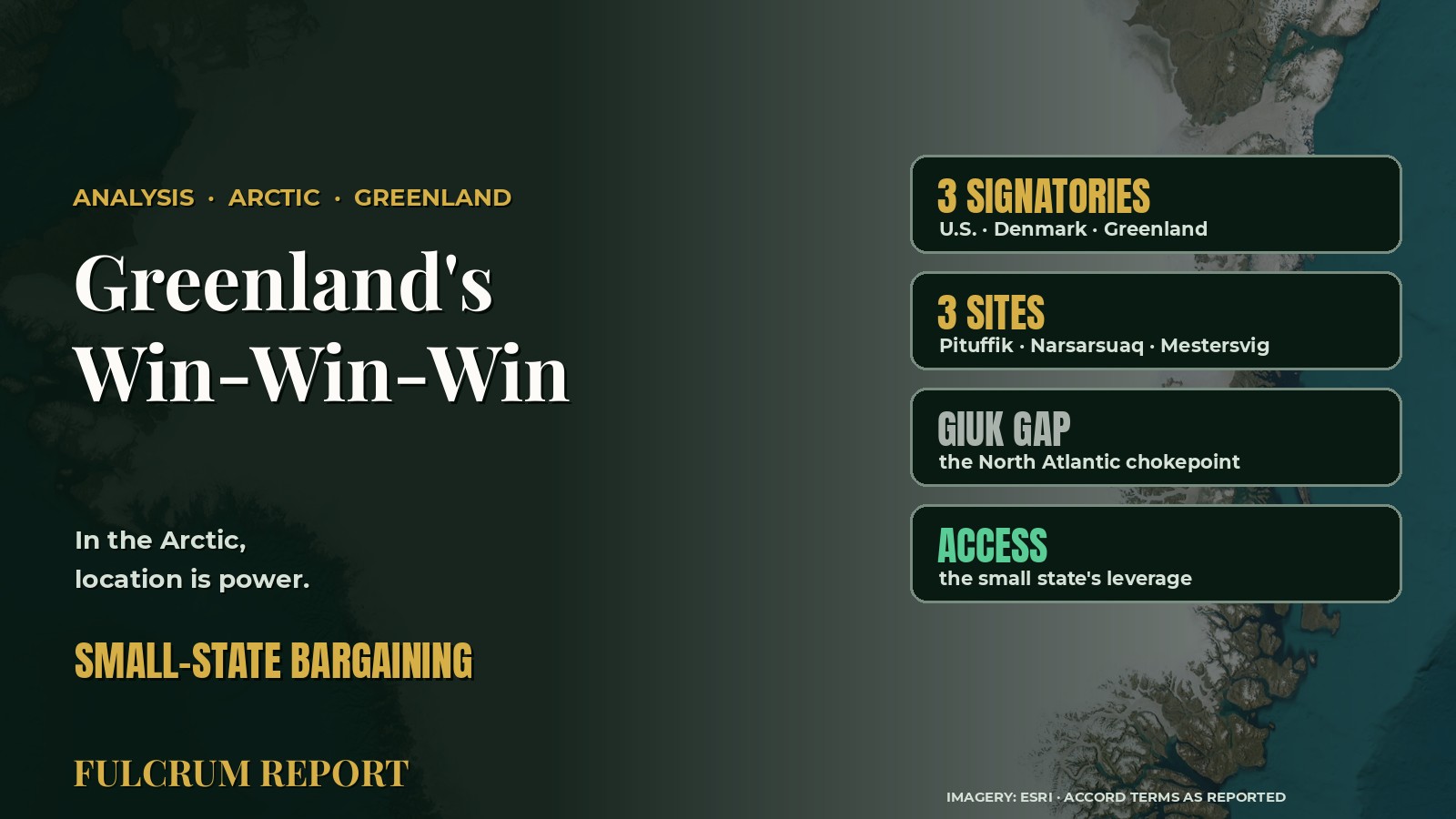
Not that long ago, the big Greenland headline was that Washington wanted to own the place. This fall, the headline is that the United States, Denmark and Greenland signed a security deal, and Greenland's prime minister is calling it a win.
I went in expecting a story about a small territory getting squeezed. I came out thinking it's closer to the opposite, and that it's one of the cleaner real-world examples of an idea political scientists have been arguing about for decades.
What's been reported
On September 22, the three governments signed a security accord. As reported, it modernizes Pituffik Space Base in the far northwest, the old Thule Air Base. It adds new sites at Narsarsuaq in the south and Mestersvig in the northeast. It grants overflight rights. It bars any persistent non-NATO military presence on the island, and it limits investment from non-NATO countries.
Prime Minister Jens-Frederik Nielsen called it "win-win-win." I'd treat the fine print with some caution until the full text is public, but the broad outline has been consistent across reports.
None of these places is new to the U.S. military, by the way. Narsarsuaq was an American airfield in the Second World War. Mestersvig had an airstrip used in the Cold War era. And Pituffik dates back to the 1951 defense agreement between Washington and Copenhagen. What's new is the scale, and the fact that Greenland signed as a party in its own right rather than having Denmark sign for it. That has a precedent too, in the 2004 Igaliku Agreement, but this goes further.
Why geography still matters
Look at a map with the North Pole at the top and the logic jumps out. Greenland sits between North America and Europe, right on the shortest routes for missiles and aircraft crossing the Arctic. That's why Pituffik hosts early-warning radar and space surveillance.
The other half is the sea. Between Greenland, Iceland and the United Kingdom runs what NATO planners call the GIUK gap. Russia's Northern Fleet is based on the Kola Peninsula. If its submarines want to reach the open Atlantic, the GIUK gap is the main way through. During the Cold War, the U.S. and its allies laid underwater listening lines across it, the SOSUS network, and flew patrol aircraft out of Keflavík in Iceland to track Soviet boats. The base at Keflavík closed in 2006, and interest faded for a while. It's back.
So when people say this deal is about Greenland, I think it's really about what Greenland lets you watch.
The idea in the reel
Here's the part I find most interesting. Greenland has about 57,000 people. It's the largest island in the world, roughly 2.17 million square kilometers, but by population it's tiny. It has no army. It's still part of the Kingdom of Denmark, which runs its defense and foreign policy.
By the usual measures, it should have almost no bargaining power. And yet it ended up with a seat at the table and a deal its leader is happy to sell at home.
That's small-state bargaining. Robert Keohane wrote about it back in 1969 in a piece called "Lilliputians' Dilemmas," arguing that small states can punch above their weight when great powers need something only they can provide. The Icelandic scholar Baldur Thorhallsson later developed what he calls shelter theory, the idea that small states trade access and cooperation for protection from bigger partners. Greenland seems to be doing a bit of both.
What Greenland had to offer wasn't money or troops. It was location, and the ability to say yes or no to who gets to use it. Access is the asset. The U.S. needs the sites. Denmark needs to keep the Kingdom together and stay in Washington's good books. Greenland, sitting in the middle, could set terms rather than just receive them.
What I'd still watch
I don't want to oversell this. A few honest caveats.
First, we don't have the full text, so "win" is the government's framing. Opposition voices in Nuuk may see more U.S. presence as a step away from independence, not toward it.
Second, the limits on non-NATO investment cut both ways. They keep out Chinese or Russian money that Washington worries about, but they also narrow Greenland's options if it wants foreign capital for mining or infrastructure. That's a real cost for an economy that still depends heavily on a block grant from Copenhagen.
Third, leverage is easier to use once than to keep. Bases are long-term. The bargaining moment is now. Whether Greenland keeps its say over the next twenty years is a different question from whether it got a good deal this year.
And I'd be careful with the word "won." The U.S. got what it most wanted, which was access. Denmark kept the island inside the Kingdom and the alliance. Greenland got recognition and terms. It's possible everyone won something, which is exactly what makes it a bargain rather than a takeover.
Why I think it matters
The bigger lesson for me is that geography hasn't stopped mattering in an age of satellites and long-range missiles. If anything, the Arctic is making it matter more. And small places that sit in the right spot aren't just pieces on someone else's board. They can play too.
In the Arctic, location is power, and Greenland just proved it. I asked in the reel who really won, the U.S., Denmark or Greenland, and I'd genuinely like to hear your answer.
Further reading: Robert O. Keohane, "Lilliputians' Dilemmas: Small States in International Politics," International Organization (1969); Baldur Thorhallsson, "Studying Small States: A Review," Small States & Territories (2018), on shelter theory; the 1951 Defense of Greenland Agreement between the United States and Denmark; the 2004 Igaliku Agreement.

About the author
Fulcrum Report
Independent Middle East analyst holding a PhD in Political Science. Fulcrum Report offers rigorous, framework-driven coverage of politics and geopolitics across the Levant and the wider region — analysis without agenda.
Related reading
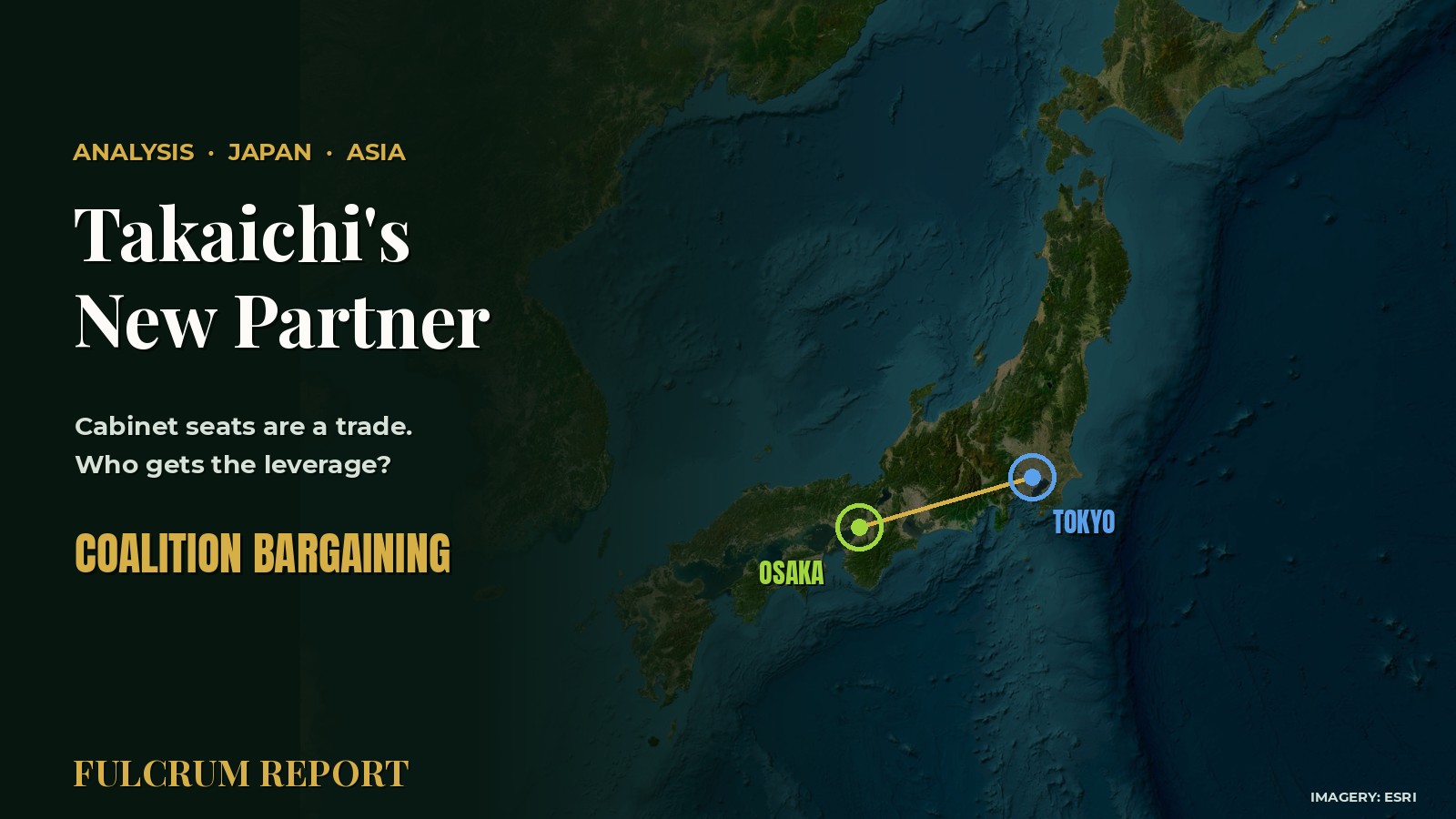
Takaichi's New Partner: Why Cabinet Seats Are a Trade
Sanae Takaichi reportedly reshuffled her cabinet on September 16 and 17, bringing in the Japan Innovation Party (Ishin) for the first time. Her camp holds two-thirds of the lower house but lacks an upper-house majority. A look at coalition bargaining and who gets the leverage.
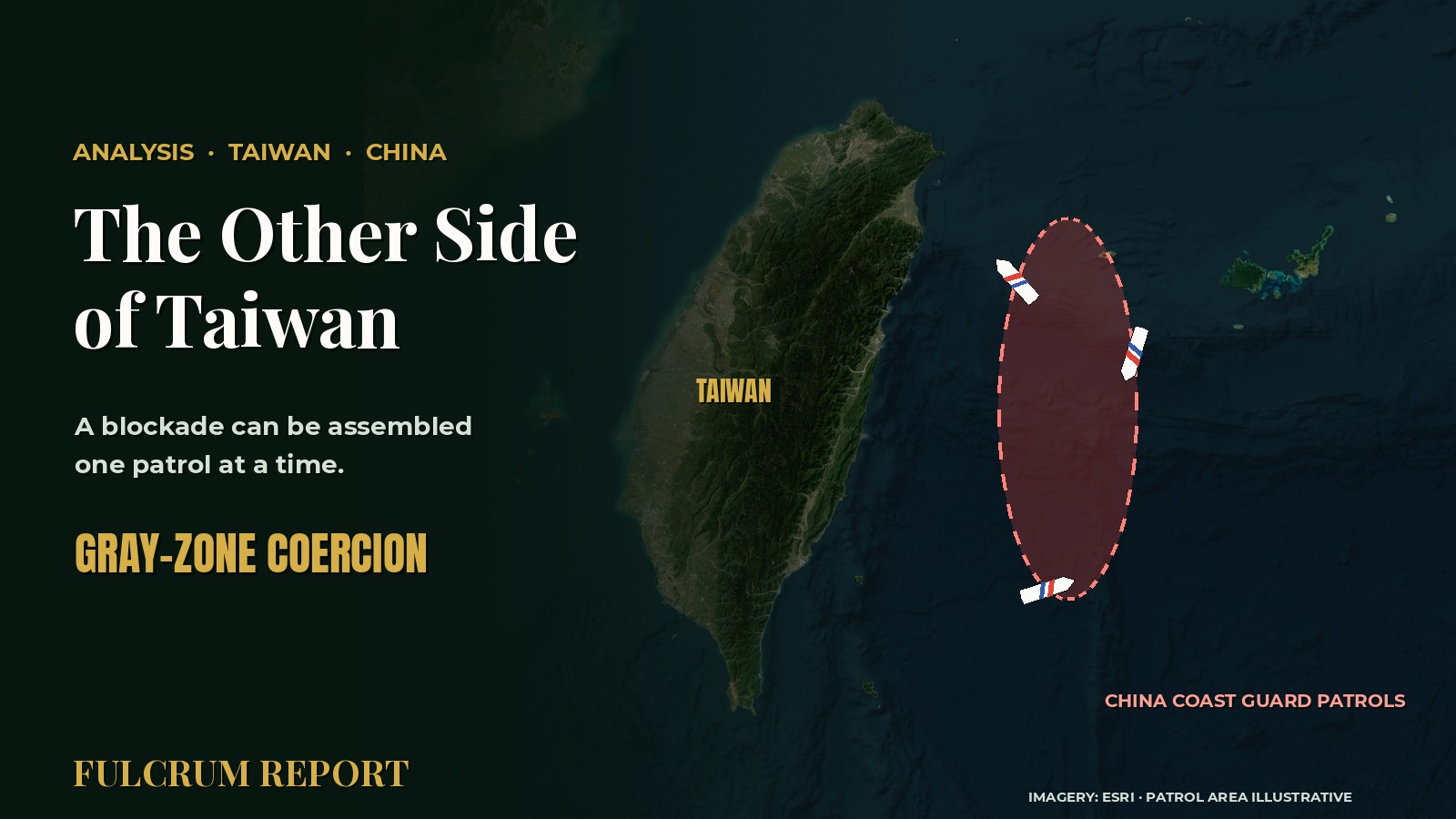
The Other Side of Taiwan: How a Blockade Gets Built Without Being Declared
China's Coast Guard has reportedly set up a regular presence east of Taiwan, framed as law enforcement, while a $14 billion U.S. arms package is pending. A look at gray-zone coercion, salami tactics and escalation control.

The Last Gate Jesus Walked Through?
The Threshold of the Judgment Gate, the "Eye of the Needle" and Constantine’s lost front door, inside Jerusalem’s Alexander Nevsky Church.