The Last Gate Jesus Walked Through?
In 1883, Russian builders hit ruins seventy meters from the Holy Sepulchre. They built a church over them instead. The faith says one thing; the dig says another.
Most people walking to the Church of the Holy Sepulchre never notice the door. It's a plain entrance on a busy lane in the Christian Quarter, about seventy meters from the great church, and the sign is easy to miss. I almost walked past it myself.
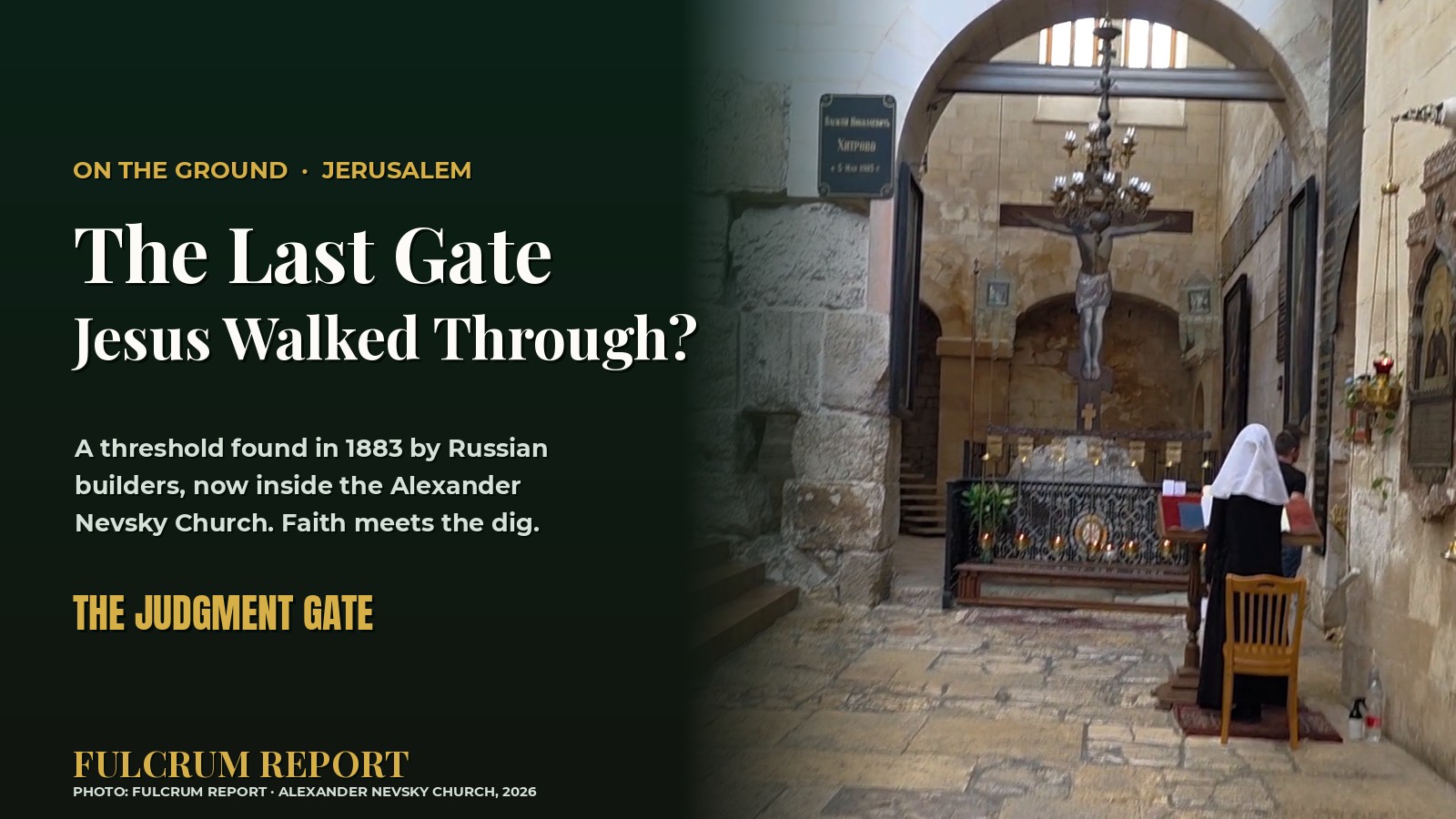
Inside, the noise of the Old City drops away. You go down worn steps onto old paving stones, the walls rise in huge, uneven blocks, and at the far end there's an arch with a crucifix hanging under it and a woman praying quietly in front. Above all of it, rows of paintings tell the story of the Passion. It feels less like a church and more like a church that grew around something it didn't expect to find.
That's more or less what happened.
A consulate that never got built
In 1859 Russia bought this plot of land. The plan was practical: a consulate and a place for the growing number of Russian pilgrims coming to Jerusalem. Nothing was built for years. Then, in 1883, workers digging the foundations started hitting ruins, and not small ones.
The dig was led by Archimandrite Antonin Kapustin, the head of the Russian Ecclesiastical Mission, and it drew some of the best-known names in the archaeology of the period, including Conrad Schick and Charles Clermont-Ganneau. What they uncovered changed the plan completely. The consulate went elsewhere, and a church was built over the remains instead. It was consecrated in 1896 and named for Alexander Nevsky, the medieval Russian prince and saint. People still call the whole compound Alexander's Courtyard.
The threshold
The most famous find is a stone threshold, the bottom of an ancient gateway, which sits under that arch at the end of the hall. The Russian excavators connected it to the gate Jesus would have passed through as he left the city on the way to Golgotha. That's why it's known as the Threshold of the Judgment Gate, and it's the reason many pilgrims come here.
I understand the pull of that idea. Standing in front of it, you can feel how much people want it to be true.
The twist
Here's where it gets more complicated. Most archaeologists today don't date the gate to Jesus' lifetime. They link it to the 2nd century, when the emperor Hadrian rebuilt Jerusalem as a Roman city called Aelia Capitolina, around a hundred years after the crucifixion. On that reading, the threshold belongs to Roman Jerusalem after the Jewish revolts, not to the city of the Gospels.
That doesn't empty the place of meaning, at least not for me. It just changes what you're looking at. Instead of a single footstep, you're looking at layers: a Roman city built over an older one, then a Christian basilica, then a 19th-century Russian church built to protect it all.
The Eye of the Needle
In the same ancient wall there's a small, narrow opening that guides call the Eye of the Needle. The story goes that it was a side passage for people arriving after the main gate had closed for the night, so small that a camel would have to be unloaded and pushed through on its knees. Pilgrims connect it to the line in Matthew 19:24 about a camel passing through the eye of a needle more easily than a rich man entering the kingdom of God.
It's a lovely story. There's no early evidence, though, that this opening had anything to do with the saying, and many scholars think Jesus simply meant a sewing needle, an image that was supposed to sound impossible. So I'd treat it as a legend attached to the stone, not a fact carved into it.
Constantine was here too
The part that surprised me most is the least advertised. Some of the big stones and column pieces in this hall belong to the 4th-century basilica that the emperor Constantine built over the site of the Holy Sepulchre. The original church was much larger than the one standing today, and its eastern entrance reached all the way to this spot. So when you're inside the Russian church, you're also standing at the old front door of Constantine's.
A quieter kind of politics
The building has its own modern story. It belongs to the Imperial Orthodox Palestine Society, and who exactly controls that society, and the property, has been argued over since the Russian Revolution split it apart. In recent years the Russian state pushed to register the site in its own name, and in 2022 a Jerusalem court cancelled that registration. The legal fight hasn't really ended. It's a good reminder that in Jerusalem, even the ownership of a doorway can be a diplomatic file.
Why it stayed with me
I went in expecting a small chapel and came out thinking about how faith and archaeology meet. One gives a place its meaning. The other tells you when the stones were actually laid. They don't always agree, and I don't think they have to. You can respect what pilgrims feel at that threshold and still be honest about the date on it.
If you go, look past the arch. Look at the size of the blocks in the walls, the paving under your feet, and the little opening in the stone. Give it ten quiet minutes. It's one of the calmest rooms in the Old City.
Does the date of a holy place matter to you, or is it the faith around it that counts? I'd really like to hear how you think about it.
About the author
Fulcrum Report
Independent Middle East analyst holding a PhD in Political Science. Fulcrum Report offers rigorous, framework-driven coverage of politics and geopolitics across the Levant and the wider region — analysis without agenda.
Related reading

Takaichi's New Partner: Why Cabinet Seats Are a Trade
Sanae Takaichi reportedly reshuffled her cabinet on September 16 and 17, bringing in the Japan Innovation Party (Ishin) for the first time. Her camp holds two-thirds of the lower house but lacks an upper-house majority. A look at coalition bargaining and who gets the leverage.
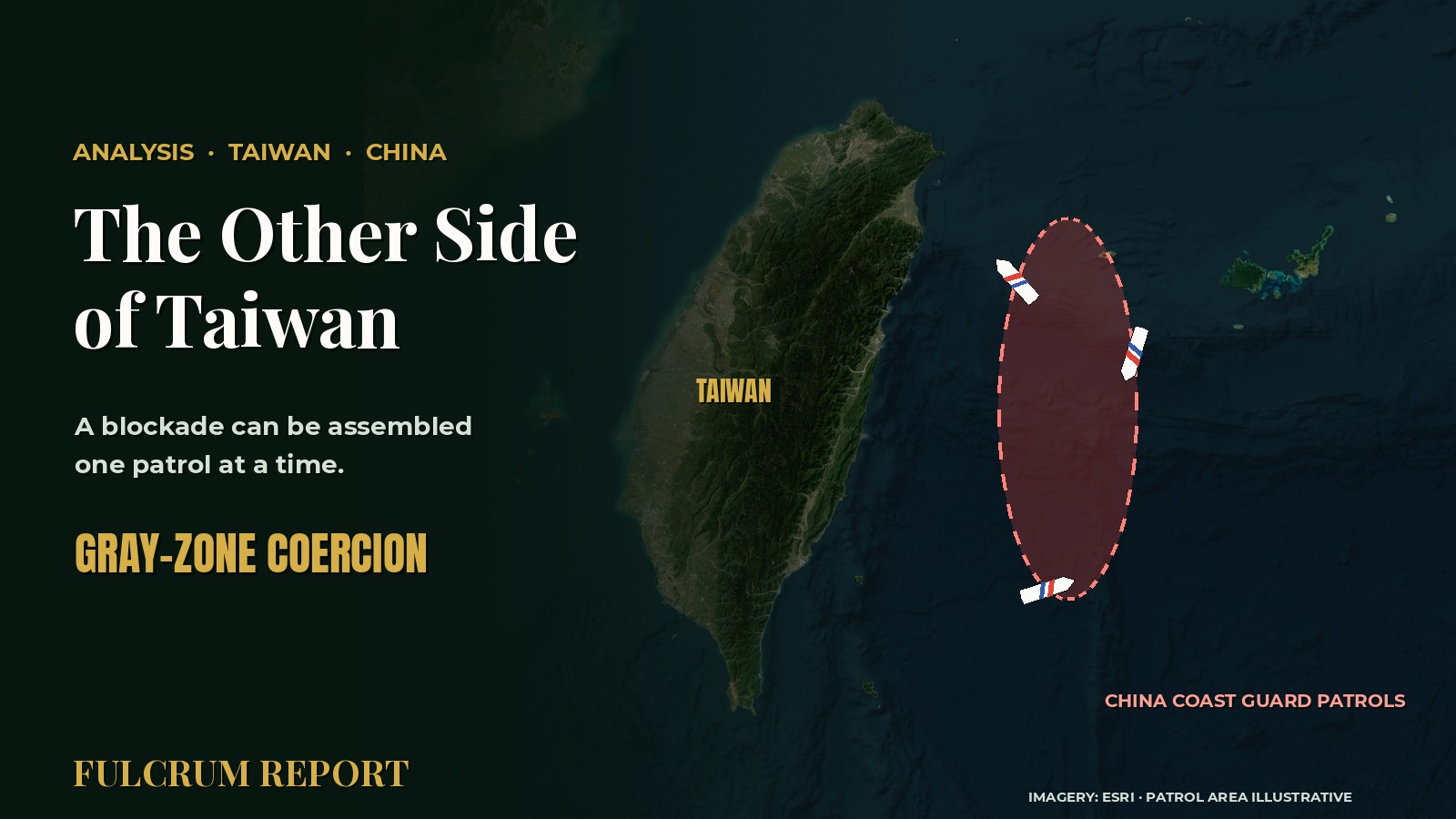
The Other Side of Taiwan: How a Blockade Gets Built Without Being Declared
China's Coast Guard has reportedly set up a regular presence east of Taiwan, framed as law enforcement, while a $14 billion U.S. arms package is pending. A look at gray-zone coercion, salami tactics and escalation control.

Pomp Over Progress: What Xi's Washington Visit Actually Bought
Xi Jinping's state visit ended with the trade truce extended two months, tariff cuts on $30 billion of goods, a coal deal and an AI incident channel. A look at managed rivalry and why guardrails matter.