Hezbollah's New Generation
Killing leaders rarely destroys an established armed group. It changes how the group operates, and a weaker Hezbollah is not necessarily a more predictable one.
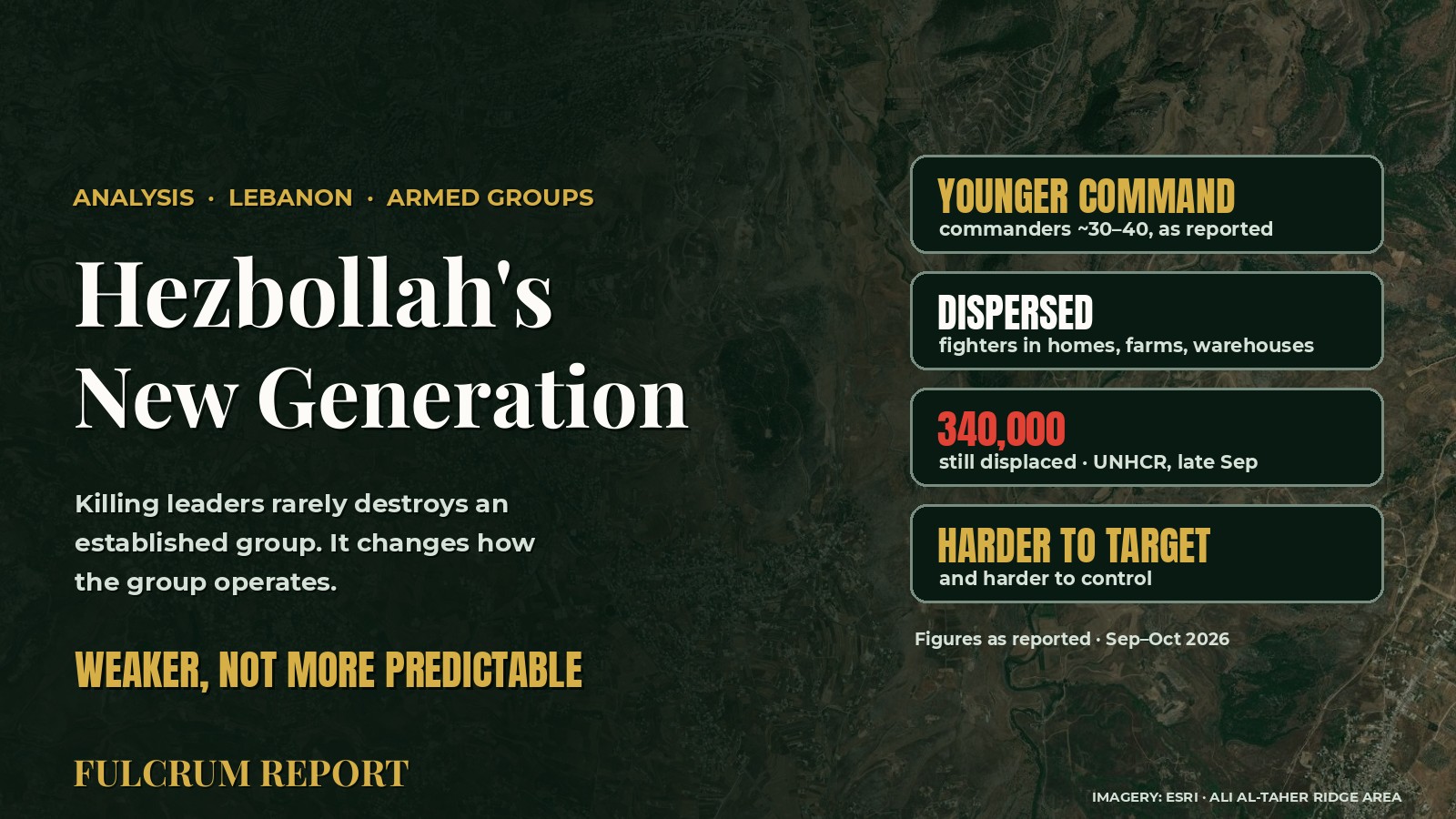
Hezbollah's commanders are younger now. A lot of the coverage treats that as proof the group is finished. I don't think it is. I think it's a sign the group is adapting, and that has its own risks.
Here's what's actually been reported, and then the research that I think explains it.
What's changed
Hezbollah has taken heavy losses over the past two years. Hassan Nasrallah, who led it for more than three decades, was killed in an Israeli strike in September 2024. Much of the senior military leadership was killed around the same time. Naim Qassem, his longtime deputy, has been secretary-general since October 2024.
What came after is the interesting part. According to reporting, including from RFI, the group has promoted a younger generation of commanders, many of them reportedly in their 30s and early 40s. It has also reportedly moved fighters and equipment out of obvious bases and into private properties: homes, farms, warehouses. I want to be careful here. These are reported details about a secretive organization, not things anyone can fully verify from the outside.
Qassem's public line is defiant. He has vowed guerrilla resistance. Meanwhile, on September 3, Israel declared control of the Ali al-Taher ridge, a hilltop of roughly 600 meters overlooking Nabatieh in the south. Hezbollah disputes how much ground Israel actually holds there.
And the human cost hasn't gone away. According to UNHCR, at least 340,000 people in Lebanon were still displaced as of late September, down from a peak of more than 1.2 million.
What the research says about killing leaders
This is where I move from reporting to analysis.
Political scientists have spent a lot of time on what's called leadership decapitation, meaning targeting the people at the top of an armed group. The intuition is simple: cut off the head and the body dies. The evidence mostly says otherwise, at least for established organizations.
Jenna Jordan's book Attacking the Leader, Missing the Mark (2014) is the work I keep coming back to. Her argument is that older, larger groups with real bureaucracies and real community support tend to survive the loss of their leaders. Some even become more dangerous afterward. Bryan Price's research (2012) found that decapitation can shorten the life of some groups, but the effect depends a lot on the group, and it's weakest for organizations that are already deeply institutionalized.
Hezbollah fits that profile almost exactly. It has three things that make groups resilient:
A bureaucracy. It isn't one man and his followers. It has departments, a chain of command, and procedures for replacing people.
Funding. It has outside backing and its own income, even if both have been squeezed.
Social roots. It runs schools, clinics and welfare networks, and it has a political party in parliament. That gives it a base that doesn't vanish when a commander dies.
Groups with those three things tend to regenerate. So the useful question isn't whether Hezbollah survives. It's how it changes.
How it changes
The pattern in the research is that groups under this kind of pressure reorganize. They become more decentralized and less hierarchical. Local units get more say. Fewer people know the whole picture. Communication gets thinner.
That makes a group harder to target, which is the point. It also makes it harder to control, and that part gets less attention than it should. A flat network with younger commanders and less contact with the top is harder for its own leadership to rein in. It's also harder for anyone negotiating with it to know whether a deal will hold on the ground.
That's why I keep pushing back on the idea that weaker means safer. A weaker Hezbollah isn't necessarily a more predictable one. In some ways it may be less predictable, at exactly the moment Lebanon's government is trying to bring all weapons under state control.
What I'm watching
I'm watching three things. First, whether Hezbollah's actions start to look less coordinated, with local incidents that don't match what its leadership says in public. Second, what happens around Ali al-Taher and the other contested points in the south, since that's where any loss of control would show up first. Third, whether the displacement number keeps falling, because a lot of the political pressure on every side comes from those 340,000 people who still can't go home.
I don't know how this ends, and I'd be suspicious of anyone who says they do. But the research tells me what not to assume, and the main thing not to assume is that a battered organization is a tame one.
So what's your read: more predictable or less? Tell me why in the comments on the reel, and follow @fulcrumreport for more analysis without agenda.

About the author
Fulcrum Report
Independent Middle East analyst holding a PhD in Political Science. Fulcrum Report offers rigorous, framework-driven coverage of politics and geopolitics across the Levant and the wider region — analysis without agenda.
Related reading
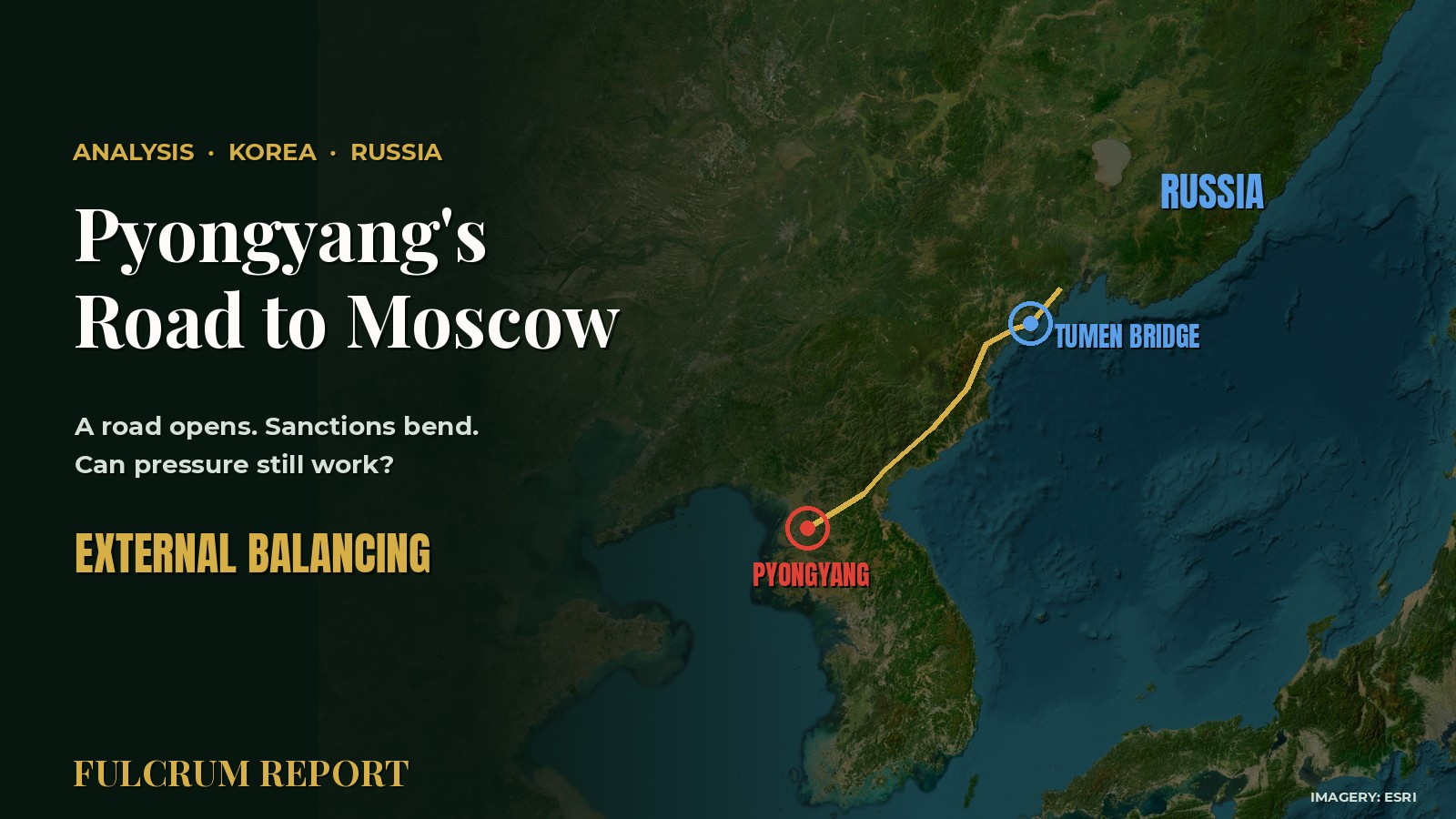
Pyongyang's Road to Moscow: Can Sanctions Still Work?
A second enrichment facility is reportedly going up at Yongbyon, and the Tumen River road bridge to Russia reportedly opened on September 8. When a major power offers a way around sanctions, how much pressure is left? An explainer on external balancing.

Takaichi's New Partner: Why Cabinet Seats Are a Trade
Sanae Takaichi reportedly reshuffled her cabinet on September 16 and 17, bringing in the Japan Innovation Party (Ishin) for the first time. Her camp holds two-thirds of the lower house but lacks an upper-house majority. A look at coalition bargaining and who gets the leverage.
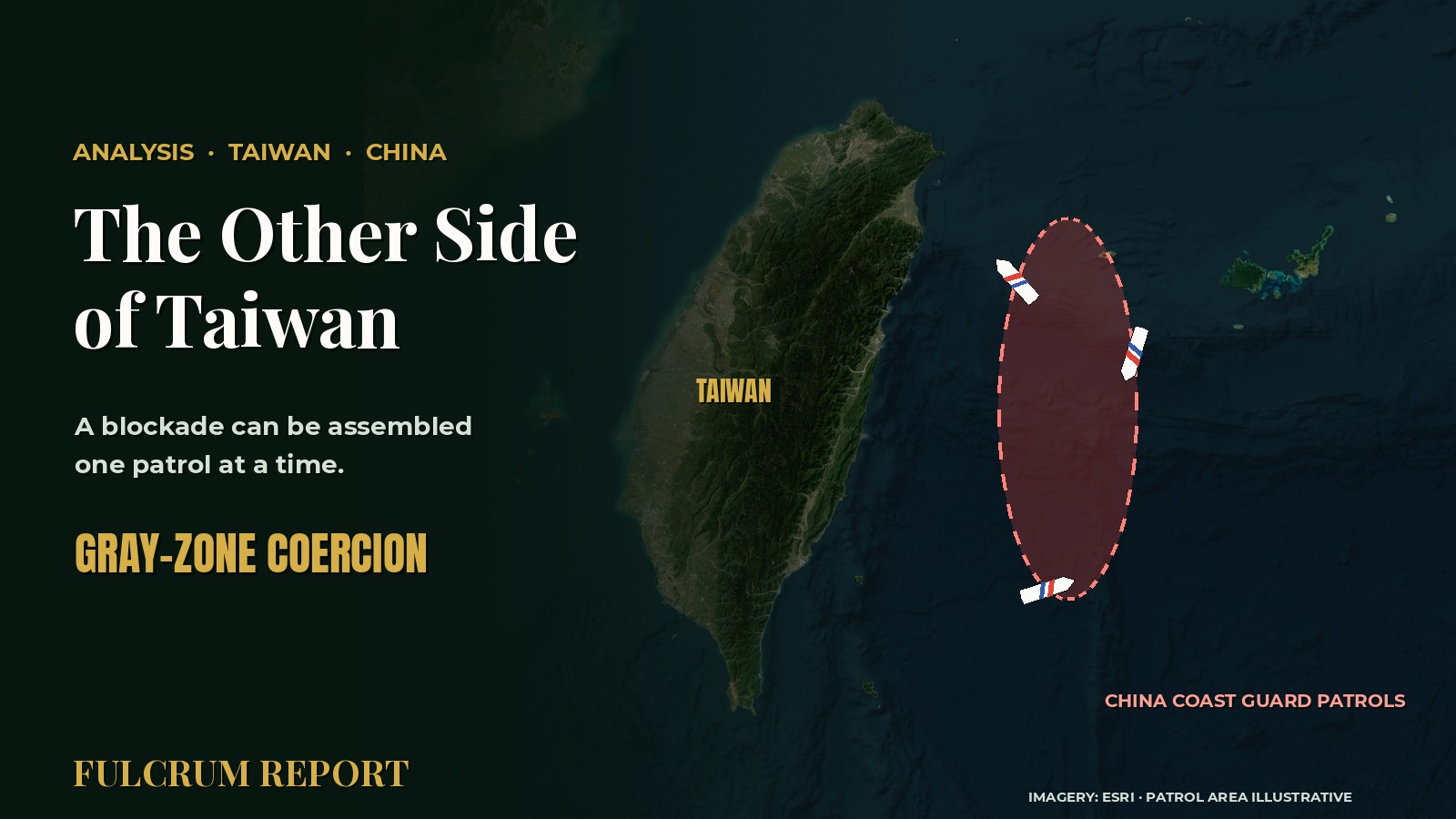
The Other Side of Taiwan: How a Blockade Gets Built Without Being Declared
China's Coast Guard has reportedly set up a regular presence east of Taiwan, framed as law enforcement, while a $14 billion U.S. arms package is pending. A look at gray-zone coercion, salami tactics and escalation control.