Six Churches, One Building, and a Key None of Them Hold
Inside the Church of the Holy Sepulchre, an Ottoman rulebook frozen in 1852 still decides who owns every lamp, step and hour — and two Muslim families keep the door.
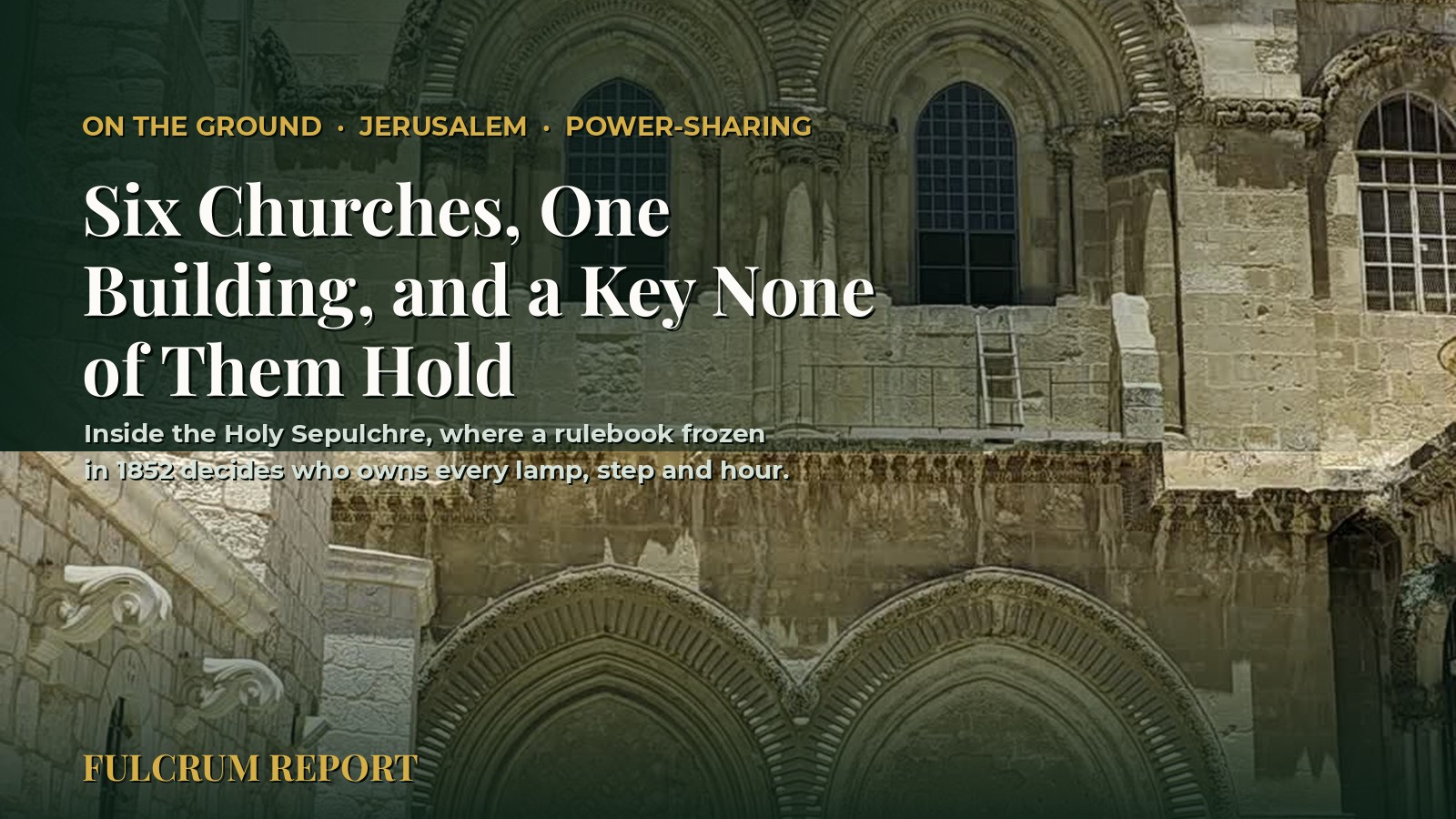
The first thing you notice at the Church of the Holy Sepulchre is not the gold, or the lamps, or even the crowd. It is how many people seem to be in charge. I stood in the courtyard in July with my phone out, filming the façade over a pile of restoration pallets, and within a few minutes I had watched a Franciscan friar, a Greek Orthodox monk and an Armenian priest cross the same stones without so much as a nod. Everyone knew exactly where they were allowed to be.
That is not an accident. It is the product of one of the oldest working power-sharing arrangements in the Middle East, and it tells you more about how this region manages conflict than most think-tank reports do.
## Six churches, one roof
The Holy Sepulchre is venerated by most of the Christian world as the site of the crucifixion at Golgotha and the tomb of Jesus. Six communities hold a stake inside it. The three major custodians are the Greek Orthodox Patriarchate, the Roman Catholic Church through the Franciscan Custody of the Holy Land, and the Armenian Apostolic Church. The Coptic, Ethiopian and Syriac Orthodox churches hold smaller chapels and rights, some of them fiercely contested.
Walk from the Stone of Anointing, where pilgrims kneel and press cloths to the slab under a gold mosaic, up the steep steps to Calvary, and you pass through several jurisdictions in the space of a minute. The silver lamps hanging over the Golgotha altar are not decoration in any neutral sense. Who hangs a lamp, who cleans it and who lights it are questions with written answers.
## The rulebook frozen in 1852
Those answers come from what is known simply as the Status Quo. The Ottoman Empire, which ruled Jerusalem for four centuries, spent much of the eighteenth and nineteenth centuries refereeing fights between the churches, often with European powers standing behind each one. Firmans issued by the sultan in 1757 and again in 1852 fixed the division of rights inside the church as they stood at that moment and forbade anyone from changing them unilaterally.
What began as an Ottoman administrative decree became international law. The 1856 Treaty of Paris, which closed the Crimean War, recognised the arrangement, and the 1878 Treaty of Berlin confirmed it. That matters, because the Crimean War itself was partly triggered by a quarrel between France and Russia over who protected which Christians at which holy sites. The Status Quo was, in effect, a peace settlement written in candle wax and floor tiles.
The British kept it during the Mandate. Jordan kept it after 1948. Israel has kept it since 1967. Four different sovereigns, one frozen agreement.
## The key held by neither side
Here is the detail that stops most people. The keys to the church are not held by any of the churches. Since Saladin took Jerusalem in 1187, custody of the door has rested with Muslim families. Today the Joudeh family holds the key, and the Nuseibeh family is responsible for opening and locking the great door every day. The logic was simple and, frankly, clever: if no Christian community controls the entrance, no Christian community can lock the others out.
I find that one of the most striking examples of third-party guarantee anywhere in the region. Political scientists talk about neutral custodians and trusted intermediaries as tools for keeping rival parties at the table. Jerusalem has been running one on a doorstep for more than eight centuries.
## A ladder nobody can move
Look up at the façade, to the right above the entrance, and you will see a plain wooden ladder leaning against a window ledge. It has been there since at least the eighteenth century. It is called the Immovable Ladder, and the reason it has not moved is that the ledge sits in shared space, and moving anything in shared space requires the agreement of everyone with a claim. Nobody has been willing to give that agreement, so the ladder stays.
It looks like a joke. It is actually the whole system in miniature. Under the Status Quo, doing nothing is always the safe choice, because any action can be read as a change in rights, and any change in rights can be read as a loss.
## Decades of talks to fix a floor
That same logic explains why the building has spent so long in need of repair. Restoring the Edicule, the shrine over the tomb, only happened in 2016 and 2017 after the Israeli authorities briefly closed it on safety grounds and pushed the churches into agreement. The floor took even longer. The Franciscans, Greek Orthodox and Armenians negotiated for roughly three decades over who would pay for what, who would oversee the work and what the result would mean for their respective rights.
Work finally began in March 2022, led by a team from Rome's Sapienza University under the archaeologist Francesca Romana Stasolla. Beneath the paving they found traces of the ancient quarry the site once was, evidence of olive and grape cultivation, and remains of the fourth-century church built under Constantine. The pallets I filmed in the courtyard belong to that project, which entered its final phase in 2025 with completion expected in early 2026.
Think about what that means. The most sacred building in Christianity waited a generation for new floor tiles, not because anyone lacked money or faith, but because agreeing on the tiles meant agreeing on everything the tiles represented.
## What this teaches about the region
It would be easy to treat all of this as a quaint story about quarrelling monks. I think that misses the point. The Status Quo is a working model of how the Middle East has managed shared sacred space for centuries: freeze the arrangement, write it down, hand the most sensitive piece to a neutral party and treat every change as a negotiation among all stakeholders.
It has real costs. It makes reform painfully slow, it rewards the party willing to say no, and it turns ladders and floor tiles into symbols of sovereignty. But it has also kept six communities praying in one building through empires, wars and changes of flag, without anyone being locked out. The same instinct shapes arrangements at the Haram al-Sharif, or Temple Mount, and at the Tomb of the Patriarchs in Hebron, and when those arrangements are challenged, the consequences travel far beyond religion.
Standing under the lamps at Golgotha, surrounded by pilgrims from a dozen countries, I kept coming back to one thought. Faith in that building is shared. Control never is. And that, more than any headline, is the Middle East in one room.
*Watch the reel filmed inside the church on our Instagram, @fulcrumreport.*
About the author
Fulcrum Report
Independent Middle East analyst holding a PhD in Political Science. Fulcrum Report offers rigorous, framework-driven coverage of politics and geopolitics across the Levant and the wider region — analysis without agenda.
Related reading
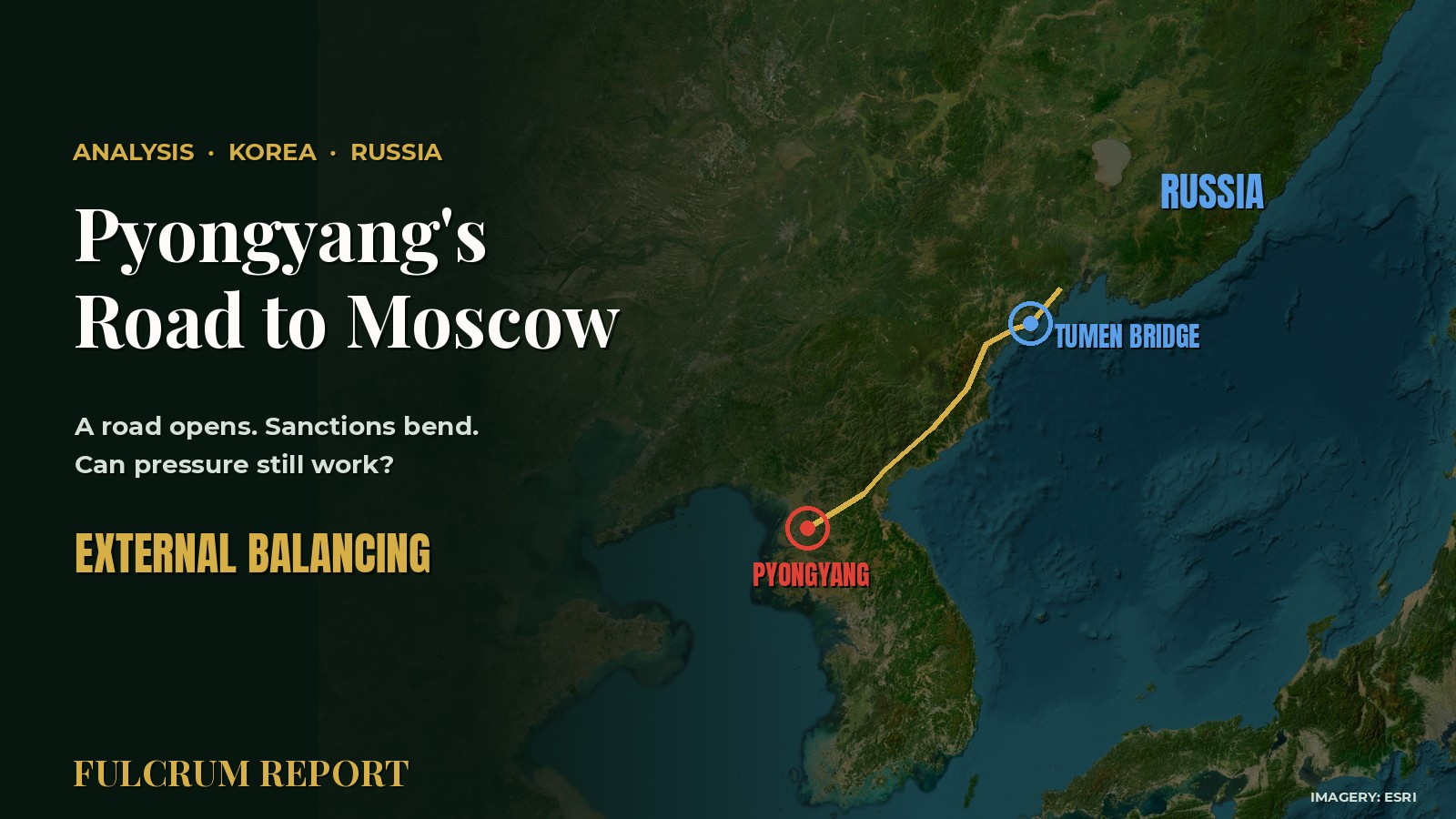
Pyongyang's Road to Moscow: Can Sanctions Still Work?
A second enrichment facility is reportedly going up at Yongbyon, and the Tumen River road bridge to Russia reportedly opened on September 8. When a major power offers a way around sanctions, how much pressure is left? An explainer on external balancing.

Takaichi's New Partner: Why Cabinet Seats Are a Trade
Sanae Takaichi reportedly reshuffled her cabinet on September 16 and 17, bringing in the Japan Innovation Party (Ishin) for the first time. Her camp holds two-thirds of the lower house but lacks an upper-house majority. A look at coalition bargaining and who gets the leverage.
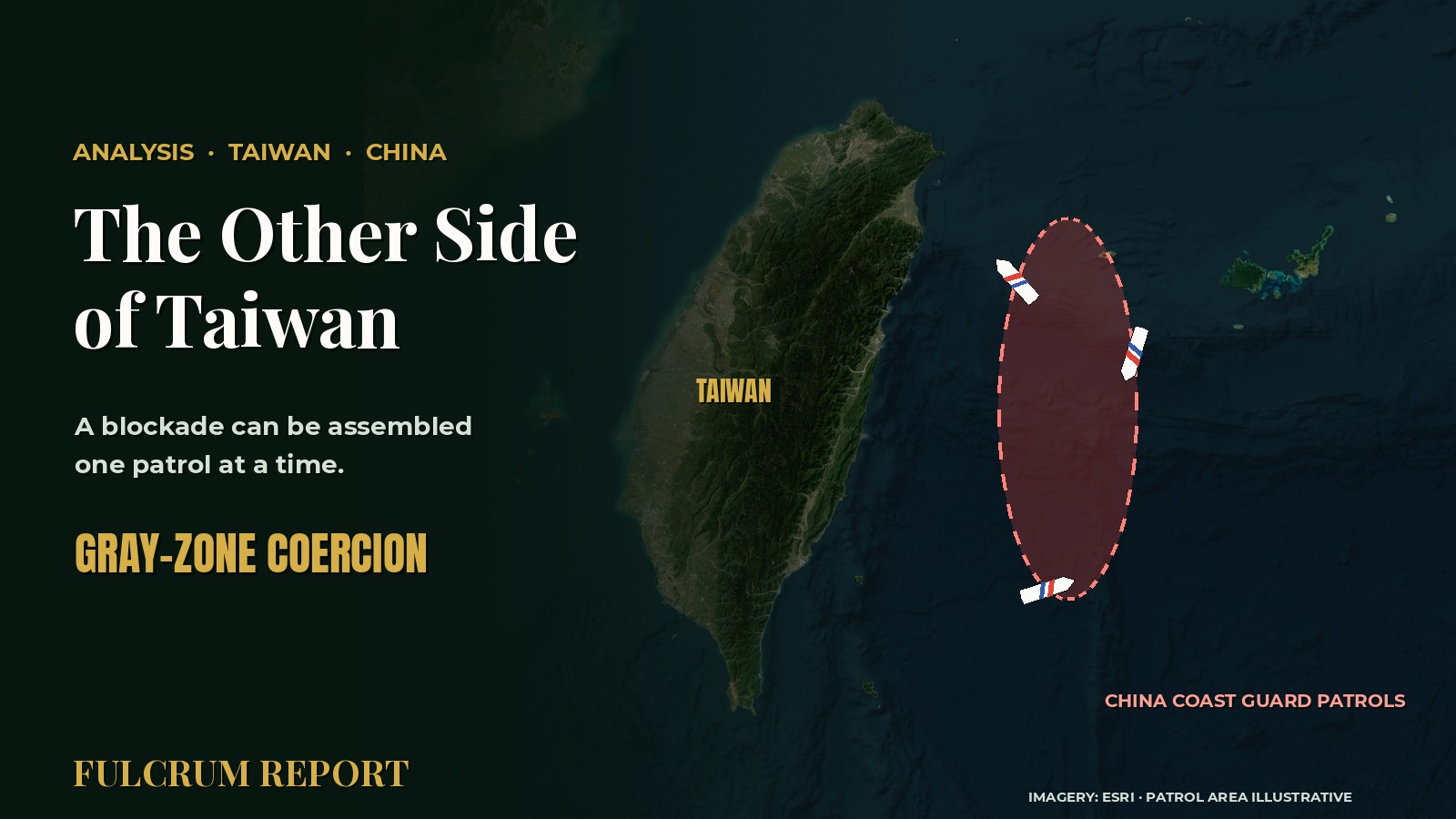
The Other Side of Taiwan: How a Blockade Gets Built Without Being Declared
China's Coast Guard has reportedly set up a regular presence east of Taiwan, framed as law enforcement, while a $14 billion U.S. arms package is pending. A look at gray-zone coercion, salami tactics and escalation control.