Hormuz at One Percent: Risk Pricing, Not Firepower
Traffic through the Strait of Hormuz has fallen from about 85 ships a day to roughly one. The reason is less about missiles than about insurance.
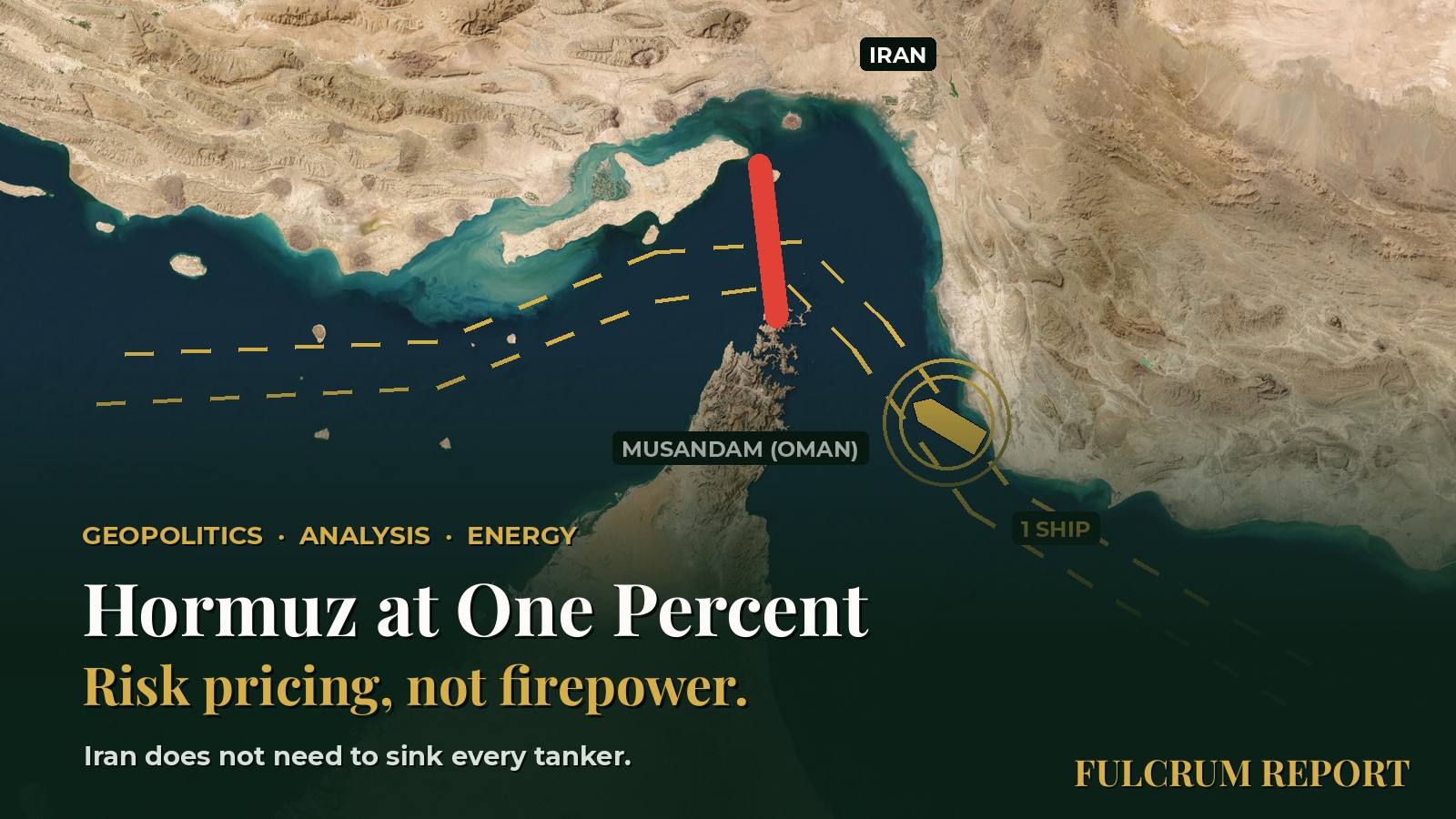
Before this crisis, about 85 ships a day passed through the Strait of Hormuz. Now it's roughly one. That number is the whole story in miniature, and it's worth sitting with for a second, because the strait isn't blockaded in the way most people picture a blockade. There's no wall of warships across the water. There's no navy sinking tankers one after another. The channel is technically open. It just isn't being used.
Since March the strait has been effectively closed, and the reason has less to do with missiles than with money.
What actually changed
The number I keep coming back to is the cost of war-risk insurance. It's a specialized policy that a ship needs before it sails into a zone where it might be attacked, and it's priced as a share of the vessel's value for a single voyage. For Hormuz it has climbed to roughly forty times its pre-crisis level. Some insurers stopped quoting it at all and pulled cover outright.
Think about what that means for a shipowner. A tanker can be worth well over a hundred million dollars, and the cargo is worth a lot more. Without war-risk cover, the owner's bank, the charterer and often the crew contracts all get nervous. With cover priced at forty times normal, the voyage may simply stop making economic sense. Either way the ship stays out.
Then there's the physical threat, which is real enough to keep those prices high. On September 26 around 75 IRGC fast boats were reported off Khasab, the small Omani port on the Musandam peninsula that looks straight across the narrowest part of the strait. There have also been reports of mine-laying in the shipping lanes. I'd treat the mine reports with some caution until they're confirmed, but notice that confirmation almost doesn't matter. The market doesn't need proof. It needs doubt.
The framework: chokepoint leverage
Political scientists and strategists call this chokepoint leverage. A chokepoint is a narrow passage that a large share of some flow has to go through, whether that's oil, container traffic or data cables. Controlling one gives a relatively small actor a kind of power that's out of all proportion to its size. You don't have to dominate the whole system. You only have to be able to threaten the one place where everything is squeezed together.
Hormuz is the textbook case. Roughly a fifth of the world's oil normally moves through it. That's the lever. On one end you have a few dozen fast boats, some mines and a credible threat. On the other end you have global oil flows. Put the fulcrum in the right place and the small force moves the heavy load.
Risk pricing, not firepower
Here's the part I think gets missed in most coverage. Iran doesn't have to sink every tanker. It doesn't even have to sink one. It only has to make passage uninsurable.
That's why I describe this as closing a strait through risk pricing, not firepower. The military threat matters, but it works through a financial channel. The sequence goes like this: the threat goes up, underwriters reprice or walk away, and shipowners follow the underwriters. Nobody in that chain is a coward or a pushover. Each of them is making a sensible decision with their own balance sheet, and the sum of those sensible decisions is a closed strait.
This is also why military escorts only solve part of the problem. The US Navy escorted tankers through the Gulf in the late 1980s, and navies can do it again. But a warship can escort a tanker. It can't escort away the insurance premium. As long as underwriters think the risk is too high to price, the escorted tanker is still an expensive tanker, and a lot of owners will still say no.
Why a ceasefire won't be the moment it reopens
This leads to a prediction that sounds counterintuitive but I think is right: Hormuz won't reopen when the shooting stops.
A ceasefire is a political event. Reopening a shipping lane is a commercial one. Underwriters look backward at losses and forward at uncertainty, and a fresh ceasefire gives them very little to go on. They'll want to see a stretch of calm, clear information about any mines in the water, and some sense that the arrangement will hold. Until they're satisfied, premiums stay high and traffic stays thin, whatever the diplomats announce.
So if you want a signal to watch, don't just watch the negotiating table. Watch the insurance market. The strait reopens when insurers say it's safe, and that will probably come later than the headlines suggest.
The bigger point
We tend to measure power in hardware: ships, missiles, troops. Hormuz is a reminder that in a globalized economy, a lot of power runs through much quieter institutions, like the underwriting rooms in London that decide what a voyage costs. Iran seems to understand that very well. The question for everyone else is whether they can build enough confidence, not just enough firepower, to bring the ships back.
If this changed the way you look at the oil map, share it with someone who still thinks straits close only when shots are fired.

About the author
Fulcrum Report
Independent Middle East analyst holding a PhD in Political Science. Fulcrum Report offers rigorous, framework-driven coverage of politics and geopolitics across the Levant and the wider region — analysis without agenda.
Related reading
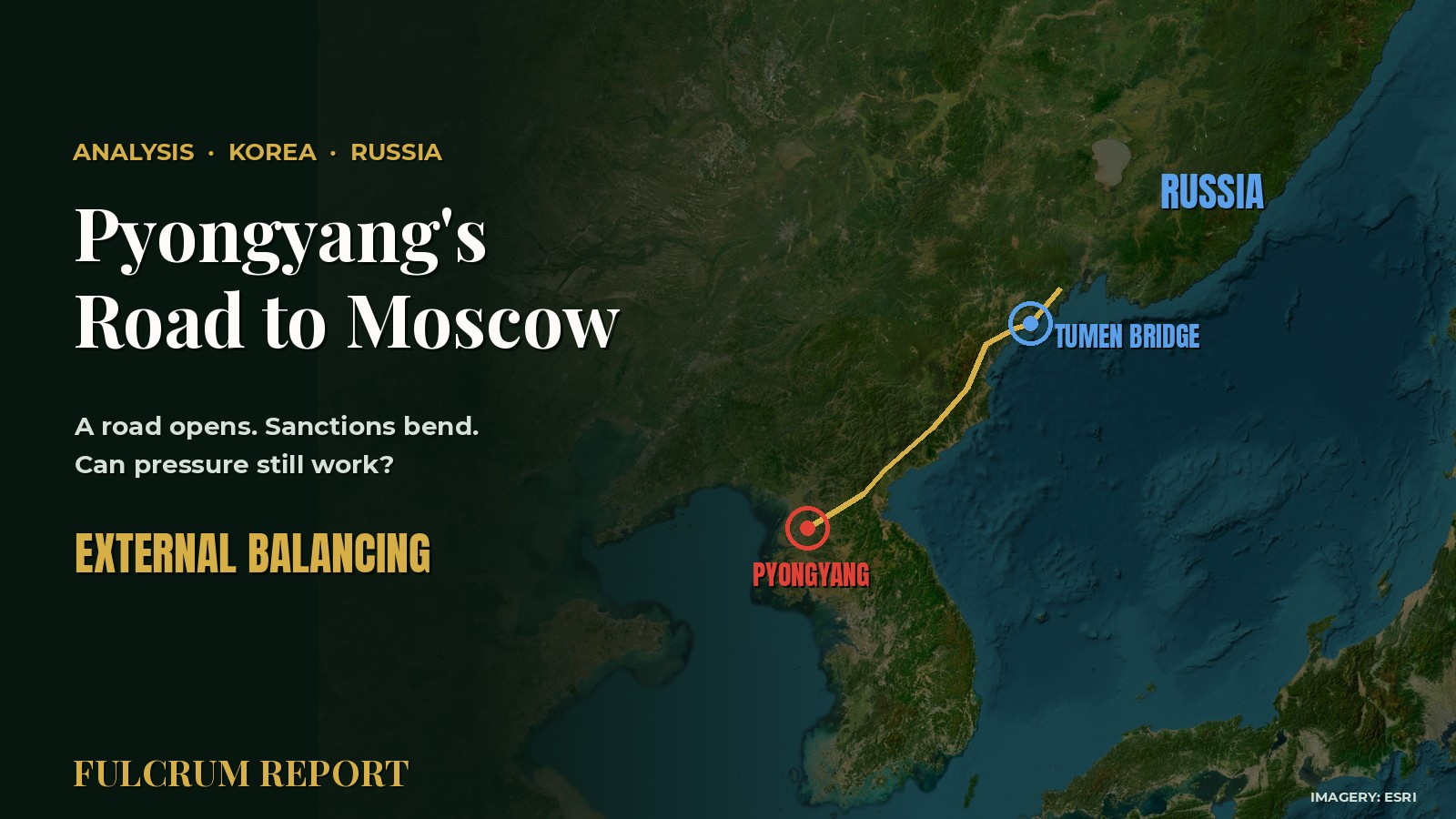
Pyongyang's Road to Moscow: Can Sanctions Still Work?
A second enrichment facility is reportedly going up at Yongbyon, and the Tumen River road bridge to Russia reportedly opened on September 8. When a major power offers a way around sanctions, how much pressure is left? An explainer on external balancing.
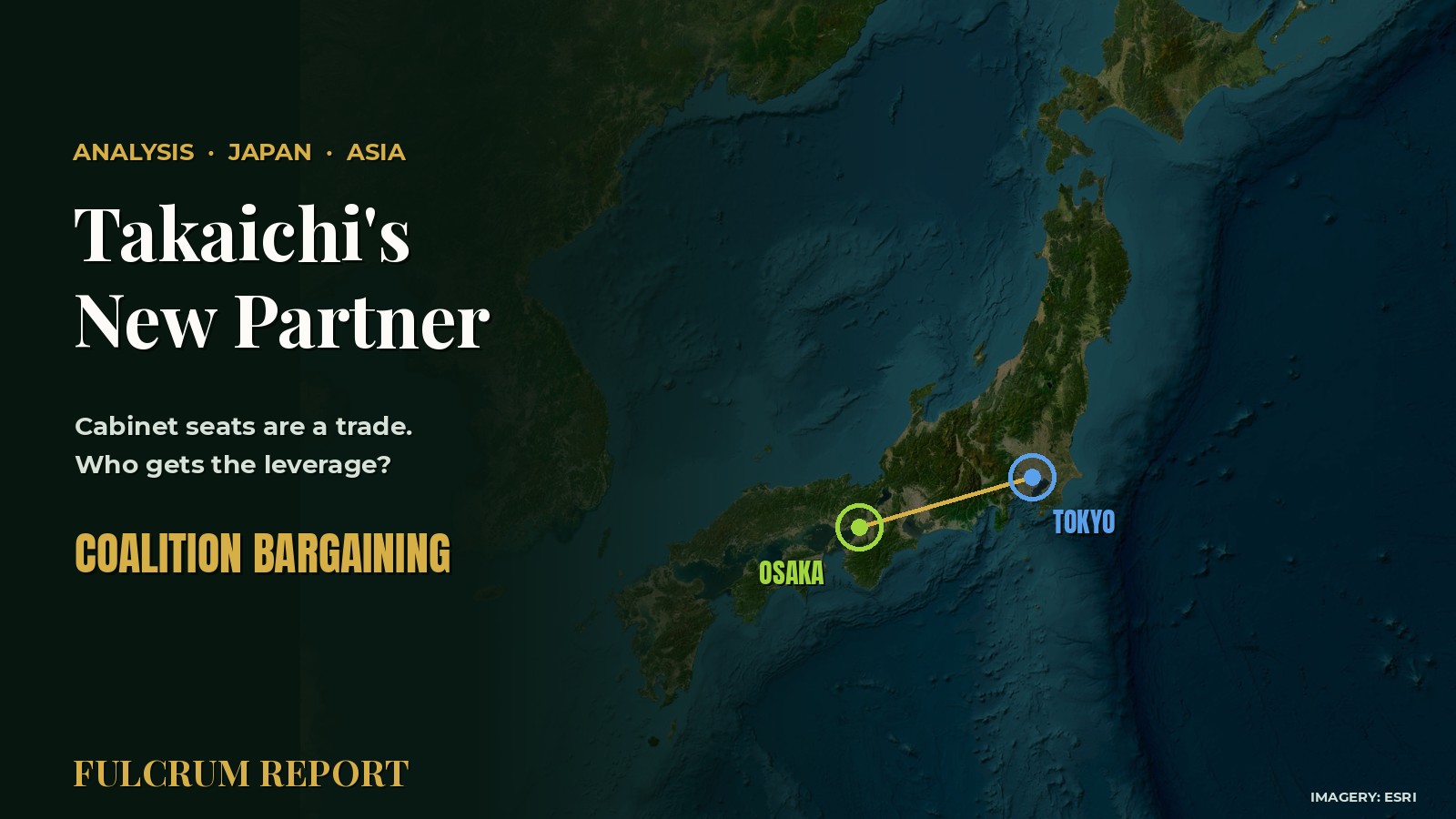
Takaichi's New Partner: Why Cabinet Seats Are a Trade
Sanae Takaichi reportedly reshuffled her cabinet on September 16 and 17, bringing in the Japan Innovation Party (Ishin) for the first time. Her camp holds two-thirds of the lower house but lacks an upper-house majority. A look at coalition bargaining and who gets the leverage.
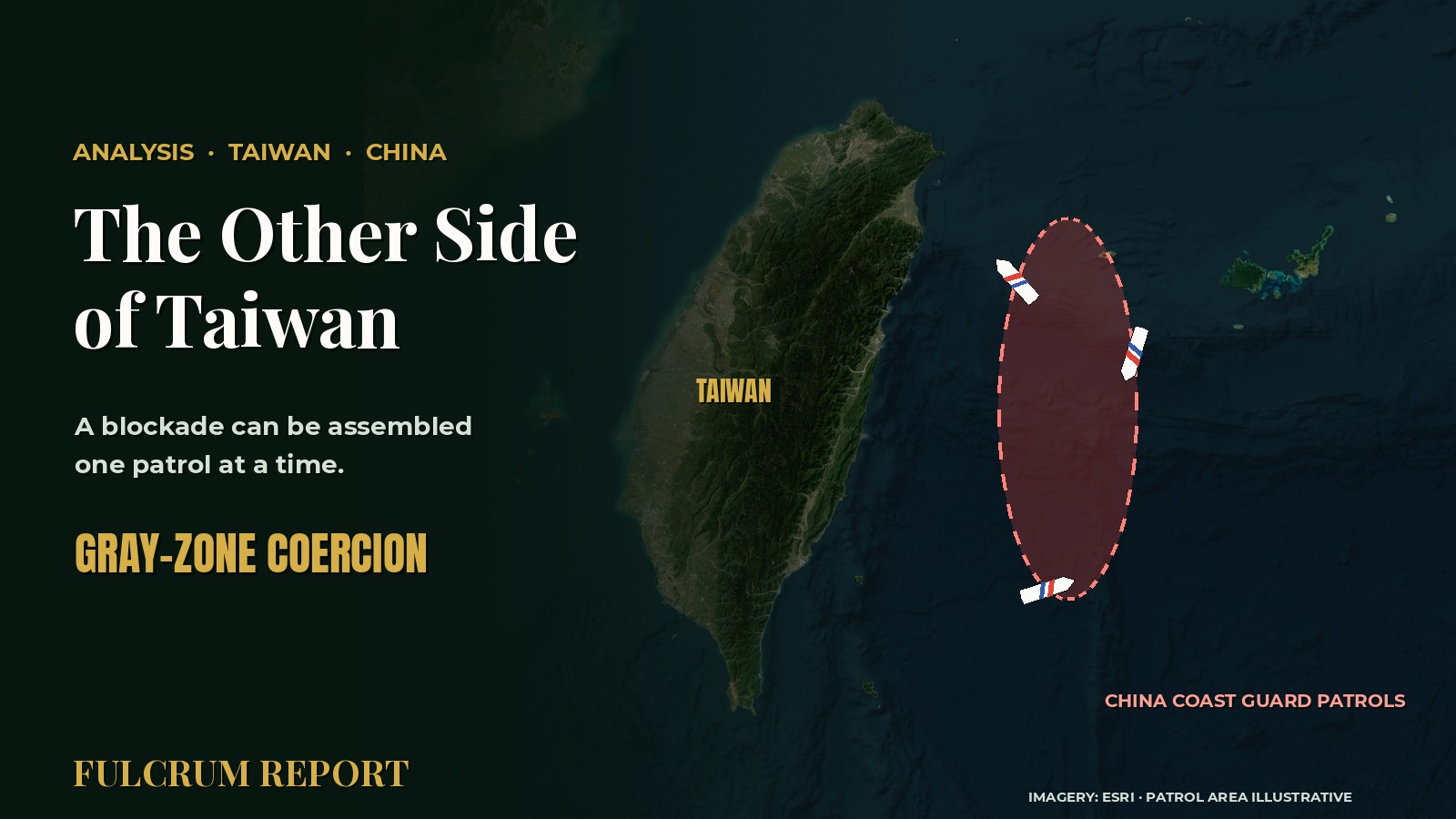
The Other Side of Taiwan: How a Blockade Gets Built Without Being Declared
China's Coast Guard has reportedly set up a regular presence east of Taiwan, framed as law enforcement, while a $14 billion U.S. arms package is pending. A look at gray-zone coercion, salami tactics and escalation control.