Armies Win Battles. Economies Win Wars.
Israel can dominate every battlefield and still lose the war of endurance. A guns-versus-butter look at what a long, multi-front war is costing its economy.
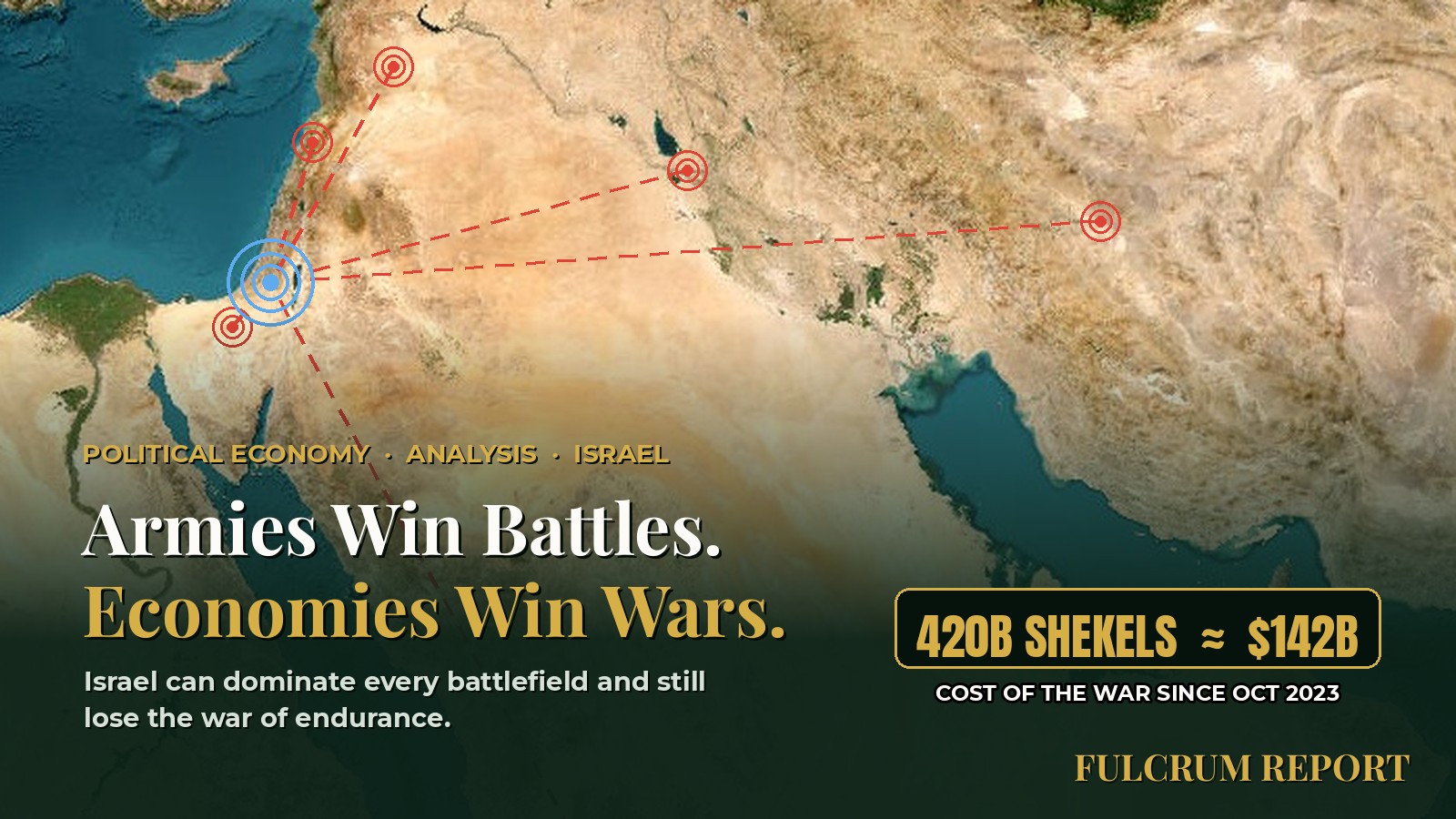
There is an old line that military historians like to repeat, usually after the parades are over: armies win battles, economies win wars. I have been thinking about it a lot this year, because Israel is the clearest live test of it I can find anywhere in the world right now.
On the battlefield, Israel's record since October 2023 is hard to argue with. It has struck deep into Lebanon, hit targets in Syria, Iraq, Yemen and Iran, and kept up an air defense shield that would have been science fiction a generation ago. If you judge a war by the scoreboard of individual engagements, it looks like domination.
But there is a second war running underneath the first one, and it doesn't show up on the maps. I call it the war of endurance. It is fought in budget lines, labor statistics and bond markets, and it is the one that tends to decide long conflicts. Israel can win every battle and still lose that one.
## The bill so far
Start with the headline number. By the most widely cited estimates, the war has cost Israel roughly 420 billion shekels, about 142 billion dollars, since October 2023. For an economy of Israel's size, that is not a rounding error. It is a multi-year hole.
The macro picture in early 2026 tells the same story from a different angle. Output fell by an estimated 10 percent. The budget deficit approached 6 percent of GDP. Defense spending climbed above 7 percent of GDP, which puts Israel far outside the range of almost every other developed economy. None of those figures on its own is fatal. Together they describe a state that is borrowing to fight, spending more of each shekel on security, and producing less while it does it.
## Guns versus butter
The lens I find most useful here is the oldest one in the political economy of war: guns versus butter. Every economy has a limited pool of money, workers, factories and attention. Whatever goes to the guns cannot go to the butter, meaning the schools, hospitals, roads, research labs and private businesses that make a country richer over time.
In peacetime that trade-off is abstract. In a long war it becomes brutally concrete, and Israel shows it through two channels better than almost anywhere else.
## The interceptor problem
The first channel is air defense. Israel's layered shield is extraordinary, but it is expensive in a way that compounds night after night. Public estimates put an Iron Dome interceptor somewhere in the range of 40,000 to 100,000 dollars. David's Sling interceptors run to roughly 700,000 dollars. Arrow interceptors, built to stop long-range ballistic missiles, are estimated in the millions each; figures of around 3 million for Arrow 2 and 4 million for Arrow 3 are commonly cited.
Now put that next to the other side of the ledger. Many of the drones and rockets fired at Israel cost a small fraction of what it takes to shoot them down. That cost asymmetry is the whole point for the people firing them. On a heavy night, when salvos come from several directions, the air defense bill can run into the tens or hundreds of millions of dollars. Every one of those interceptors does its job. And every one of them is money that cannot fund something else.
## The reservist problem
The second channel is people. Israel fights with a citizen army, which means that when it mobilizes, it is not moving soldiers from barracks to the front. It is pulling engineers out of tech companies, farmers off their land, teachers out of classrooms, and owners out of the small businesses that only function when they are there.
Every reservist called up is a worker pulled from the economy. The state pays for that twice: once in reserve-duty pay and compensation, and again in the output that doesn't happen because the person who would have produced it is in uniform. Firms lose key staff for months at a time. Families lose a paycheck or a parent. Small businesses simply close. Repeated call-ups over a war that stretches across years turn a temporary disruption into a structural drag on the labor force.
## A short war is a shock. A long war compounds.
This is the part I think gets missed most often. Economists treat a short war as a shock: output drops, spending spikes, and then, if the war ends, the economy bounces back. Israel has actually done this before. Its economy has historically recovered quickly from short conflicts.
A long, multi-front war is a different animal. The costs don't just add up; they compound. Deficits become debt, and debt carries interest that has to be paid for years. Reservists who spend long stretches away from work lose skills and clients. Investors who were willing to wait out a three-week war start pricing in a three-year one. Credit rating agencies notice. Young, mobile, highly skilled workers, the ones a tech economy depends on most, start weighing whether to build their careers elsewhere. Each of those effects feeds the next.
That is why duration matters so much more than any single battle. A state can absorb a sharp blow. What drains it is the grind.
## Who pays, and for how long
There is also a political dimension here that I think is worth naming. Borrowing a principal-agent frame from political science: in a democracy, the public is the principal and the government is its agent. Citizens hand the state their taxes, their savings through the bond market, and, in Israel's case, their own bodies through reserve service. In return they expect security, and eventually a return to normal life.
In a short war that bargain holds easily. In a long one the terms start to shift. The agent keeps asking for more: more money, more call-ups, more patience. The principal, at some point, starts asking what it is getting in return. That tension shows up in protests, in coalition politics, and in fights over who carries the burden, whether that means reservists versus the exempt, or taxpayers versus the defense budget. It is one more way a long war erodes a society that is still winning on the battlefield.
## How powerful states actually lose
History is full of great powers that were never defeated in any decisive battle. They lost anyway. Imperial Spain was the dominant military power of its age and defaulted on its debts again and again under the weight of constant war. Britain came out of the Second World War on the winning side and nearly bankrupt, and spent the next two decades unwinding an empire it could no longer afford. The Soviet Union's decade in Afghanistan did not break the Red Army, but it helped drain a system that was already running out of money. The historian Paul Kennedy gave the pattern a name: imperial overstretch.
The lesson is uncomfortable. Powerful states often lose not because they run out of military strength, but because they can no longer afford to use it. The tanks are still there. The planes still fly. What runs out is the capacity to keep paying for them without hollowing out everything else.
## The iceberg
I am not predicting that Israel is about to collapse. It has a sophisticated, innovative economy, deep capital markets, and allies who have historically helped carry the load. It has come back from hard years before.
My point is narrower, and I think more important. Battlefield strength and economic health are not the same thing, and the first can hide the second. What you see on the news is the tip of the iceberg: the strikes, the interceptions, the map of fronts. What sits below the waterline is the debt, the deficit, the lost workdays, the investment that quietly went somewhere else.
If you want to know how this war ends, watch the battles, but watch Israel's economy more closely. That is where the war of endurance is being fought, and that is the part of the story that isn't about weapons.

About the author
Fulcrum Report
Independent Middle East analyst holding a PhD in Political Science. Fulcrum Report offers rigorous, framework-driven coverage of politics and geopolitics across the Levant and the wider region — analysis without agenda.
Related reading
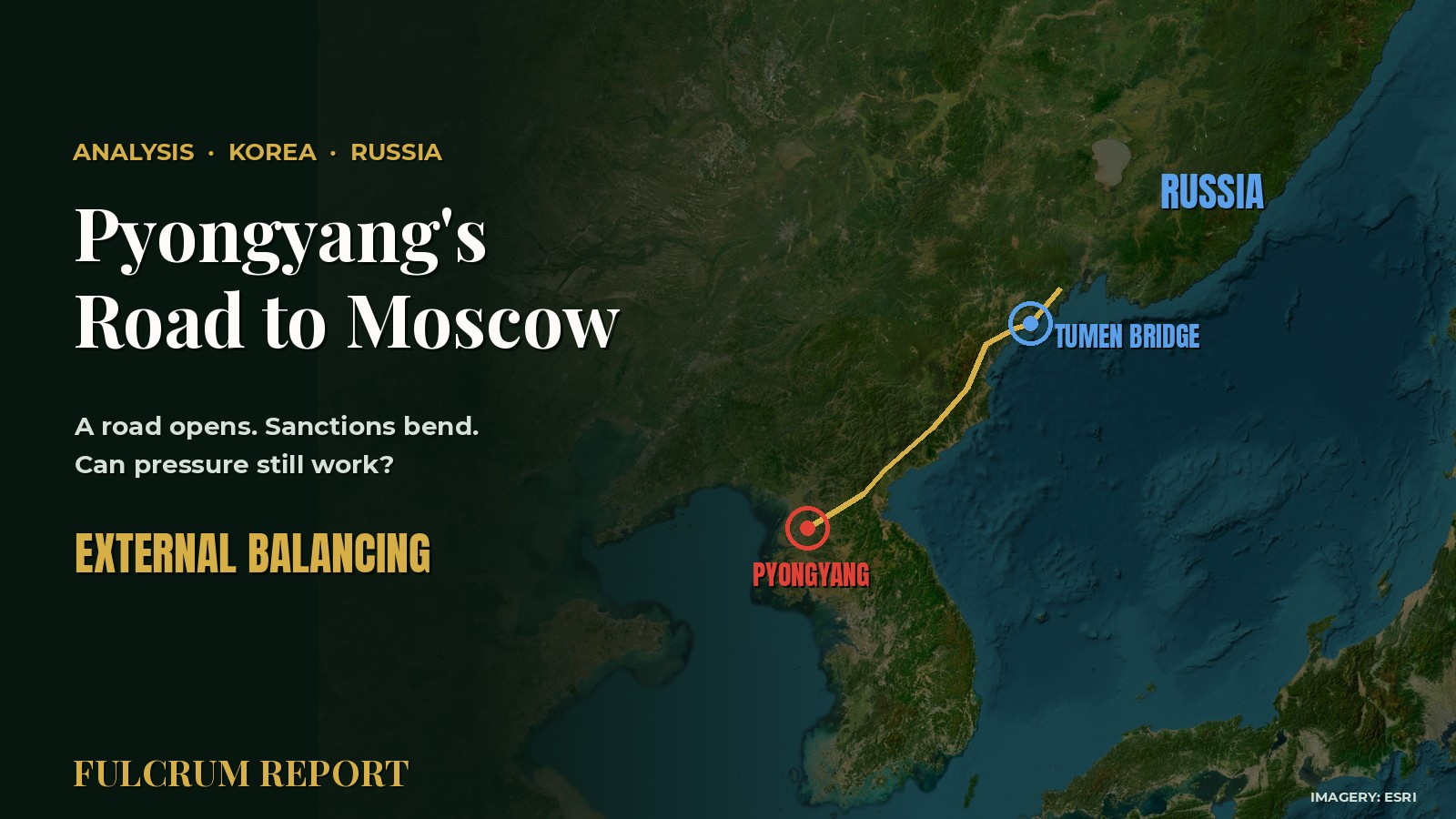
Pyongyang's Road to Moscow: Can Sanctions Still Work?
A second enrichment facility is reportedly going up at Yongbyon, and the Tumen River road bridge to Russia reportedly opened on September 8. When a major power offers a way around sanctions, how much pressure is left? An explainer on external balancing.

Takaichi's New Partner: Why Cabinet Seats Are a Trade
Sanae Takaichi reportedly reshuffled her cabinet on September 16 and 17, bringing in the Japan Innovation Party (Ishin) for the first time. Her camp holds two-thirds of the lower house but lacks an upper-house majority. A look at coalition bargaining and who gets the leverage.
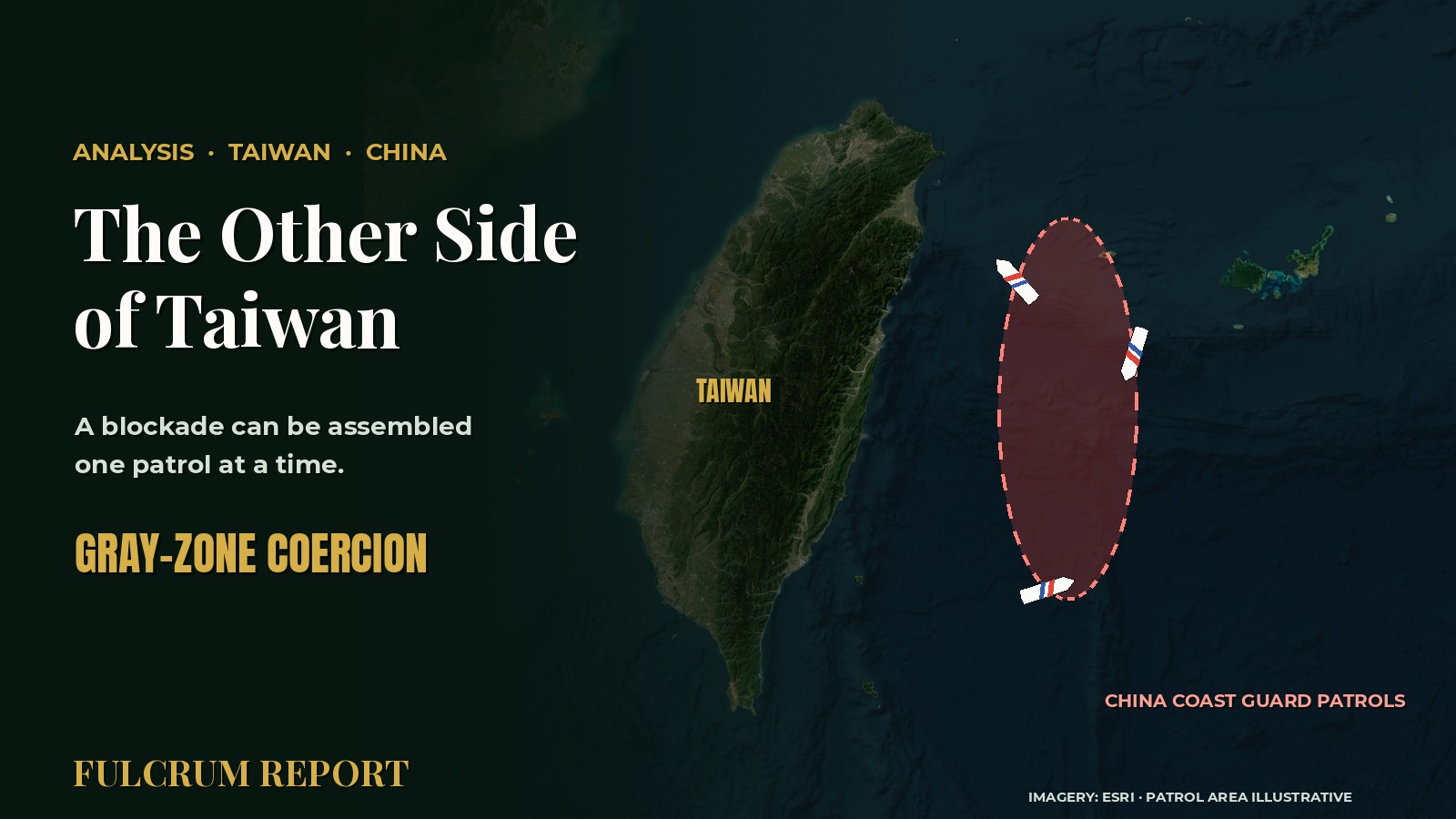
The Other Side of Taiwan: How a Blockade Gets Built Without Being Declared
China's Coast Guard has reportedly set up a regular presence east of Taiwan, framed as law enforcement, while a $14 billion U.S. arms package is pending. A look at gray-zone coercion, salami tactics and escalation control.