The Calmest Country on the Map Is Where It Breaks
Why Jordan—the region's quiet buffer—could become the Middle East's next fault line, and the forty-year-old theory that explains how.
If you want to guess where the next Middle East crisis begins, don't start with the country that's already burning. Start with the one everybody keeps calling stable. That's usually the one nobody is watching closely enough.
Right now that country is Jordan. It rarely leads a broadcast. It has no oil boom to gossip about, no dramatic revolution on the calendar, no strongman picking fights for the cameras. And that quiet is exactly what makes me nervous, because I've spent enough years reading this region to know that calm is often just pressure that hasn't found its crack yet.
## Look at the map before you argue with me
Start with geography, because geography is the part nobody gets to vote on. Jordan borders Israel, the West Bank, Syria, Iraq and Saudi Arabia. Sit with that list for a second. Almost every fault line that has defined the modern Middle East runs up against Jordanian territory. When something goes wrong next door—any door—Jordan is in the room.
Then layer on the internal picture. A large share of Jordan's population is of Palestinian origin, a majority by most counts, which means the Israeli-Palestinian question is not a foreign-policy file in Amman. It is a domestic one, tangled into identity and citizenship and the everyday politics of who belongs. On top of that, there are roughly four thousand U.S. troops stationed on Jordanian soil. Those bases are a sign of trust and a magnet for trouble in the same breath.
And the trouble has already arrived. Iran has struck bases in Jordan; an attack in the summer killed three. Unemployment hovers near sixteen percent, the kind of number that quietly corrodes patience. And from Israel's far right you keep hearing the old, incendiary line that "Jordan is Palestine"—a phrase that, to Jordanian ears, sounds less like commentary and more like a threat to the country's very existence.
None of these facts is secret. What's missing is the frame that ties them together.
## The idea that makes it click
The frame is buffer-state theory, and once you see it you can't unsee it. A buffer state is a country wedged between larger, rival powers, and its odd talent is absorbing pressure that those bigger players would rather manage from a distance than confront head-on. Jordan has played this role for decades. It takes in refugees. It keeps quiet channels open to enemies who won't talk to each other. It soaks up shocks so its neighbors and its patrons don't have to.
That is why Jordan looks stable. Not because it is insulated from the region's storms, but because it has been standing in the rain on everyone else's behalf. The stability is real, but it is earned the hard way, and it is conditional.
Here's the part I want you to hold onto. That whole arrangement rests on three bargains, and all three have to hold at the same time.
The first: public anger stays manageable. Jordanians can be furious about Gaza, about prices, about corruption, and the state can still contain it without the lid blowing off.
The second: the American relationship stays worth it. Hosting U.S. forces has to keep delivering more security than it invites danger—even now, with those bases sitting inside an active shooting range.
The third: the crises next door stay next door. Syria's collapse, the West Bank's tension, Iraq's militias—all of it has to remain on the other side of the border rather than spilling across it.
Notice how none of these is guaranteed, and how each one is under strain at this exact moment.
## When the shock-absorber becomes the conductor
This is the hinge of the whole thing, so let me say it plainly. A buffer state absorbs shocks—right up until it can't. The moment one of those three bargains fails, the country stops absorbing pressure and starts transmitting it. The shock-absorber becomes a conductor. And because Jordan touches so many fault lines at once, whatever passes through it doesn't stay contained. It travels.
That is the scenario worth losing sleep over. Not a dramatic invasion, not a single decisive event, but a quiet country reaching the limit of what it can quietly hold, and the pressure it had been swallowing suddenly finding somewhere to go.
There's a tidy phrase for governments and analysts who assume a stabilizing state will simply keep stabilizing forever: they treat it as permanent furniture rather than a load-bearing wall under stress. But a stabilizing domino is still a domino. It can hold the line for years and still fall—and when it does, it knocks into everything it was quietly propping up.
I'm not predicting Jordan collapses tomorrow. Buffer states are tougher than they look; that toughness is the whole job. What I am saying is that "stable" is a description of this moment, not a promise about the next one, and that the smart move is to watch the calm country precisely because it's calm. The loud crises will always find you. It's the quiet one, doing the invisible work of holding the region together, that you have to keep your eye on—because that's where it breaks.

About the author
Fulcrum Report
Independent Middle East analyst holding a PhD in Political Science. Fulcrum Report offers rigorous, framework-driven coverage of politics and geopolitics across the Levant and the wider region — analysis without agenda.
Related reading
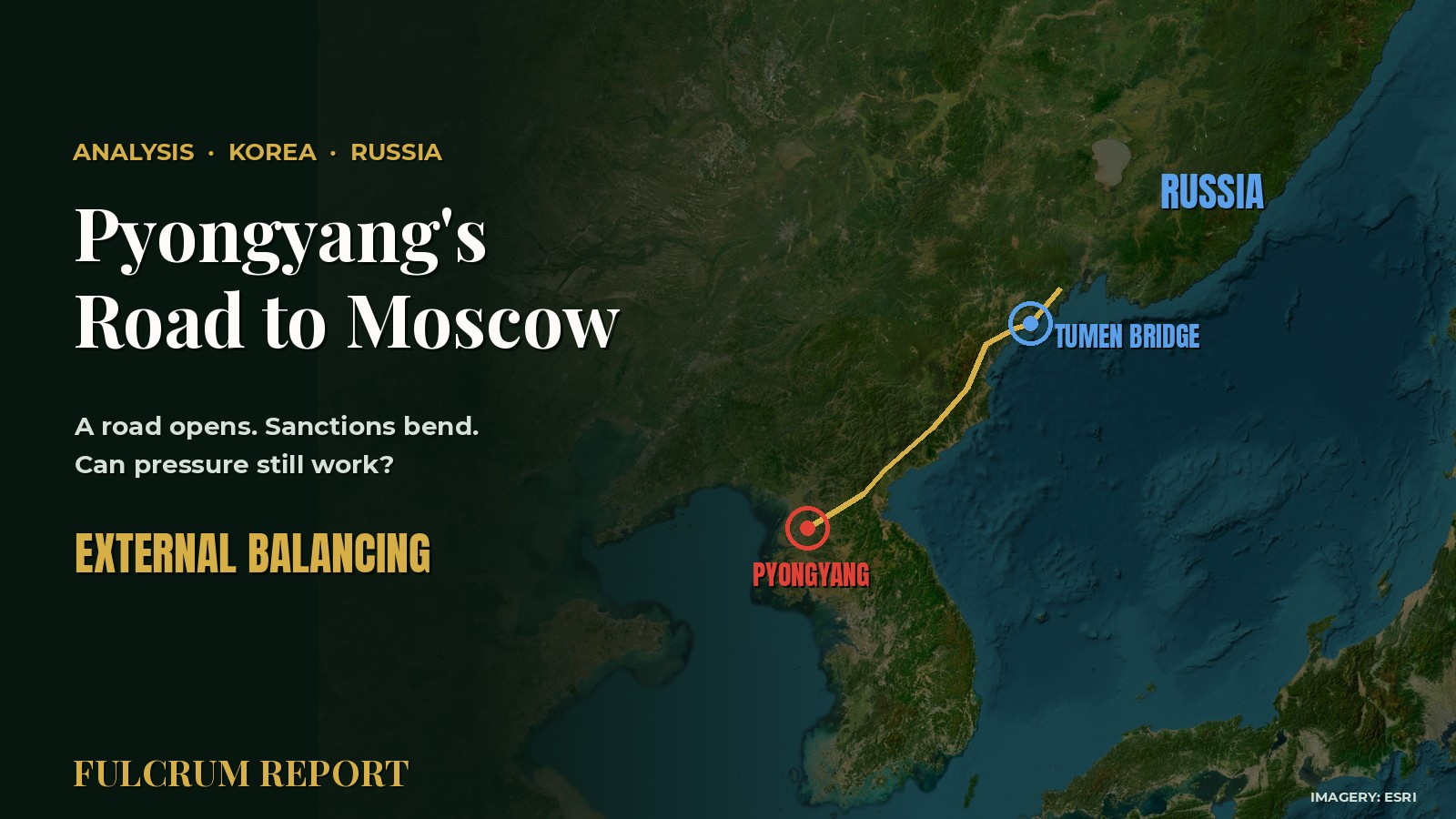
Pyongyang's Road to Moscow: Can Sanctions Still Work?
A second enrichment facility is reportedly going up at Yongbyon, and the Tumen River road bridge to Russia reportedly opened on September 8. When a major power offers a way around sanctions, how much pressure is left? An explainer on external balancing.
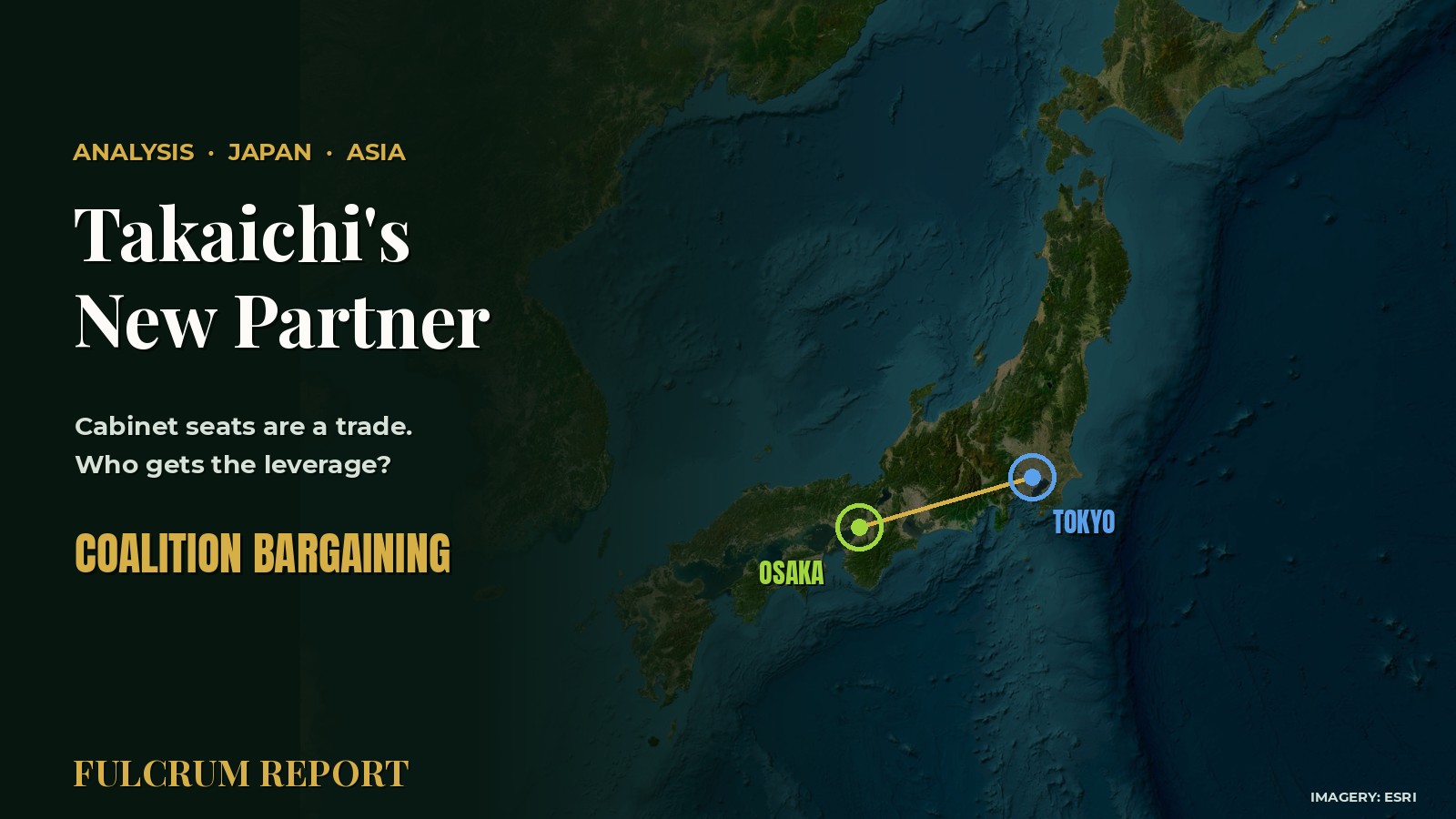
Takaichi's New Partner: Why Cabinet Seats Are a Trade
Sanae Takaichi reportedly reshuffled her cabinet on September 16 and 17, bringing in the Japan Innovation Party (Ishin) for the first time. Her camp holds two-thirds of the lower house but lacks an upper-house majority. A look at coalition bargaining and who gets the leverage.
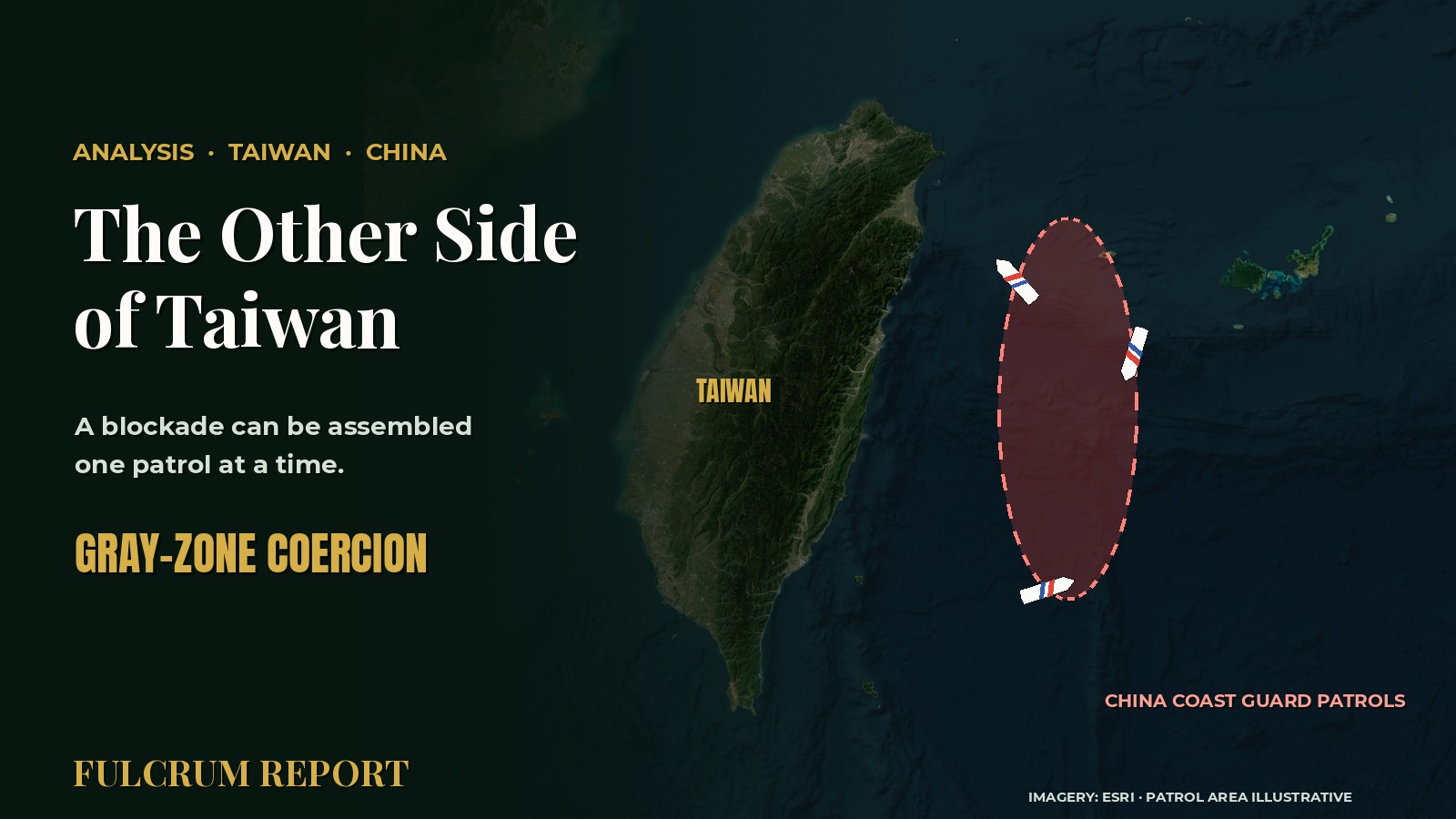
The Other Side of Taiwan: How a Blockade Gets Built Without Being Declared
China's Coast Guard has reportedly set up a regular presence east of Taiwan, framed as law enforcement, while a $14 billion U.S. arms package is pending. A look at gray-zone coercion, salami tactics and escalation control.