Only the State Gets Guns
Lebanon's leaders want a state monopoly on arms. Max Weber's definition of the state explains why that matters, and why it will come down to a bargain.
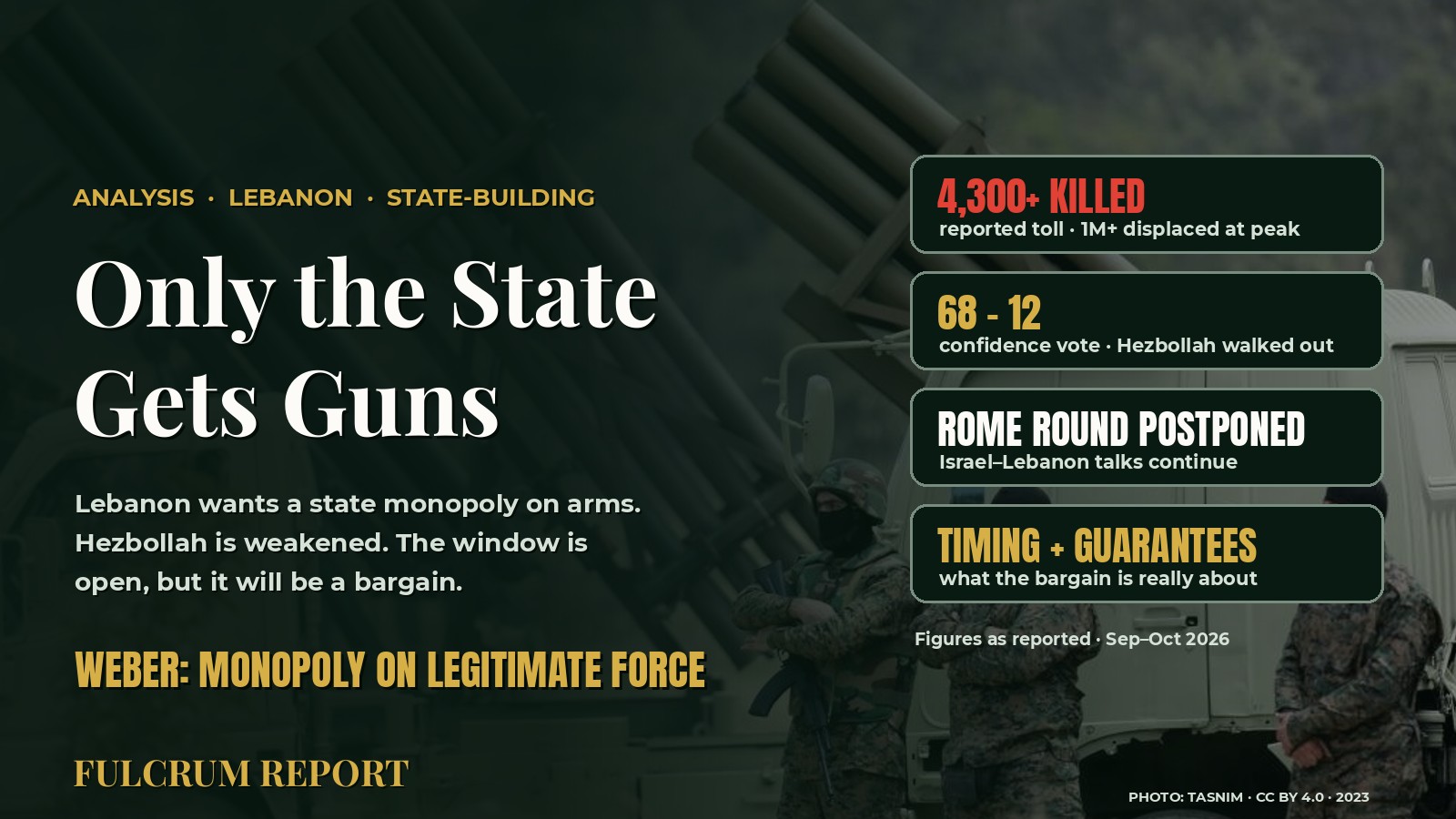
Lebanon's government is telling Hezbollah something that would have been almost unsayable a few years ago: only the state gets weapons.
I've followed Lebanese politics for a long time, and I still did a double take when I saw how plainly the country's leaders are now putting it. So let me walk through what's happening, and then why I think one old idea from political science explains the stakes better than anything else.
Where things stand
Lebanon is coming out of a war that, by reported counts, has killed more than 4,300 people and displaced over a million at its peak. Casualty figures vary by source, so treat those as reported numbers rather than final ones. Either way, the damage is enormous for a country of Lebanon's size.
Out of that, President Joseph Aoun and Prime Minister Nawaf Salam are pushing for what they call a state monopoly on arms. In plain terms: the Lebanese Army, and nobody else, holds the guns.
That position was tested in parliament. On September 16, Salam's government survived a confidence vote, 68 in favor, 12 against, with 2 abstentions. Hezbollah's MPs walked out rather than take part. Its ally Amal, notably, voted yes.
At the same time, US-mediated talks on an Israel–Lebanon framework are still going. The round that was supposed to take place in Rome was postponed, but the talks themselves haven't collapsed. The framework that came out in June lays out a gradual Israeli withdrawal, Hezbollah's disarmament, and a bigger role for the Lebanese Army in the south. The area south of the Litani River, near the border with Israel, is where the army has been taking over positions.
Hezbollah hasn't simply said no. Its line is that it accepts the principle, as long as its weapons are folded into what it calls a "national defense strategy." That phrase is doing a lot of work, and much of the next year will turn on what it ends up meaning.
The one idea that explains it
Here's where I switch from reporting to analysis.
In 1919, the German sociologist Max Weber gave a lecture called "Politics as a Vocation." In it, he defined the state as the body that successfully claims a monopoly on the legitimate use of force within a territory. It's probably the most quoted definition in all of political science, and it's the first thing I think of when I look at Lebanon.
By Weber's standard, Lebanon has never fully had one. When the civil war ended with the Taif Agreement in 1989, the country's militias were supposed to hand over their weapons, and most did. Hezbollah kept its arsenal, on the grounds that it was resisting Israel's occupation of the south. Israel withdrew in 2000, and the arsenal stayed. For decades, Lebanon has had a national army and, alongside it, an armed movement that was in many ways stronger.
So when Aoun and Salam talk about a monopoly on arms, they're not making a technical security point. They're talking about what kind of country Lebanon is.
Why the window is open now
The window for this kind of change tends to open when an armed group has been weakened, and the state still has enough leverage to press it to disarm. Neither half is enough on its own. A strong armed group can just refuse. A state with no leverage can't make the demand stick.
Lebanon seems to be in that narrow space right now. Hezbollah has taken heavy losses. The state has international backing and a government that just showed it can survive a vote without Hezbollah in the room.
But no one should expect a clean handover. Disarming an armed movement by force is costly, and in Lebanon it could reopen old wounds. My read is that this becomes a bargain, and the two things being bargained over are timing and guarantees.
Timing is about how fast, in what order, and who moves first. Does Hezbollah give up heavy weapons before Israel withdraws, or after? Guarantees are about protection. Who protects the communities that have long counted on Hezbollah for security, and who guarantees that the army can actually hold the border once it's in charge?
Every serious disarmament deal I've studied comes down to those two questions. Lebanon's will too.
What I'm watching
I'm watching three things. First, whether the postponed Rome round happens, and whether it produces anything concrete on withdrawal timelines. Second, whether Hezbollah's "national strategy" language turns into a real plan or stays a way to delay. Third, whether the army keeps expanding beyond the area south of the Litani.
The bigger picture is this. Lebanon isn't just trying to end a war. It's trying to become a full state, in Weber's sense of the word, for the first time in its modern history. That's a much harder thing to pull off, and it's why I think this is one of the most important stories in the region right now.
So I'll put the question to you: can it happen? Yes or no? Tell me why in the comments on the reel, and follow @fulcrumreport for more analysis without agenda.

About the author
Fulcrum Report
Independent Middle East analyst holding a PhD in Political Science. Fulcrum Report offers rigorous, framework-driven coverage of politics and geopolitics across the Levant and the wider region — analysis without agenda.
Related reading
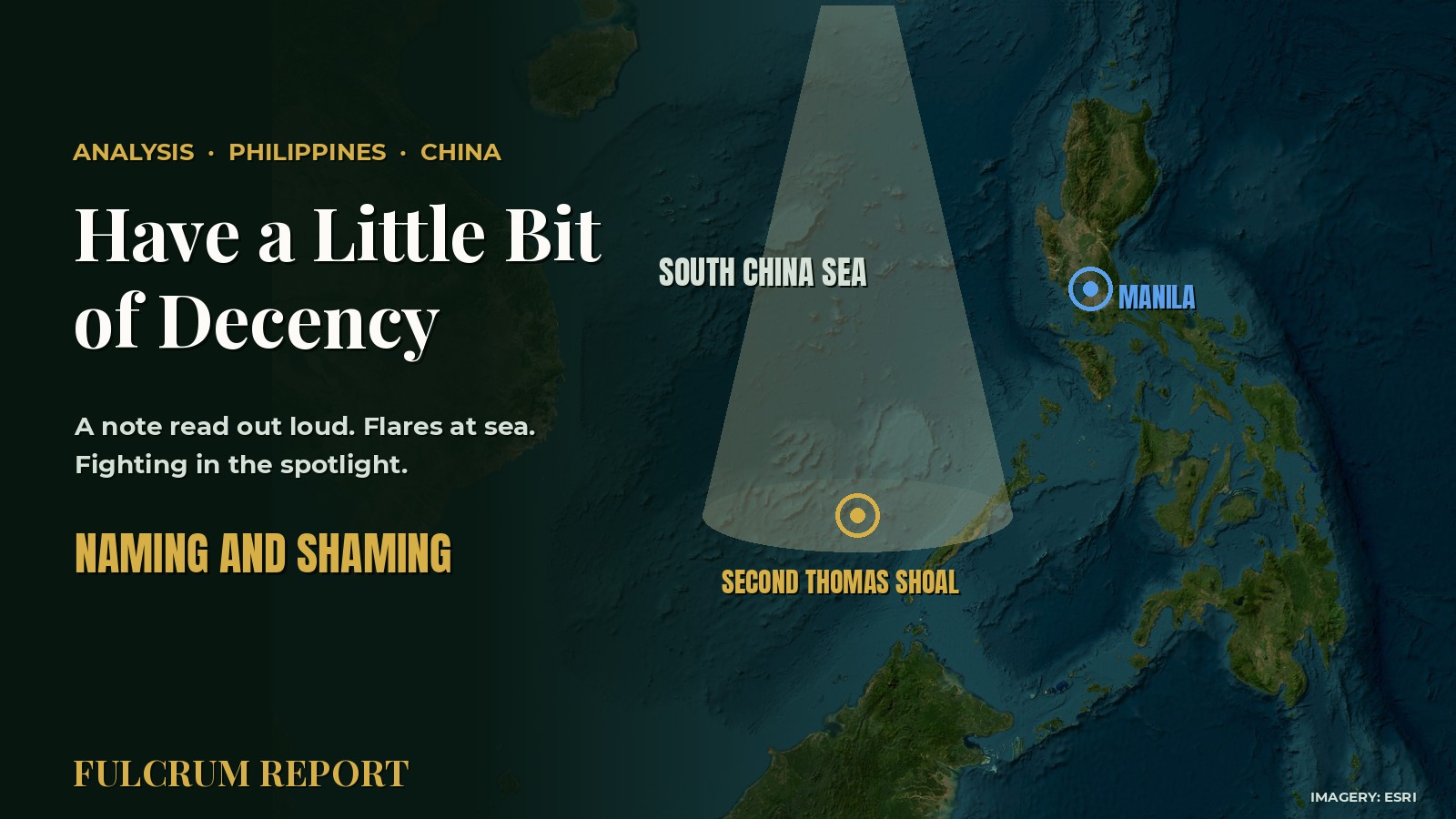
Have a Little Bit of Decency: Why Manila Fights in the Spotlight
At the Seoul Defense Dialogue, Gilberto Teodoro reportedly read a Chinese attaché’s note in public. Weeks later, flares were reportedly fired at a Philippine aircraft near Second Thomas Shoal. When you can’t win at sea, can visibility give you leverage? An explainer on naming and shaming.
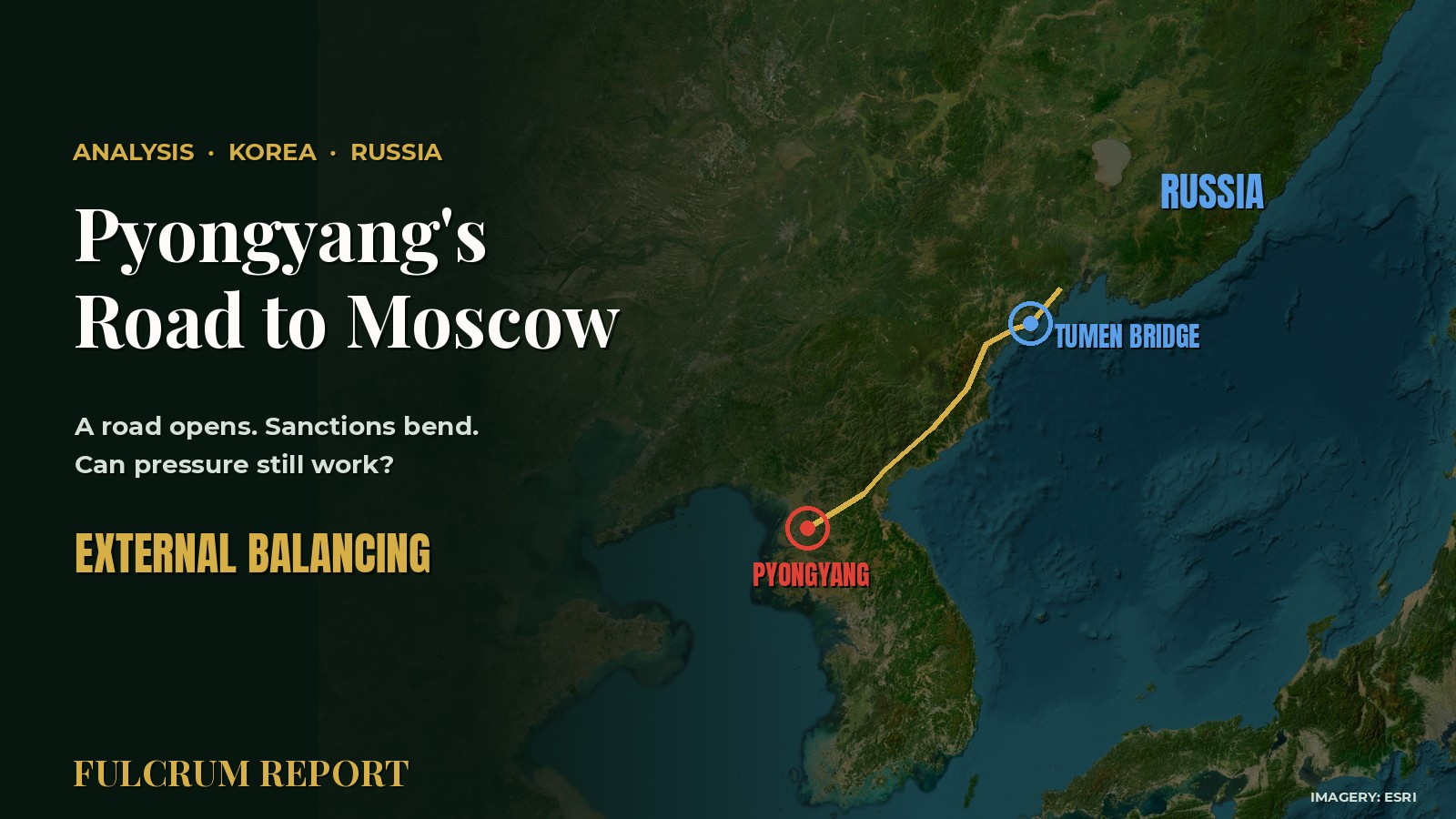
Pyongyang's Road to Moscow: Can Sanctions Still Work?
A second enrichment facility is reportedly going up at Yongbyon, and the Tumen River road bridge to Russia reportedly opened on September 8. When a major power offers a way around sanctions, how much pressure is left? An explainer on external balancing.
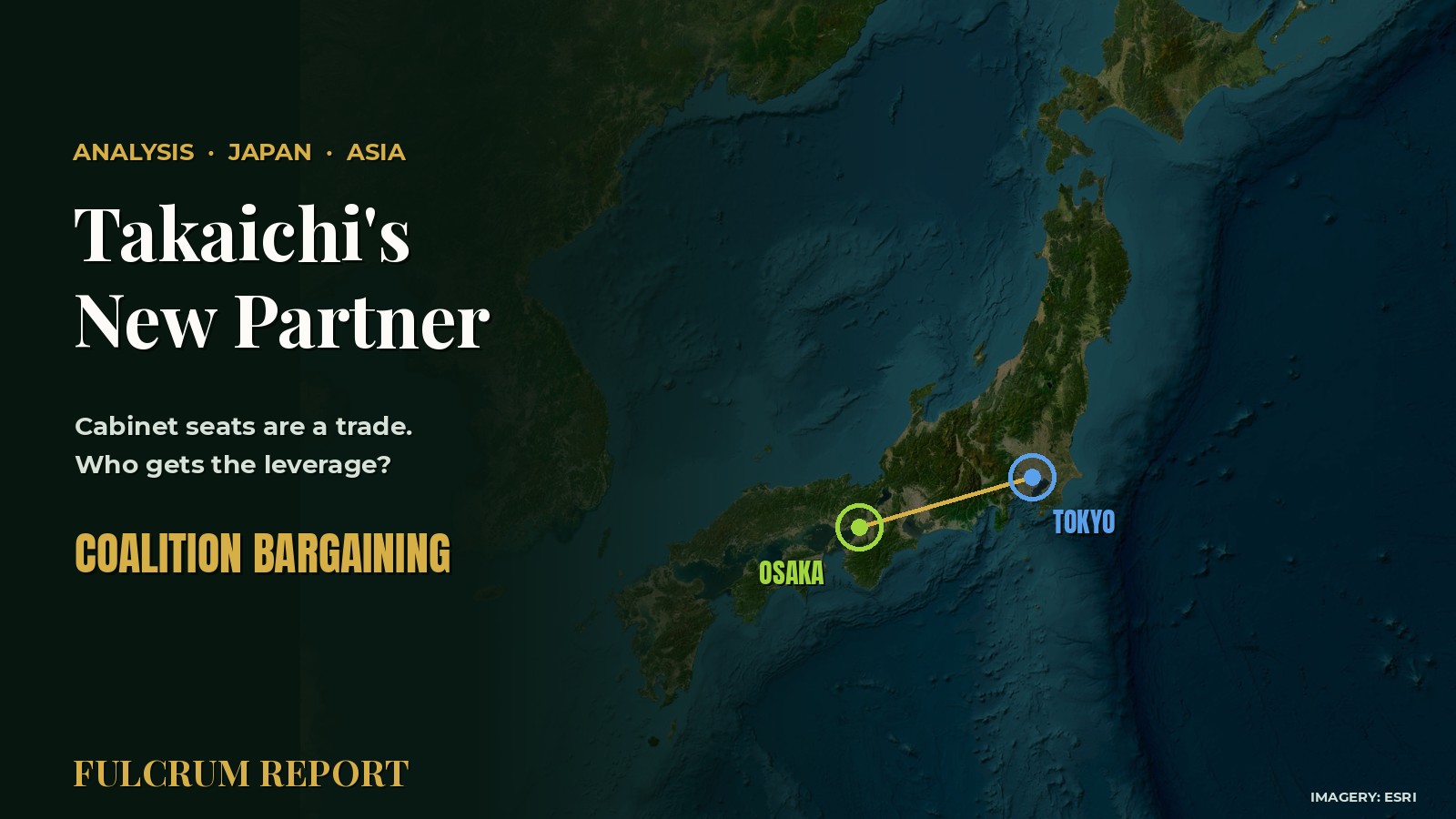
Takaichi's New Partner: Why Cabinet Seats Are a Trade
Sanae Takaichi reportedly reshuffled her cabinet on September 16 and 17, bringing in the Japan Innovation Party (Ishin) for the first time. Her camp holds two-thirds of the lower house but lacks an upper-house majority. A look at coalition bargaining and who gets the leverage.