Pomp Over Progress: What Xi's Washington Visit Actually Bought
A red carpet, a two-month truce and an AI hotline. Why the summit was a pause, not a reset, and how managed rivalry explains it.
Xi Jinping got everything a state visit can offer in Washington. The arrival ceremony, the honor guard, the banquet, the photos on the South Lawn. Then you read what actually came out of it, and the list is a lot shorter than the guest list.
My first reaction was that this was pomp over progress. After thinking about it for a few days, I'd put it a bit differently. The pomp was the point, and the small results tell you exactly what both sides are trying to do.
What came out of it
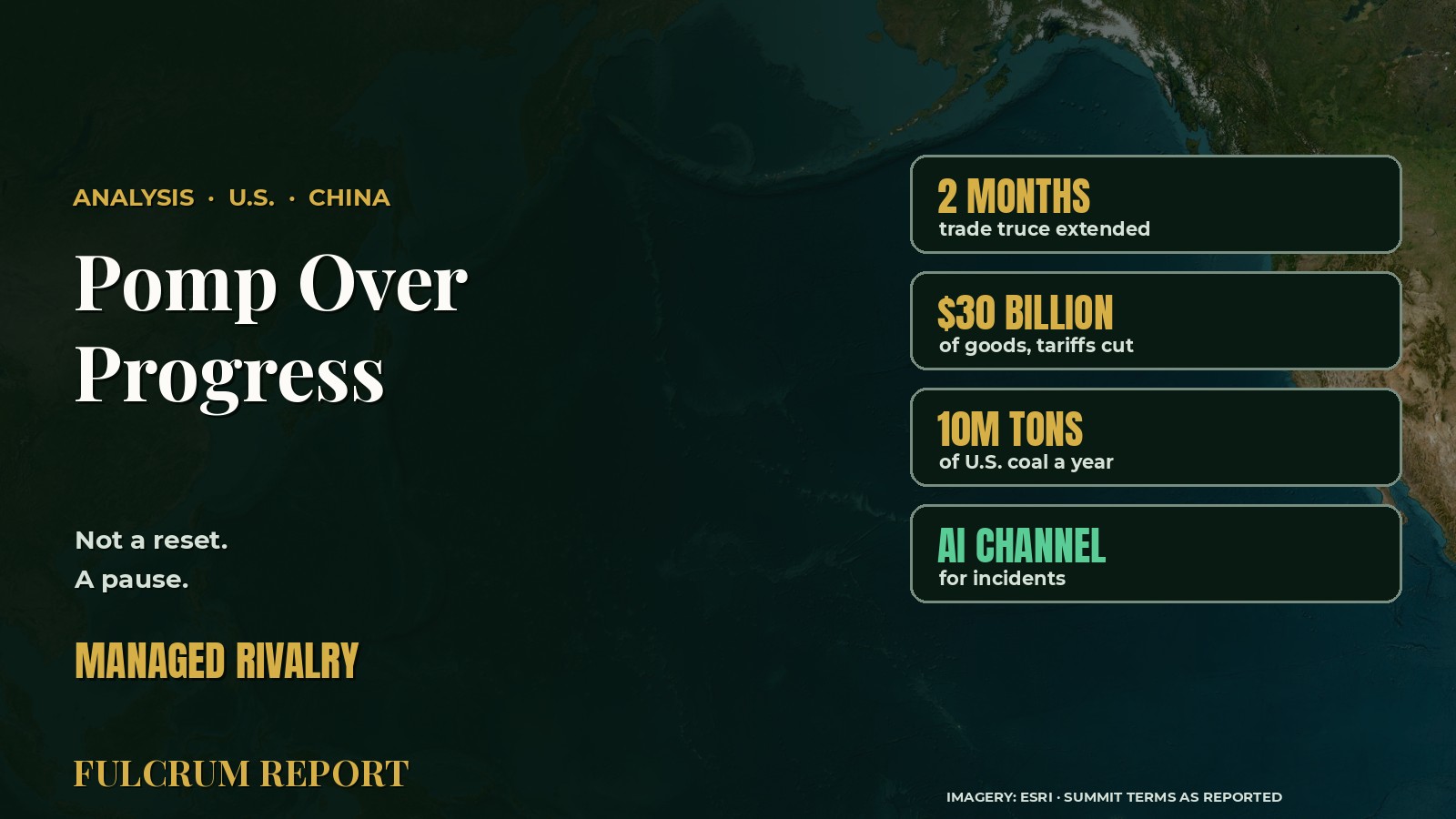
Here's what has been reported so far. The trade truce between the two countries was extended, but only by two months. Tariffs were cut on about $30 billion worth of goods. China agreed to buy 10 million tons of American coal a year. And the two governments set up a channel for handling incidents involving artificial intelligence.
Then there's what didn't come out of it. Taiwan wasn't mentioned in either side's official readout. That doesn't mean it didn't come up. According to reports, Xi pressed Washington to say it opposes Taiwanese independence, which is stronger wording than the U.S. has traditionally used. Washington's long-standing line is that it doesn't support independence, and the gap between those two verbs has been fought over for decades.
A caveat before going further: summit readouts are written to be vague, and some of these details may shift once the fine print is out. I'm treating all of the numbers above as reported, not confirmed.
Two months is a strange number
The detail that stuck with me most was the length of the truce. Two months is barely enough time for negotiators to book their next flights. If either side wanted a real trade settlement, they'd have pushed for something longer. If either side wanted a trade war, they wouldn't have extended it at all.
A short extension sits in the middle. It keeps tariffs from snapping back right away, which calms markets and businesses on both sides. But it also keeps the pressure on. Neither government has to give up the threat of new tariffs, because the deadline is always close. That's leverage you keep in your pocket, not leverage you trade away.
The idea in the reel
The concept I used to explain all of this is managed rivalry. The basic premise is simple. Neither Washington nor Beijing expects the competition between them to end. They disagree about trade, technology, Taiwan and who sets the rules in Asia, and none of that is going away. So instead of trying to fix the relationship, the goal becomes keeping it from spinning out of control.
Kevin Rudd, the former Australian prime minister who has spent a career studying China, made this argument at length in his 2022 book The Avoidable War. He called it managed strategic competition. His point was that the U.S. and China could compete hard while agreeing on a few guardrails, mainly ways of communicating and some shared red lines, so that the competition doesn't accidentally turn into a war neither of them wants.
Read with that lens, the summit makes more sense. The short truce is a guardrail on the economic side. It gives both governments breathing room without forcing either one to give up much. The AI channel is a guardrail on the security side.
Why a hotline matters
The AI incident channel is the part I'd watch most closely, because it fits a long pattern.
In October 1962, during the Cuban Missile Crisis, messages between Washington and Moscow took hours to deliver. Some went through embassies and couriers. Both sides came away rattled by how close they'd come to war partly because they couldn't talk fast enough. The following June, they signed an agreement setting up a direct link, the hotline people still picture as a red phone, although it was actually a teletype.
A decade later, in 1972, the two superpowers signed the Incidents at Sea Agreement, which set rules for how their navies would behave when ships and planes got close to each other. Neither of these agreements ended the Cold War. They were never meant to. They were meant to stop small accidents from turning into big crises.
The U.S. and China have tried versions of this before. There's been a defense telephone link since 2008. In November 2024, Joe Biden and Xi agreed that humans, not AI, should keep control over decisions to use nuclear weapons. An AI incident channel is the next step in the same direction. If an AI system does something unexpected, whether in cyberspace, in finance or near military hardware, there's at least a line to call before anyone assumes the worst.
The weakness of any hotline is that someone has to pick up. In February 2023, during the Chinese balloon episode, the Pentagon said Beijing declined a call from the U.S. defense secretary. A channel on paper isn't the same as a channel that works under pressure. We'll only know which one this is the first time something goes wrong.
What I'd still watch
I don't want to oversell any of this. The rivalry is just as real as it was before the visit. Export controls on advanced chips are still in place. The disagreement over Taiwan is still there, and the reported push on the word oppose suggests Beijing sees this as a moment to test how far Washington will bend. Coal purchases and tariff cuts can be reversed with a phone call.
The honest summary is that the summit didn't solve the rivalry. It made the rivalry easier to manage. That's less exciting than a breakthrough, but in a relationship this big, it isn't nothing.
What comes next
This wasn't a reset. It was a pause. The next real test comes at the APEC summit in Shenzhen in November, when the two-month truce will be close to expiring. If the truce gets extended again, or turned into something longer, that's a sign the guardrails are holding. If it lapses, we'll know the pause was just that.
I asked in the reel whether you see this as a reset or a pause, and I'd genuinely like to hear your read on the summit.
Further reading: Kevin Rudd, The Avoidable War: The Dangers of a Catastrophic Conflict between the US and Xi Jinping's China (2022); the U.S.-Soviet Memorandum of Understanding establishing a direct communications link (June 20, 1963); the U.S.-Soviet Agreement on the Prevention of Incidents On and Over the High Seas (1972); the White House readout of the Biden-Xi meeting in Lima (November 2024).

About the author
Fulcrum Report
Independent Middle East analyst holding a PhD in Political Science. Fulcrum Report offers rigorous, framework-driven coverage of politics and geopolitics across the Levant and the wider region — analysis without agenda.
Related reading
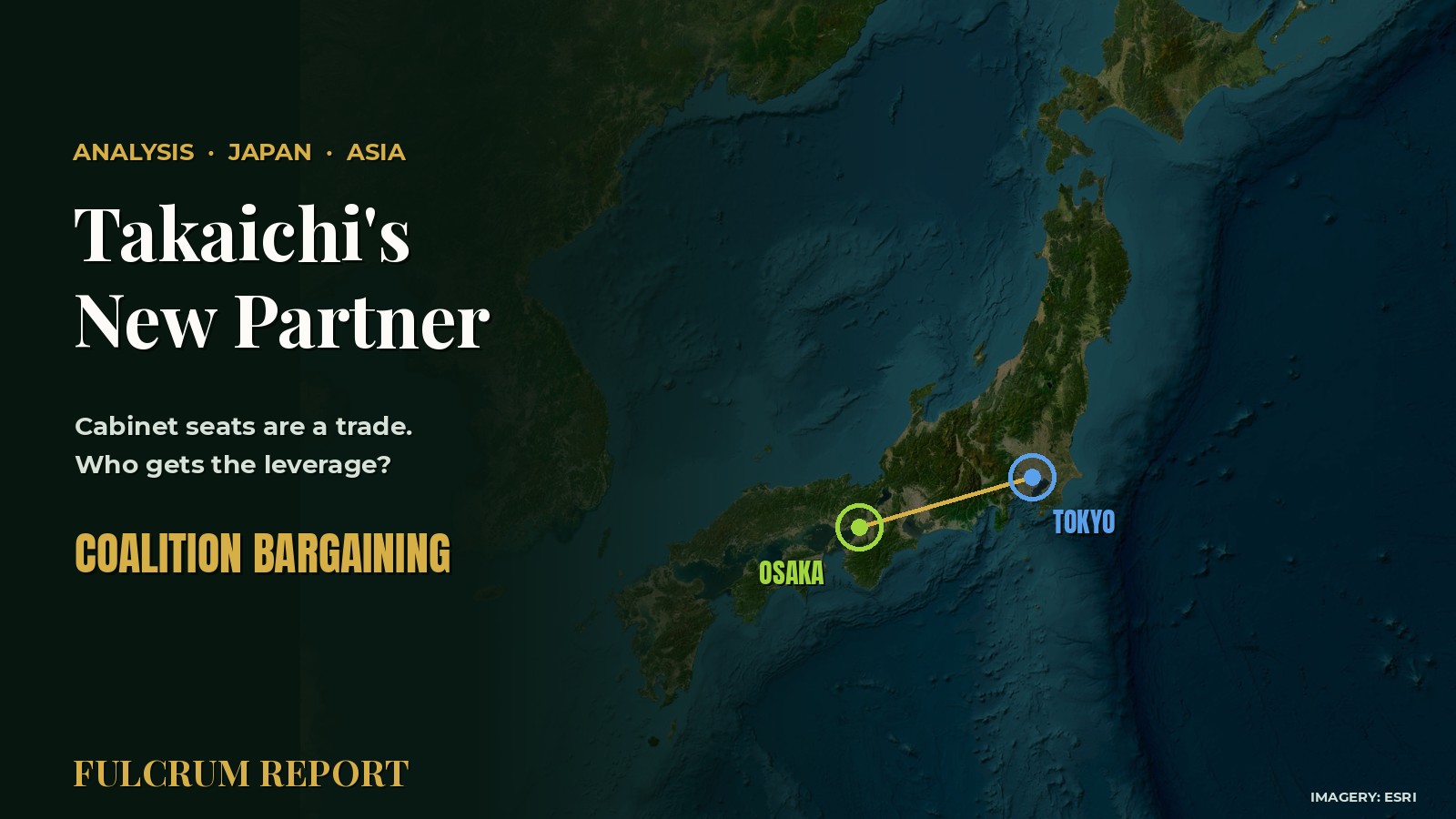
Takaichi's New Partner: Why Cabinet Seats Are a Trade
Sanae Takaichi reportedly reshuffled her cabinet on September 16 and 17, bringing in the Japan Innovation Party (Ishin) for the first time. Her camp holds two-thirds of the lower house but lacks an upper-house majority. A look at coalition bargaining and who gets the leverage.
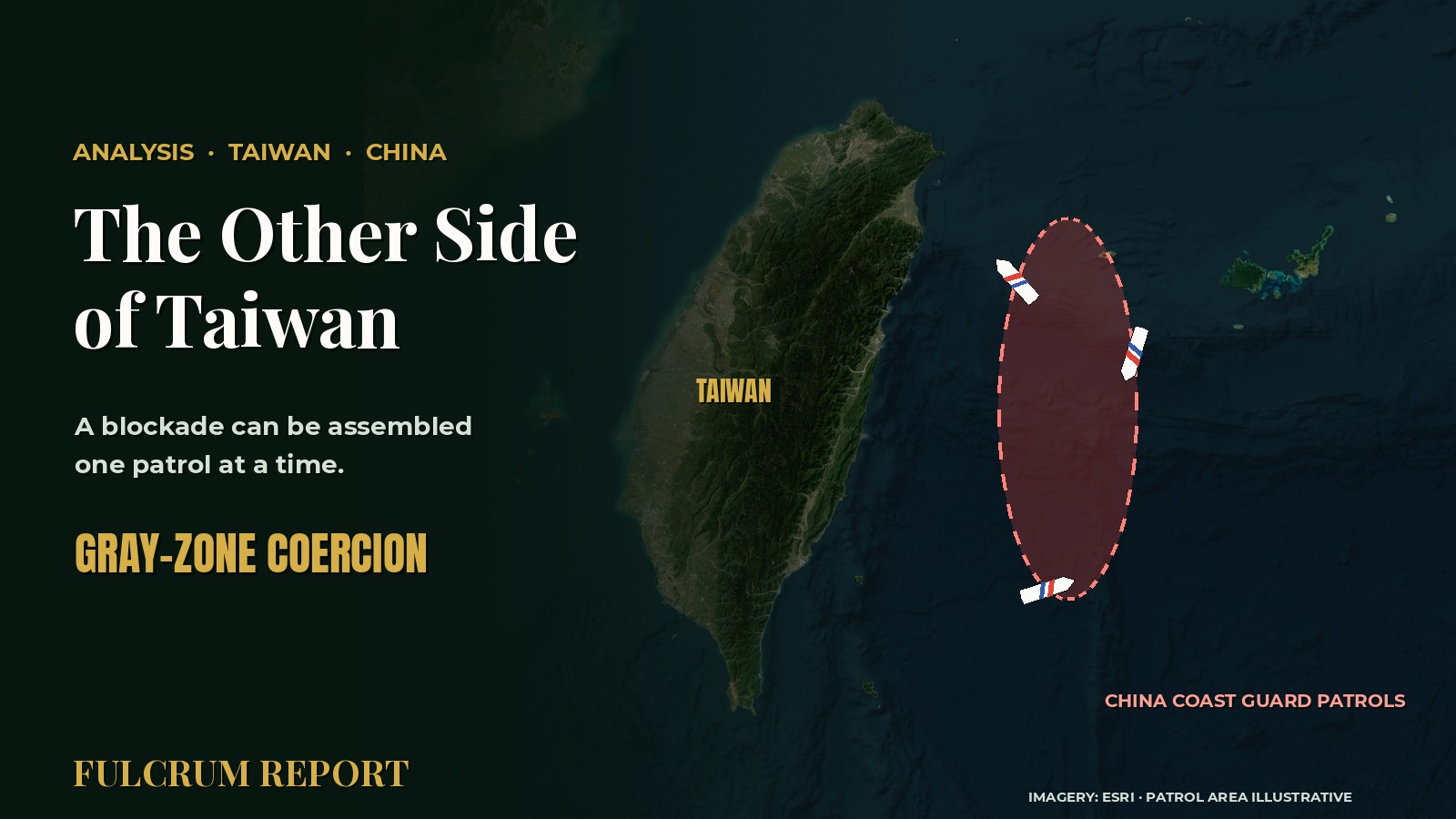
The Other Side of Taiwan: How a Blockade Gets Built Without Being Declared
China's Coast Guard has reportedly set up a regular presence east of Taiwan, framed as law enforcement, while a $14 billion U.S. arms package is pending. A look at gray-zone coercion, salami tactics and escalation control.

The Last Gate Jesus Walked Through?
The Threshold of the Judgment Gate, the "Eye of the Needle" and Constantine’s lost front door, inside Jerusalem’s Alexander Nevsky Church.