How a Drone in the Red Sea Reaches Your Mortgage
A strike in a distant strait and a higher payment in an American suburb are the same event seen from opposite ends of a chain. Here is the chain, link by link.
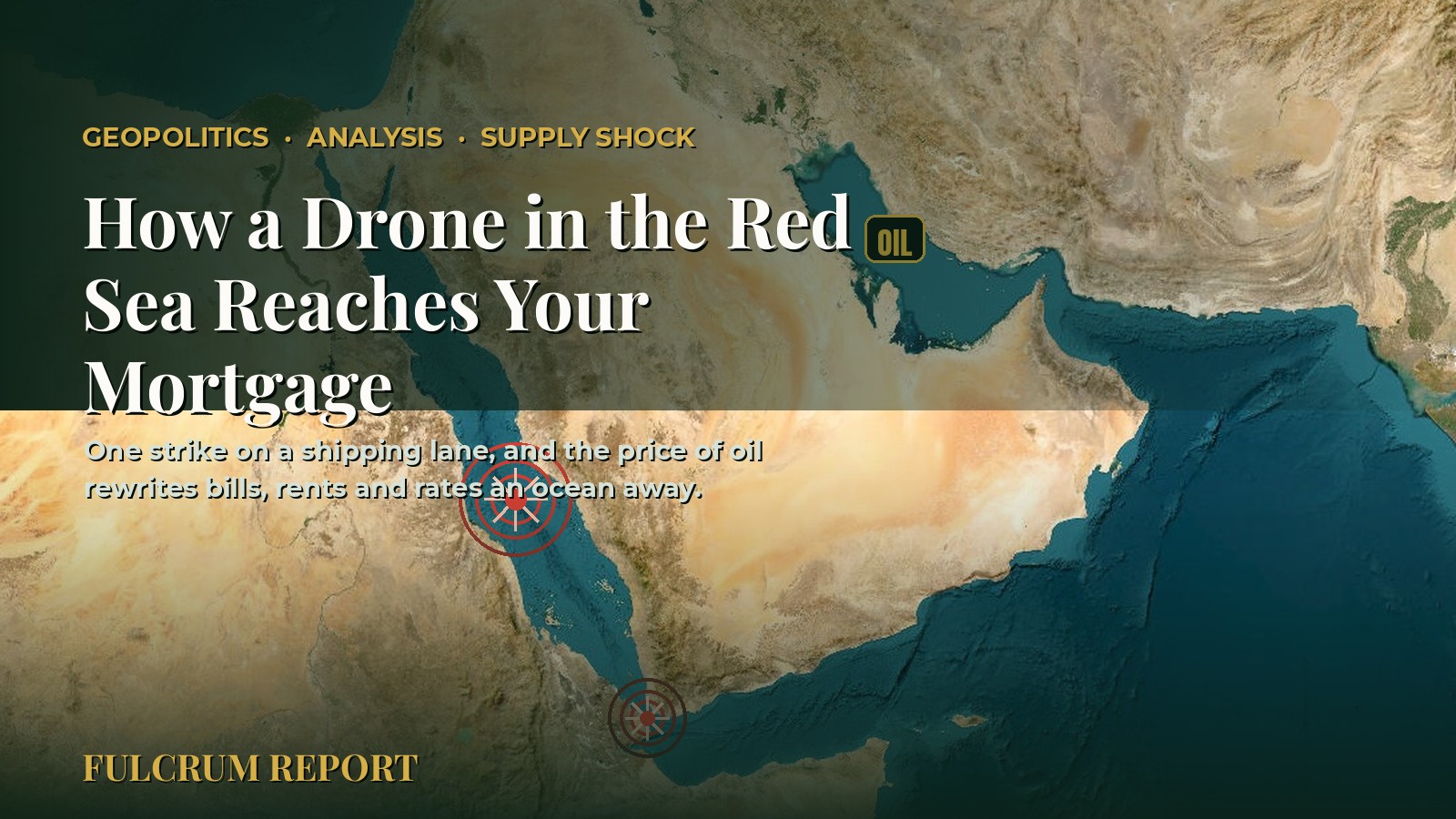
A drone hits a tanker in the Red Sea. You are eight thousand miles away, standing in your kitchen, and a few months later the number on your mortgage renewal is higher than you budgeted for. Those two facts feel unrelated — one is a headline about a war, the other is a line item in your life. They are not unrelated. They are the same event, seen from opposite ends of a chain, and once you can see the chain you cannot unsee it.
I want to walk that chain link by link, because the distance between a strike in a distant strait and a payment in an American suburb is where most people lose the thread. It is not magic and it is not a metaphor. It is plumbing.
## It starts at a chokepoint
Begin with geography, because geography is doing most of the work here. A huge share of the world's oil and manufactured goods moves through a handful of narrow passages, and two of them sit right next to each other at the bottom of the Middle East: the Strait of Hormuz, the mouth of the Persian Gulf, and the Bab el-Mandeb, the gate at the southern end of the Red Sea that feeds into the Suez Canal. Squeeze either one and you are not inconveniencing a shipping company. You are pinching a valve that the whole global economy breathes through.
Right now both valves are under pressure at once. Attacks in the Red Sea and the constant threat around Hormuz have made those waters something ships no longer trust. And when a captain cannot trust a route, the cargo does not stop moving — it just moves the hard way.
## The long way around Africa
The hard way is the Cape of Good Hope. Instead of slipping through the Red Sea and up the Suez, a vessel bound for Europe now sails all the way down and around the southern tip of Africa. That detour adds something like three to four thousand nautical miles and roughly ten days to two weeks to the trip. Ten to fourteen days of extra fuel, extra crew wages, extra everything.
Put a number on it and the abstraction disappears. The rerouting adds on the order of two to two and a half million dollars to a single voyage. Not a year of voyages — one. A ship burns hundreds of extra tons of fuel, its insurance premium spikes because underwriters price war risk into every mile near the strait, and because each ship now completes fewer trips per year, the effective capacity of the entire global fleet shrinks. Fewer available ships chasing the same cargo means the price of moving anything by sea goes up for everyone, even goods that never went near the Red Sea. That is the first quiet cruelty of a chokepoint: the cost does not stay with the ships that got rerouted. It spreads.
## Oil is not just fuel
Here is the part I think people genuinely underestimate, and it is the heart of what economists call supply-shock transmission. When the price of oil climbs — and it has, hovering around a hundred dollars a barrel, roughly a quarter above where it sat before this war — we picture the gas pump. The pump is the least of it.
Oil is not a product you buy at the end of a process. It is an ingredient at the beginning of almost every process. It is the diesel in the tractor that plants and harvests your food, and the feedstock in the fertilizer that makes the field yield anything at all. It is the raw material in plastics, which means it is in packaging, in medical supplies, in the housing of nearly every device you own. It is the energy that runs the factory and the fuel that moves the finished product from that factory to the shelf. Trace almost anything in your house backward and you will hit petroleum somewhere along the line, usually in several places at once.
So when oil gets more expensive, the cost does not rise in one place. It rises in a thousand places simultaneously, a little at each one, and those little increases stack on top of each other as a product moves from raw material to farm to factory to truck to store. By the time it reaches you, the strike in the Red Sea has been baked into the price of bread, the price of a phone case, the price of getting a package to your door. That is transmission: one shock at the source, radiating outward through every input it touches, arriving at your wallet as a general rise in the cost of living rather than a single obvious bill.
## Then it gets worse: stagflation
If the story ended at higher prices, it would be painful but simple. It does not end there, and the reason is a word that gives economists nightmares: stagflation.
Normally, when prices rise it is because the economy is running hot — people are spending, demand is strong, growth is up. That kind of inflation is uncomfortable but it comes with a healthy economy underneath it. A supply shock does something crueler. It pushes prices up while pushing growth down at the same time. Everything costs more, but businesses are getting squeezed by those same higher costs, so they hire less and invest less, and the economy slows even as the price tags climb. Prices up, growth down, together. That combination is stagflation, and it is genuinely hard to fix.
## The trap the central banks are in
This is where the chain reaches its final, decisive link — the one that actually touches your mortgage — and it runs through the people whose entire job is to manage inflation: the central banks.
A central bank has essentially one powerful lever, the interest rate, and in a stagflation it faces two problems that lever cannot solve at the same time. Raise rates to fight the inflation, and you make borrowing more expensive across the whole economy, which cools spending and investment and risks tipping a slowing economy into an outright recession. Cut rates to protect growth, and you pour cheaper money into an economy where prices are already rising, and you risk letting inflation run away from you entirely. Fight the inflation, break the growth. Protect the growth, feed the inflation. There is no clean move. Whichever way they turn, someone pays.
And notice what raising rates — the more likely response when inflation is the louder problem — actually does. The interest rate the central bank sets ripples out into the rate on government bonds, and the rate on long-term government bonds is the benchmark that mortgage rates are built on top of. So the central bank, cornered by a supply shock it did not cause and cannot cure with its tools, keeps rates high to hold the line on prices, bond yields stay elevated, and the cost of a home loan climbs right along with them. That is the last link. That is how a drone in the Red Sea ends up in the number on your renewal.
## Distant wars aren't distant anymore
I keep coming back to that phrase because it is the whole point. We are trained to file foreign conflict under "news from over there" — tragic, important, but happening to other people in other places. The machinery of a connected economy quietly erases the "over there." A tanker rerouted off the coast of Yemen, an oil price set in a market that never sleeps, an interest rate decision made in a marble building, a mortgage payment in an ordinary house: those are not four separate stories. They are one chain, and you are standing on the last link of it.
Understanding that does not lower your payment. But it does something almost as useful — it lets you read the map on the news as a forecast of your own budget, instead of as somebody else's war. Watch the chokepoints. The rest of the chain follows.

About the author
Fulcrum Report
Independent Middle East analyst holding a PhD in Political Science. Fulcrum Report offers rigorous, framework-driven coverage of politics and geopolitics across the Levant and the wider region — analysis without agenda.
Related reading
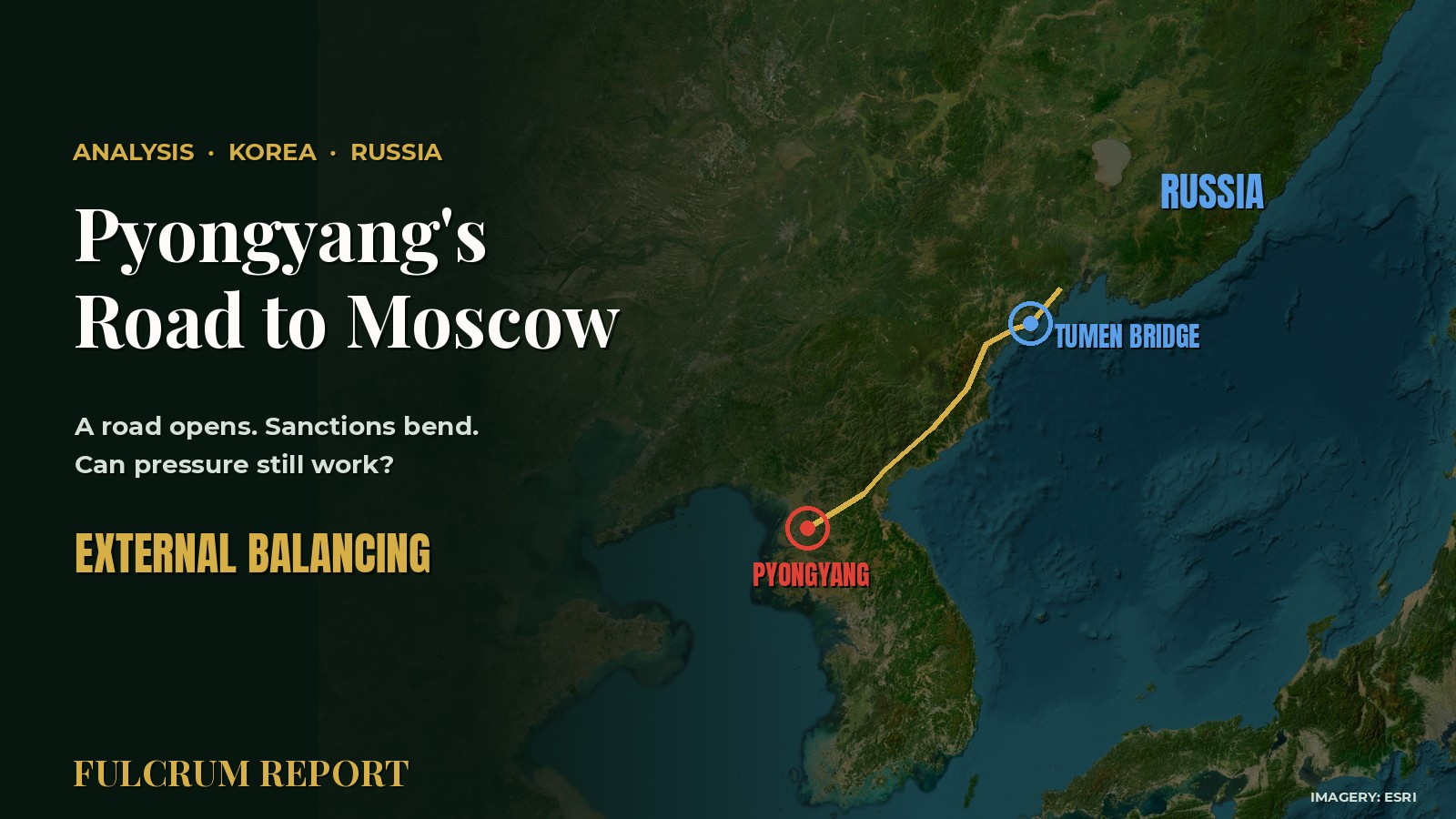
Pyongyang's Road to Moscow: Can Sanctions Still Work?
A second enrichment facility is reportedly going up at Yongbyon, and the Tumen River road bridge to Russia reportedly opened on September 8. When a major power offers a way around sanctions, how much pressure is left? An explainer on external balancing.
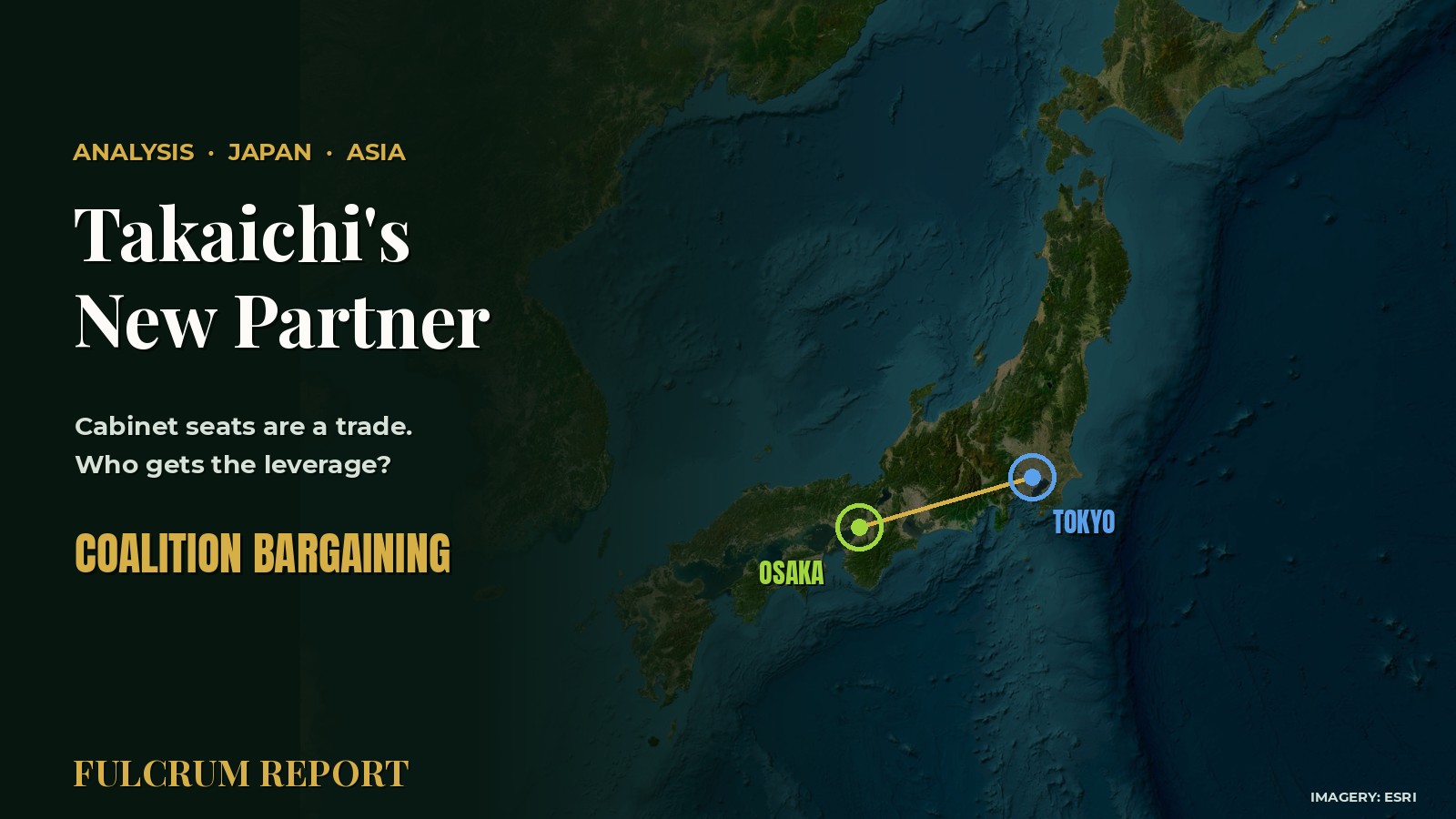
Takaichi's New Partner: Why Cabinet Seats Are a Trade
Sanae Takaichi reportedly reshuffled her cabinet on September 16 and 17, bringing in the Japan Innovation Party (Ishin) for the first time. Her camp holds two-thirds of the lower house but lacks an upper-house majority. A look at coalition bargaining and who gets the leverage.
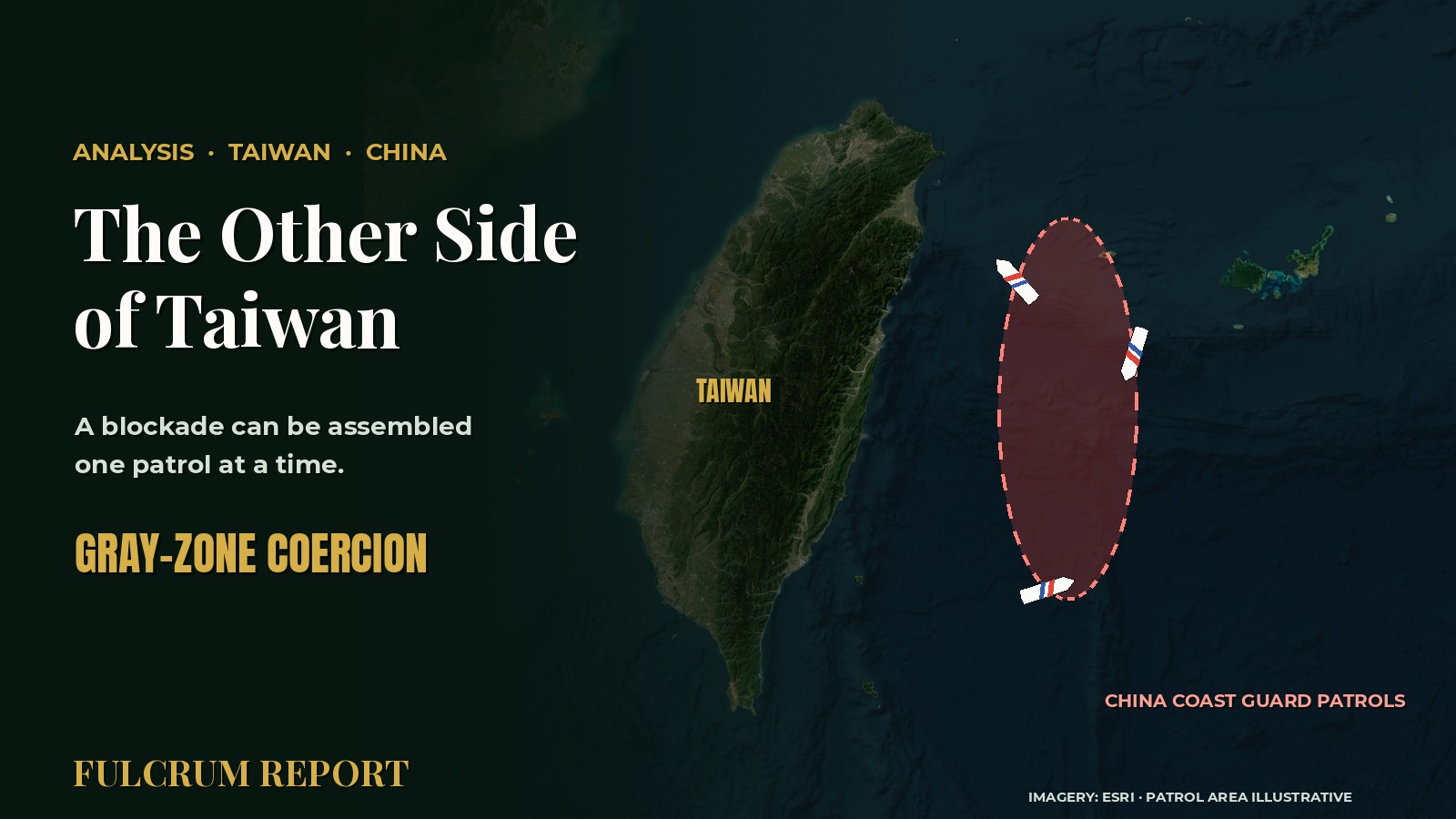
The Other Side of Taiwan: How a Blockade Gets Built Without Being Declared
China's Coast Guard has reportedly set up a regular presence east of Taiwan, framed as law enforcement, while a $14 billion U.S. arms package is pending. A look at gray-zone coercion, salami tactics and escalation control.