Refugees Will Decide Elections Far From This War
The most enduring weapon in this war isn't a missile. It's the millions forced to flee — and the politics they carry, for years, into countries that never fired a shot.
I want to start with the claim that sounds like hyperbole and isn't: a war fought in the Levant may end up deciding elections in countries that never fired a shot in it. Not metaphorically. Literally — in the sense that the composition of parliaments in Berlin, Stockholm, Vienna and Rome can be moved by what happens in Gaza, southern Lebanon and the Syrian interior. I've spent enough years watching this region to have stopped being surprised by it, but I still think it's the single most underappreciated dynamic of the current war. So let me lay it out the way I'd explain it to a colleague over coffee, without the jargon doing the thinking for us.
## The weapon that isn't a weapon
When we talk about the instruments of this war, we reach instinctively for the hardware — missiles, drones, air defense, tunnels. That's the war that photographs well. But the effect that will still be shaping politics a decade from now isn't kinetic at all. It's people. Specifically, it's the millions of human beings who are forced to move because staying has become impossible and returning has become unimaginable.
Displacement is the most enduring output of modern war, and it behaves differently from every other weapon. A missile detonates once. A displaced population keeps generating political consequences for years, and it generates them somewhere else — in the countries that receive the people, long after the fighting that produced them has faded from the headlines. That delay, and that dispersion, is exactly why it gets underestimated.
## The numbers, and an honest word about them
Let me put some figures on the table, because the scale is the argument.
Inside Gaza, roughly 1.9 million people — on the order of nine in ten residents — have been displaced from their homes, many of them repeatedly, shunted from one shrinking "safe" zone to the next. In Lebanon, the escalation with Israel has uprooted more than a million people, close to a fifth of the entire country, the largest displacement there since the civil war. Out of Syria's long catastrophe, somewhere between five and six million people are still living as refugees beyond its borders, with several million more displaced inside the country — one of the largest displacement situations on earth.
And then there's the figure I want to handle carefully, because honesty about the data matters more than a clean narrative. You'll hear that roughly 3.2 million refugees live inside Iran. That number is real, but the overwhelming majority of them are Afghans, not people fleeing the current Levant war. I include Iran because it's part of the region's displacement map and because Iran's own population is now exposed to this conflict's shocks — but I won't pretend those 3.2 million are a product of this war. They aren't. Blurring that line is exactly the kind of shortcut that makes people distrust the whole argument, and the argument is strong enough that it doesn't need the exaggeration.
Here is what the honest version still gives you: several million people, across multiple overlapping crises, who can neither safely stay where they are nor safely return to where they came from. When both of those doors close at once, there is only one direction left. People move. And the geography channels them along predictable corridors — toward Jordan, toward Turkey, and onward toward Europe.
## Second-order effects and the securitization of migration
The lens I find most useful here has two parts, and I want to name them plainly because they're the intellectual spine of the whole piece.
The first is second-order effects. A war's first-order effects are the obvious ones: the dead, the destroyed buildings, the collapsed economy. The second-order effects are what those first-order shocks set in motion afterward — and displacement is the great second-order effect, the one that travels. It crosses borders, ages, hardens into diasporas, and reshapes the domestic politics of countries that were never belligerents. If you only track the first-order damage, you will consistently misjudge where a war's real consequences land.
The second concept is the securitization of migration. This is a piece of political science that describes a move — a rhetorical and policy move — in which something is lifted out of the ordinary domain of humanitarian or economic policy and reframed as an existential security threat. Once an issue is "securitized," the normal rules bend. Emergency measures become justifiable. Borders that were administrative become defensive. And a person fleeing a war stops being read primarily as a victim in need of protection and starts being read as a risk to be screened, contained, or deterred.
Put those two ideas together and you have the engine of this entire story. Displacement is the second-order effect; securitization is the political machine that converts it into electoral change.
## First it kills. Then it votes.
Here's the sequence as I've come to understand it.
War first kills and destroys — that's the phase we all watch. Then, as the fighting recedes, displacement carries the war's politics across borders and holds them there for years. Arrivals rise in the receiving countries. Public services strain, or are perceived to strain, which in politics is often the same thing. And at that point a choice gets made — usually not by the migrants, but by the politicians and media of the host country — about how to describe what's happening.
They can describe it as a humanitarian situation to be managed. Or they can recast it as a security crisis to be repelled. When they choose the second framing — and under electoral pressure they very often do — three things follow with grim reliability. Borders harden, physically and legally. Nationalist and anti-immigration parties, who have been waiting for exactly this moment, surge. And the political center of gravity shifts, dragging even mainstream parties toward tougher positions they'd previously have rejected, because they can feel the ground moving under them.
That is how a war in the Middle East reshapes an election in a country far from the battlefield. Not through some conspiracy, but through this ordinary, observable chain: displacement, arrival, securitization, backlash, votes.
## We have already watched this movie
If this sounds speculative, remember that we ran the experiment less than a decade ago.
In 2015, more than a million asylum seekers reached Europe in a single year, driven above all by the Syrian war. The political aftershocks were enormous and they are still with us. In Germany, the decision to admit around a million refugees became the central fault line of national politics and gave the Alternative for Germany the grievance it needed to transform itself from a fringe anti-euro party into a durable anti-immigration force. In Sweden — Sweden, of all places, long the self-image of humanitarian openness — the strain shattered the old consensus and propelled the Sweden Democrats, a party with roots in the ugliest corners of the far right, into the mainstream and eventually into the machinery of government. In Hungary, Viktor Orbán built an entire, enduring political identity out of border fences and civilizational alarm.
And the European Union's institutional response told you everything about which framing had won. The 2016 EU-Turkey deal essentially paid a transit country to hold people back, turning Turkey into a buffer and migration into a chip that Ankara could threaten to cash whenever it wanted leverage. That is securitization written into treaty form: the humanitarian question quietly subordinated to the border-control question.
The 2015 wave transformed European politics. That's not a prediction; it's history. The prediction is only this: a larger or renewed wave, layered on top of an electorate that is already more anxious and a party system that has already tilted, could push things further and faster than it did the first time — because the groundwork has been laid and the political entrepreneurs are already in position.
## Why this should change how you read the war
So when you watch this conflict, I'd gently suggest widening the frame. The map that matters isn't only Gaza, southern Lebanon and the Syrian corridor. It runs through the Jordanian and Turkish towns absorbing the first shock, and onward to the ballot boxes of central and northern Europe, where the political consequences will actually be counted.
The uncomfortable truth is that the people forced to flee this war are not only its victims. They become, entirely against their will, a force that reshapes the politics of the countries that receive them — and, through those politics, the alliances, the aid budgets and the immigration regimes that will define the next decade. None of that is their intention. It's simply what displacement does when it collides with democracies under strain.
The consequences of this war will not stay in the Middle East. They will travel the same roads the refugees do, and they will arrive, quietly, in places that thought the war had nothing to do with them. The only real question is where they land — and whether the countries in their path meet them with policy or with panic.

About the author
Fulcrum Report
Independent Middle East analyst holding a PhD in Political Science. Fulcrum Report offers rigorous, framework-driven coverage of politics and geopolitics across the Levant and the wider region — analysis without agenda.
Related reading
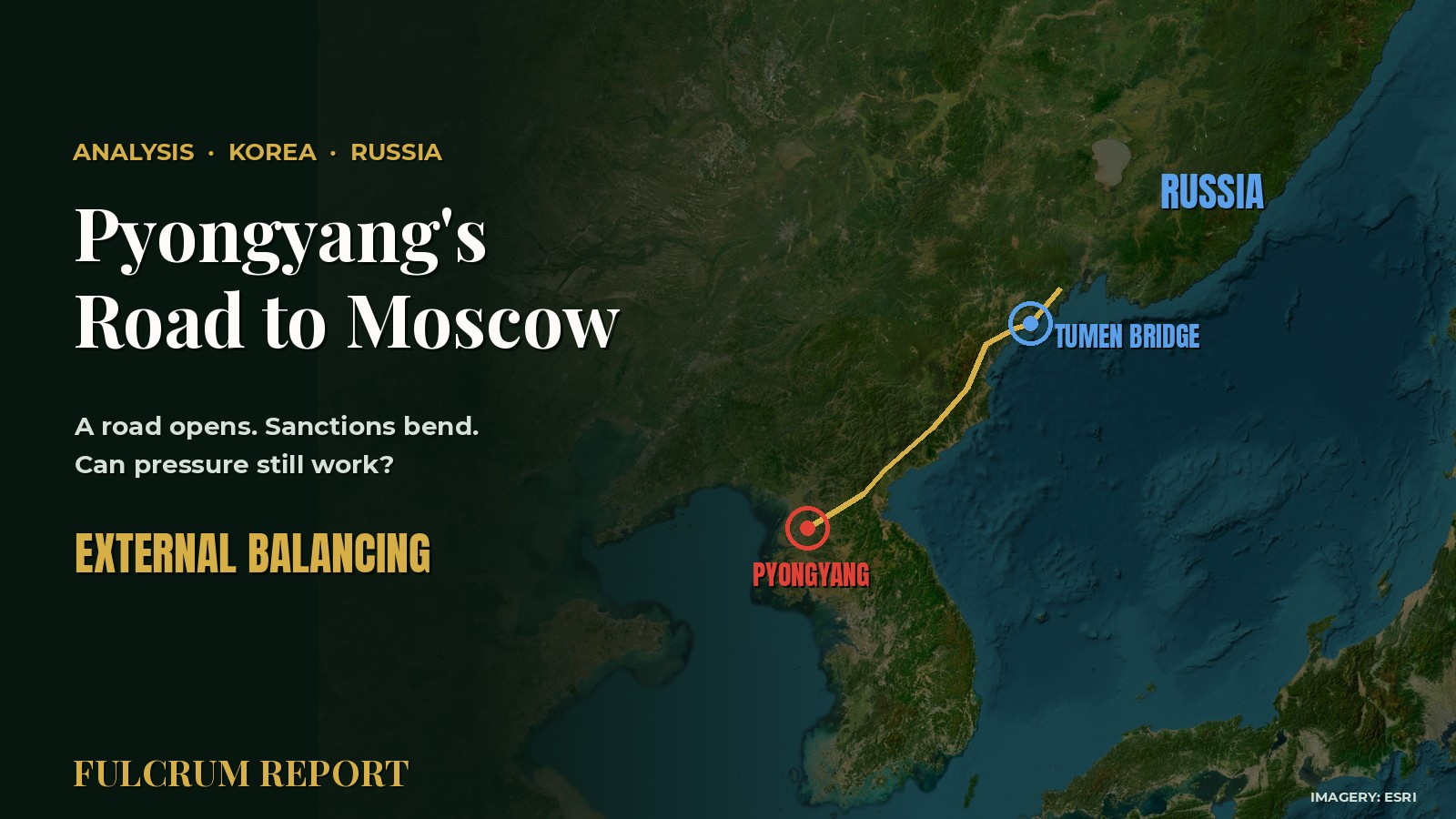
Pyongyang's Road to Moscow: Can Sanctions Still Work?
A second enrichment facility is reportedly going up at Yongbyon, and the Tumen River road bridge to Russia reportedly opened on September 8. When a major power offers a way around sanctions, how much pressure is left? An explainer on external balancing.
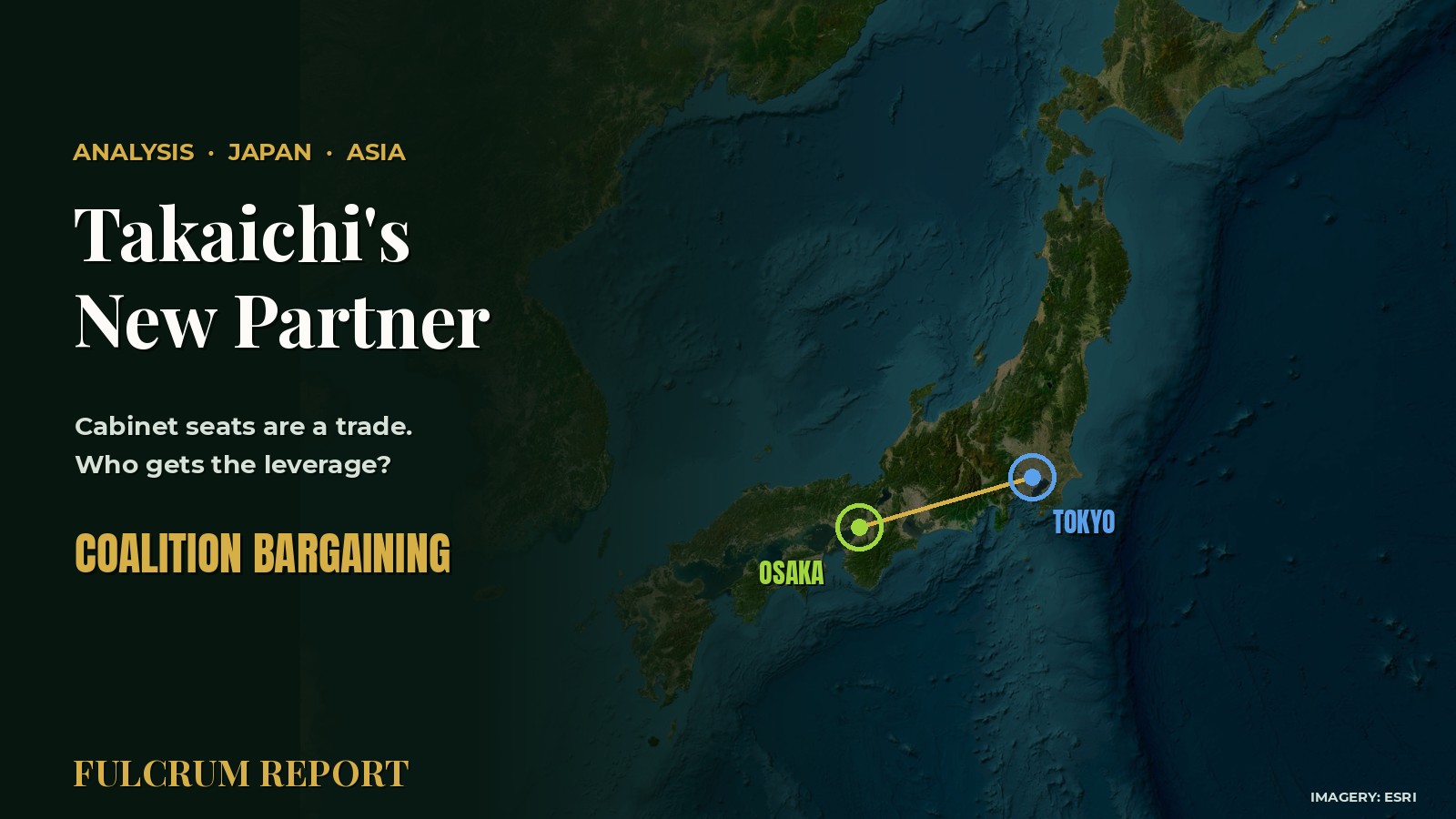
Takaichi's New Partner: Why Cabinet Seats Are a Trade
Sanae Takaichi reportedly reshuffled her cabinet on September 16 and 17, bringing in the Japan Innovation Party (Ishin) for the first time. Her camp holds two-thirds of the lower house but lacks an upper-house majority. A look at coalition bargaining and who gets the leverage.
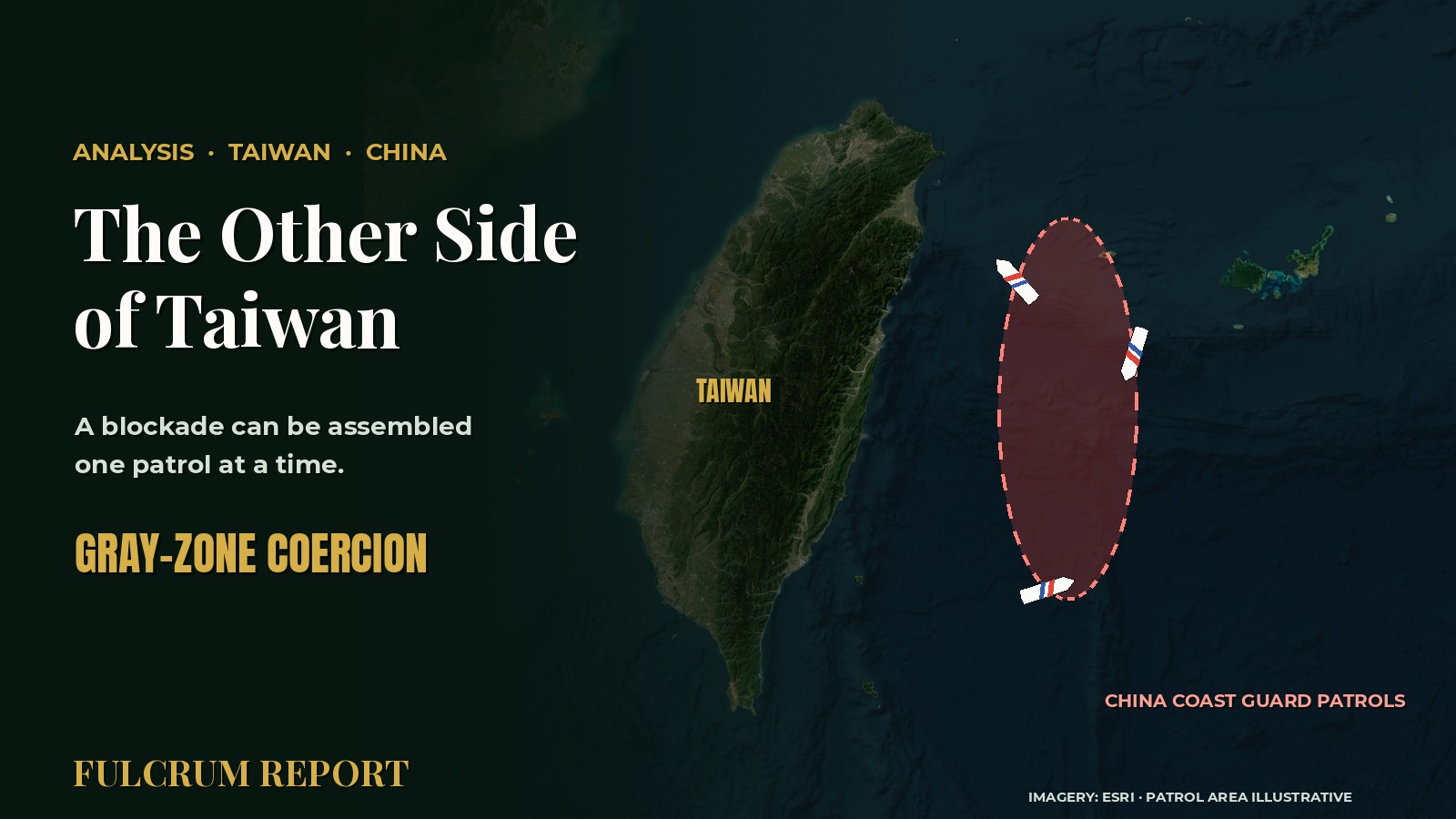
The Other Side of Taiwan: How a Blockade Gets Built Without Being Declared
China's Coast Guard has reportedly set up a regular presence east of Taiwan, framed as law enforcement, while a $14 billion U.S. arms package is pending. A look at gray-zone coercion, salami tactics and escalation control.