There's a Skull Under the Cross
A small detail in the Holy Sepulchre mosaic points to one of Christianity's oldest traditions: that Adam was buried where the cross stood.
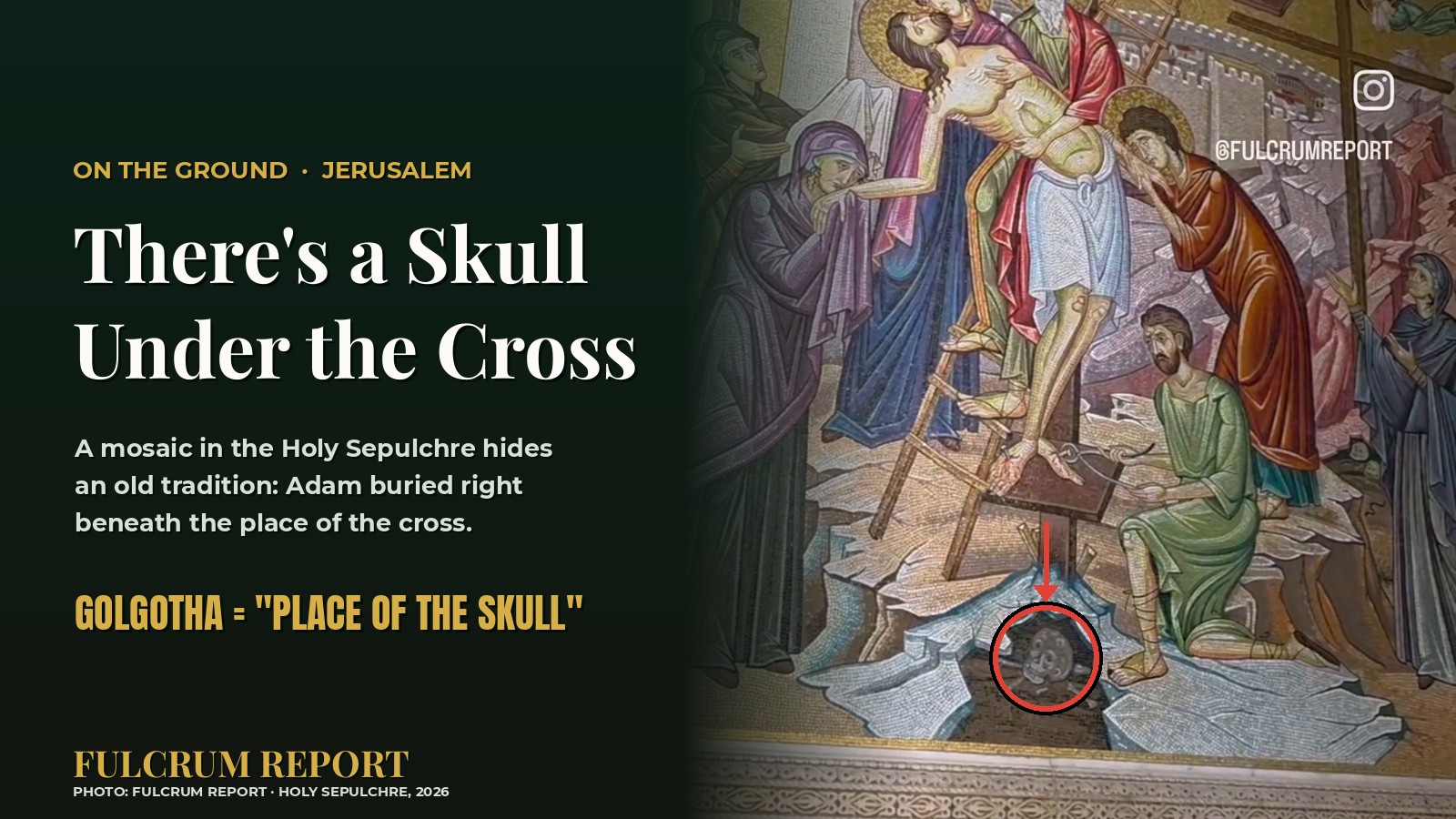
I almost missed it.
I was standing in the Church of the Holy Sepulchre in Jerusalem, filming the big gold mosaic behind the Stone of Anointing. It's the first thing you see when you walk in, and most people give it a quick look and then turn to the stone. I was doing the same. Then I went back through the footage and noticed something small at the bottom of the first panel, tucked into a crack in the rock right under the cross.
A skull.
Once you see it, you can't stop seeing it. So I went looking for why it's there.
What the wall shows
The mosaic went up in 1990, and it tells a story in three scenes. You read it right to left, which threw me at first. On the right, Jesus is taken down from the cross. In the middle, his body is anointed for burial. On the left, it's carried to the tomb.
The skull sits in the first scene, in a dark split in the rock directly beneath the foot of the cross. It isn't decoration and it isn't an accident. It's a very old idea, and you'll find the same detail in Orthodox icons of the crucifixion all over the world.
Whose skull it is
According to an old Christian tradition, it's Adam's.
The idea is that the first man was buried at the exact spot where, much later, the cross would stand. It's recorded as early as the 3rd century by the theologian Origen, and later writers such as Epiphanius and Basil repeat it. Some versions add that when Jesus died, his blood ran down through the rock and onto Adam's skull. The symbolism is pretty clear even if you're not religious: the story of the first man and the story of the cross meet at one point.
I want to be straight about what this is. It's a tradition and a piece of theology, not something archaeology has confirmed. Some scholars think the link to Adam developed later as a way of explaining the name of the place, and there's a rival Jewish tradition that places Adam's burial in Hebron. Both of those are worth knowing.
The name gives it away
The place where Jesus was crucified is called Golgotha. In the Gospel of Matthew (27:33), it's translated as "the place of the skull." Calvary, the more familiar English word, comes from the Latin for skull too.
Nobody knows for certain why it got that name. It may have been the shape of the hill, or it may have been a place of execution. But you can see how a name like that and a story about Adam's skull would end up feeding each other over the centuries.
It's not just on the wall
This is the part that surprised me most. The tradition isn't only in the art. It's built into the church itself.
Go up the steep stairs near the entrance and you reach Calvary, the rock venerated as the place of the crucifixion. Directly underneath it, on the ground floor, is a small space called the Chapel of Adam. Through glass there you can see a crack running through the rock, which tradition links to the earthquake described in Matthew 27:51 when Jesus died. In the Middle Ages, two Crusader kings of Jerusalem, Godfrey of Bouillon and Baldwin I, were buried in that chapel. Their tombs are gone now.
So the skull in the mosaic is pointing at something real in the building. The cross above, Adam below, a few meters of rock between them.
Why almost nobody notices
Right under the mosaic is the Stone of Anointing, the slab where tradition says Jesus's body was prepared for burial. The current stone dates from 1810. When I was there, people were kneeling around it, praying, laying scarves and rosaries on it, some of them in tears. It's a moving thing to watch, and it's where everyone's attention goes.
Which is exactly why the skull gets missed. The whole room pulls your eyes down to the stone. Very few people look up and read the wall.
The church itself is shared by several Christian communities, mainly the Greek Orthodox, Roman Catholic and Armenian churches, under an arrangement known as the Status Quo. I wrote about that, and about the stone, in an earlier piece. This time I just wanted to talk about one small detail that holds a lot of history.
If you go
Stand by the Stone of Anointing, then look up at the right-hand side of the wall. Find the foot of the cross and follow it down into the rock. That's where it is. Afterward, walk around to the Chapel of Adam beneath Calvary and see the cracked rock for yourself. Please go quietly. For a lot of the people around you, this is one of the holiest places on earth.
Did you spot the skull before I pointed it out? Tell me in the comments on the reel, and follow @fulcrumreport for more from the ground.

About the author
Fulcrum Report
Independent Middle East analyst holding a PhD in Political Science. Fulcrum Report offers rigorous, framework-driven coverage of politics and geopolitics across the Levant and the wider region — analysis without agenda.
Related reading

Pyongyang's Road to Moscow: Can Sanctions Still Work?
A second enrichment facility is reportedly going up at Yongbyon, and the Tumen River road bridge to Russia reportedly opened on September 8. When a major power offers a way around sanctions, how much pressure is left? An explainer on external balancing.

Takaichi's New Partner: Why Cabinet Seats Are a Trade
Sanae Takaichi reportedly reshuffled her cabinet on September 16 and 17, bringing in the Japan Innovation Party (Ishin) for the first time. Her camp holds two-thirds of the lower house but lacks an upper-house majority. A look at coalition bargaining and who gets the leverage.
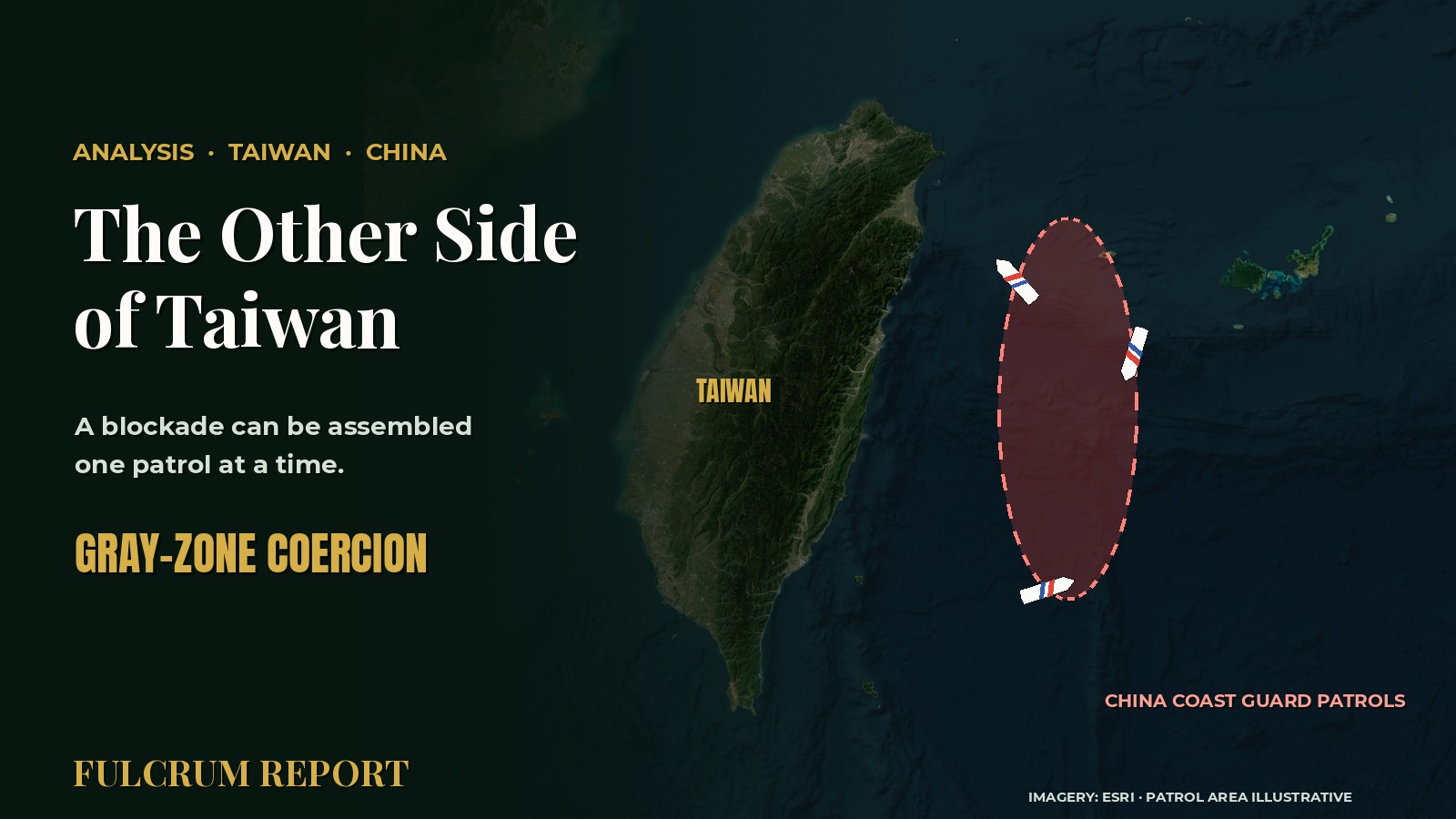
The Other Side of Taiwan: How a Blockade Gets Built Without Being Declared
China's Coast Guard has reportedly set up a regular presence east of Taiwan, framed as law enforcement, while a $14 billion U.S. arms package is pending. A look at gray-zone coercion, salami tactics and escalation control.