The Stone Is New. The Fight Is Old.
Millions kiss the Stone of Anointing in Jerusalem. It was laid in 1810, the mosaic above it went up in 1990, and the rivalry over who controls it once helped start the Crimean War.
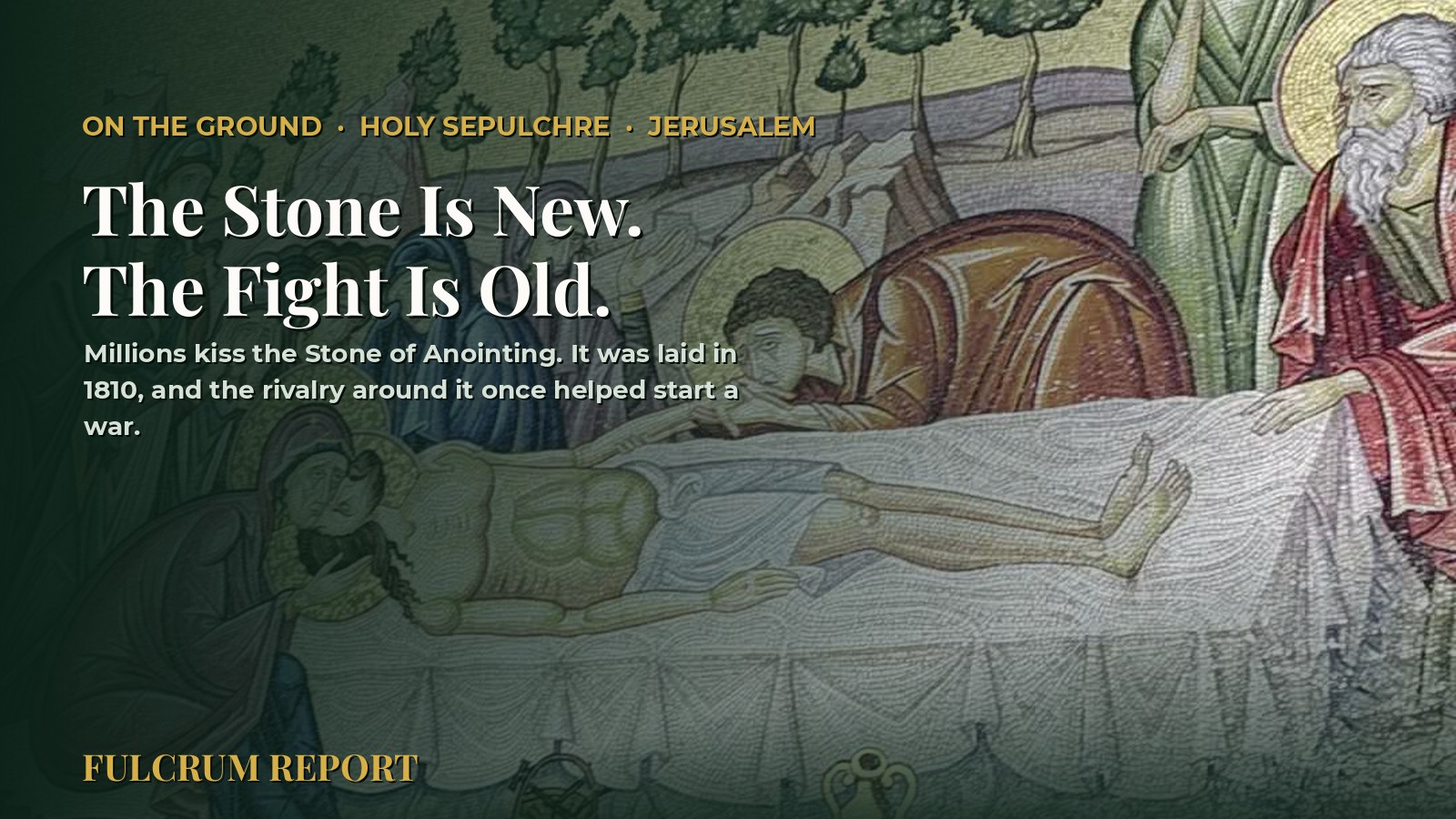
Walk through the main door of the Church of the Holy Sepulchre and you almost trip over it. Before your eyes have adjusted to the dim light, before you have worked out where the tomb is, there is a long, flat slab of reddish stone set into the floor, a row of lamps hanging above it, and people on their knees all around it.
They press their foreheads to it. They lay scarves, rosaries and small icons on its surface and then fold them back into their bags. Some pour oil on it and wipe it off with cloths they will take home. Some just put a palm flat on the stone and stay there, eyes closed, while the crowd moves around them. I stood beside it with my phone and filmed a few seconds of feet shuffling past and hands reaching down. It is one of the most touched objects on earth.
Here is the part almost nobody in that line knows: the stone they are kissing was laid in 1810.
## What the stone is supposed to be
This is the Stone of Anointing, also called the Stone of Unction. Christian tradition holds that it marks the place where the body of Jesus was laid after it was taken down from the cross, and where it was anointed and wrapped before burial. The Gospel of John describes Joseph of Arimathea and Nicodemus bringing myrrh and aloes and binding the body in linen "as the manner of the Jews is to bury." The slab is the church's way of giving that moment a physical address, just a few steps from Golgotha on one side and the tomb on the other.
It is worth being honest about what tradition claims and what it does not. Nobody seriously argues that this particular piece of limestone held a body two thousand years ago. What the pilgrims are venerating is the place and the memory, not the geology. But it still surprises people to learn how young the stone really is.
## Why it is only two centuries old
In 1808 a fire broke out in the church. It spread through the rotunda, badly damaged the structure over the tomb and destroyed much of what stood around it. The earlier slab at this spot was lost with it.
What followed matters more than the fire itself. The rebuilding was led by the Greek Orthodox, who obtained the Ottoman permissions and paid for the works, and it was completed in 1810. The new slab was set down as part of that restoration. The other communities in the church, above all the Latin Catholics under the Franciscans and the Armenians, watched this closely and not happily. In Jerusalem, whoever rebuilds a holy place is widely understood to be staking a claim to it. Restoration is never just masonry. It is a statement about ownership.
## The mosaic that tells the story
The second clip in my reel is the wall directly behind the stone. It is covered in a long, glittering gold mosaic in three panels that read from left to right like a storyboard. First, the body is taken down from the cross. Second, it is laid out and anointed on a slab, surrounded by mourning women, with a small jar of oil on the ground in front. Third, it is carried to the tomb.
This is the section people photograph most, and it looks ancient. It is not. The mosaic was installed in 1990, commissioned under the Greek Orthodox Patriarchate, and if you look closely at the Greek inscription along the bottom edge you can find the date worked into the tiles. I love this detail. The panel above the stone is younger than a lot of the people who walk under it.
So the stone is from 1810 and the art above it is from 1990. The oldest thing in this corner of the church is the story, and the argument over who gets to tell it.
## Six churches, one building
That argument has a name: the Status Quo. The Church of the Holy Sepulchre is shared by six Christian communities. The Greek Orthodox, the Latin Catholics and the Armenian Apostolic Church hold the major rights, and the Coptic, Syriac and Ethiopian Orthodox have smaller footholds. Every chapel, every stretch of wall, every lamp and every hour of the liturgical day is assigned.
The arrangement was frozen by Ottoman decrees in the eighteenth and nineteenth centuries, most famously the firman of 1852, and later written into international treaties. The rule is simple and brutal: nothing changes unless everyone agrees. Moving a chair, repairing a crack or cleaning a shared staircase can become a diplomatic incident. The row of lamps above the Stone of Anointing is a small illustration of the system. They are divided among the communities, and each one is tended by whoever owns it.
This is also why the Muslim families who have held the keys to the church's front door for centuries still open and lock it every day. A neutral gatekeeper suited everyone better than letting one Christian community control the only entrance.
## How a church helped start a war
The fire of 1808 and the rebuilding that followed are part of a much larger story. In the early nineteenth century the question of who controlled the holy places was not a local squabble among monks. It was a lever of great-power politics.
Russia presented itself as the protector of the Orthodox Christians of the Ottoman Empire. France claimed the same role for the Catholics. When the Latin and Orthodox communities fought over keys, doors, stars and precedence at the holy sites, including this church and the Church of the Nativity in Bethlehem, Paris and St Petersburg backed their clients. In 1852, under French pressure, the Ottoman sultan granted new privileges to the Catholics. Russia treated this as an insult and a threat, pushed back hard, and by 1853 Russia and the Ottoman Empire were at war. France and Britain joined the next year.
Historians are careful here, and I will be too. The Crimean War was about much more than churches: the decline of Ottoman power, Russian access to the Black Sea and the Mediterranean, and the balance of power in Europe. But the dispute over the holy places was the spark and the public justification. A quarrel about who could hang a lamp or hold a key in Jerusalem helped put hundreds of thousands of soldiers into the ground on the far side of the Black Sea.
## Why this belongs in a geopolitics feed
I get asked why an account about power and conflict keeps filming inside churches. The Stone of Anointing is the best answer I have.
It shows how a symbol becomes an asset. A slab of stone in a dark doorway is worth nothing as material and almost everything as meaning. Because it is meaningful, it is worth controlling, and because it is worth controlling, local actors look for powerful patrons and powerful patrons look for local causes. That is the same principal-and-client logic that runs through the region today, from militias and their sponsors to the states that trade on their role as guardians of one faith or another. Empires did not go to war over this church because they were pious. They went to war because piety was useful.
It also shows how fragile the peace can be. The Status Quo has kept the church functioning for more than a century and a half, but it works by freezing everything in place. That is stability, not trust. When the communities finally agreed to restore the tomb itself in 2016 and 2017, and later to renovate the floor, it was treated as a small miracle, because it was.
And it shows how new the old can be. The stone is from 1810. The mosaic is from 1990. The crowd is from this morning. The only thing in that doorway that is genuinely ancient is the rivalry over who gets to stand closest to it.
The stone is new. The fight is old.
*Watch the reel I filmed at the Stone of Anointing on our Instagram, @fulcrumreport.*
About the author
Fulcrum Report
Independent Middle East analyst holding a PhD in Political Science. Fulcrum Report offers rigorous, framework-driven coverage of politics and geopolitics across the Levant and the wider region — analysis without agenda.
Related reading

Pyongyang's Road to Moscow: Can Sanctions Still Work?
A second enrichment facility is reportedly going up at Yongbyon, and the Tumen River road bridge to Russia reportedly opened on September 8. When a major power offers a way around sanctions, how much pressure is left? An explainer on external balancing.

Takaichi's New Partner: Why Cabinet Seats Are a Trade
Sanae Takaichi reportedly reshuffled her cabinet on September 16 and 17, bringing in the Japan Innovation Party (Ishin) for the first time. Her camp holds two-thirds of the lower house but lacks an upper-house majority. A look at coalition bargaining and who gets the leverage.
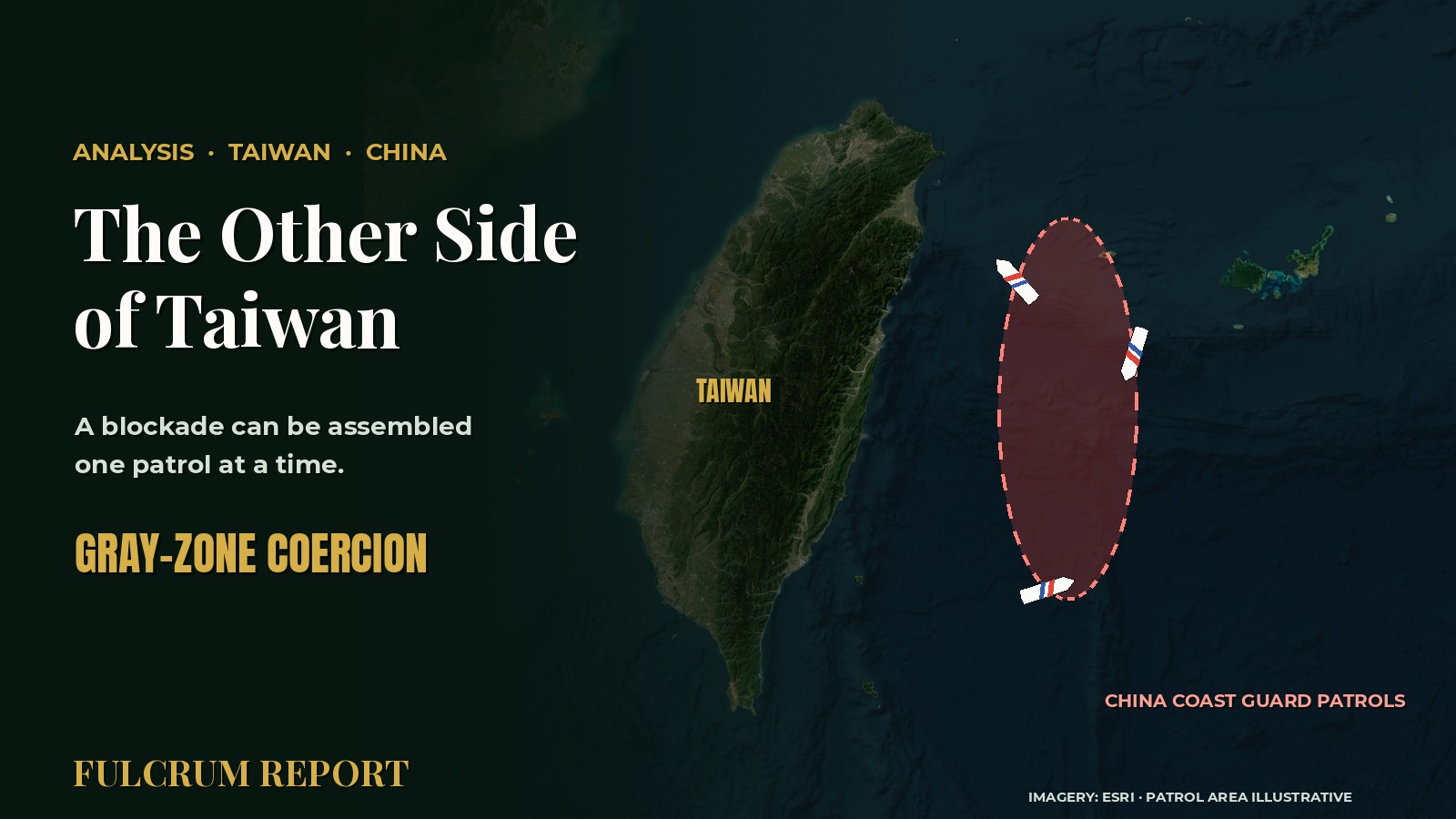
The Other Side of Taiwan: How a Blockade Gets Built Without Being Declared
China's Coast Guard has reportedly set up a regular presence east of Taiwan, framed as law enforcement, while a $14 billion U.S. arms package is pending. A look at gray-zone coercion, salami tactics and escalation control.