This Floor Looks Ancient. It Isn’t.
Below the Church of the Holy Sepulchre, a 20th-century mosaic of Armenia’s churches sits inside a 12th-century chapel where pilgrims carved their names in 1451.
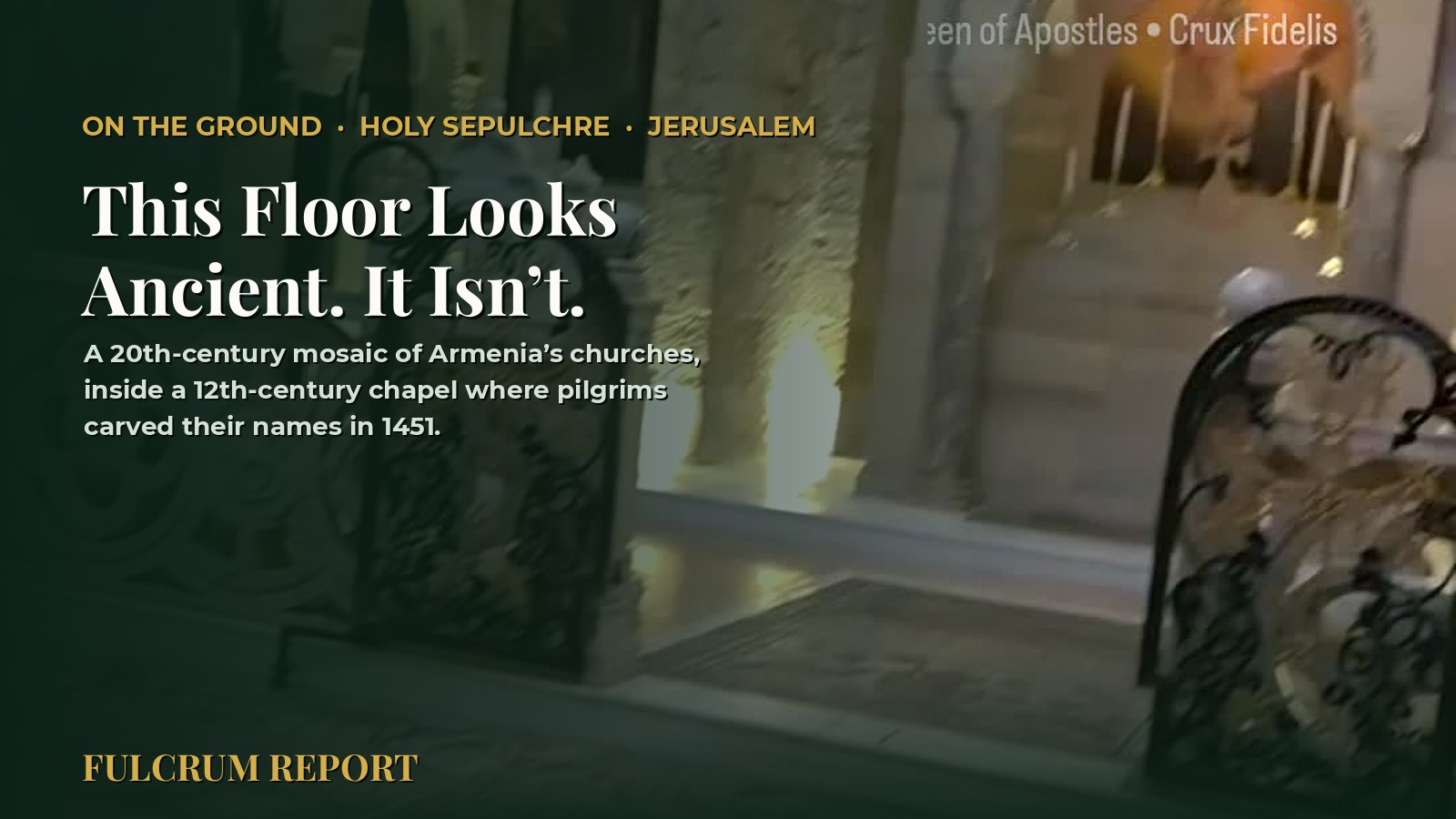
The first time I walked down the worn steps into the Chapel of St. Helena, I did what almost everyone does. I looked at the floor and assumed I was standing on something very old. The colors are soft, the stones look worn, and there are Armenian letters running along the edges. It feels like it has been there for a thousand years.
It hasn't. And that small surprise turned out to be a good way into a much bigger story.
A modern floor in an old room
The mosaic was made in the 20th century by the Israeli artist Hava Yofe. It depicts churches of historical Armenia, many of them in places where Armenian communities no longer live. Some guides still tell visitors the floor is ancient. It isn't, but I don't think that makes it any less meaningful. If anything, it tells you how a community chose to remember its own past, in stone, in the heart of Jerusalem's most contested church.
The room around the floor is the old part. The chapel sits in the lower level of the Church of the Holy Sepulchre and dates to the 12th century, the Crusader period. You reach it by going down from the main church, past walls where medieval pilgrims carved small crosses.
Why Armenians call it something else
Most visitors know it as the Chapel of St. Helena, after the mother of the Roman emperor Constantine, who tradition credits with finding the site of the crucifixion. The Armenian Apostolic Church, which looks after the chapel, calls it the Chapel of St. Gregory the Illuminator.
Gregory is the saint who, by tradition, converted the Armenian king Tiridates III around 301 AD. That date is debated by historians, but it is the basis for Armenia's claim to be the first nation to adopt Christianity as its official religion, before Rome itself. When you stand under the painted dome and see Gregory's story on the walls, you're looking at a national origin story, not just a religious one.
Names scratched into the walls
The part that stayed with me most isn't the floor or the paintings. It's the graffiti. Researchers who catalogued the Armenian inscriptions in this chapel found that the oldest dated one was scratched into the stone in 1451. Another, on the outside of the cupola, dates to 1666 and is attributed to a priest named Kirakos.
Those aren't decorations. They're people who travelled a very long way, at real risk, and wanted to leave proof that they had been here. In a building where every lamp, every step and every hour of prayer time is divided among different churches under the old Status Quo arrangement, those scratched names are a reminder that this has always been about communities claiming a place.
What the floor really tells you
So the floor is new and the faith is old. I like that tension. It's a useful habit in a city like Jerusalem to ask, about anything that looks ancient, when it was actually made and who made it. The answer is often more interesting than the legend, and it usually tells you something about the politics of memory that the legend leaves out.
If you're planning a trip, go down those steps, look closely at the walls as well as the floor, and give yourself a few quiet minutes there. It's one of the calmer corners of a very crowded church.
Have you been to the Holy Sepulchre? What surprised you most?

About the author
Fulcrum Report
Independent Middle East analyst holding a PhD in Political Science. Fulcrum Report offers rigorous, framework-driven coverage of politics and geopolitics across the Levant and the wider region — analysis without agenda.
Related reading

Pyongyang's Road to Moscow: Can Sanctions Still Work?
A second enrichment facility is reportedly going up at Yongbyon, and the Tumen River road bridge to Russia reportedly opened on September 8. When a major power offers a way around sanctions, how much pressure is left? An explainer on external balancing.

Takaichi's New Partner: Why Cabinet Seats Are a Trade
Sanae Takaichi reportedly reshuffled her cabinet on September 16 and 17, bringing in the Japan Innovation Party (Ishin) for the first time. Her camp holds two-thirds of the lower house but lacks an upper-house majority. A look at coalition bargaining and who gets the leverage.
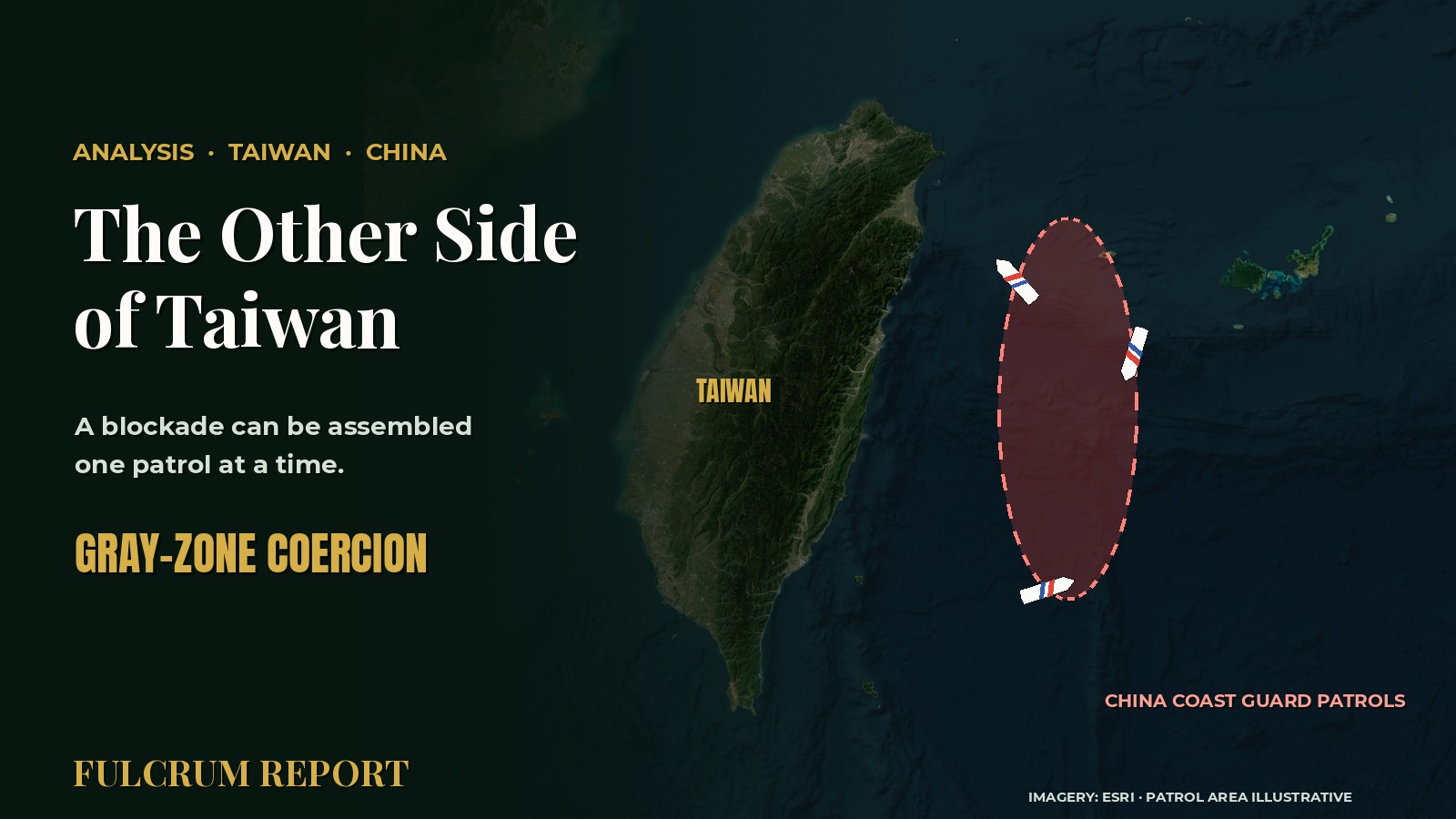
The Other Side of Taiwan: How a Blockade Gets Built Without Being Declared
China's Coast Guard has reportedly set up a regular presence east of Taiwan, framed as law enforcement, while a $14 billion U.S. arms package is pending. A look at gray-zone coercion, salami tactics and escalation control.