Ukraine’s Zero-Steel Week
For the first time in about a century, Ukraine made no steel for a week. Russia is aiming at the economy behind the front, betting that economies break before armies do.
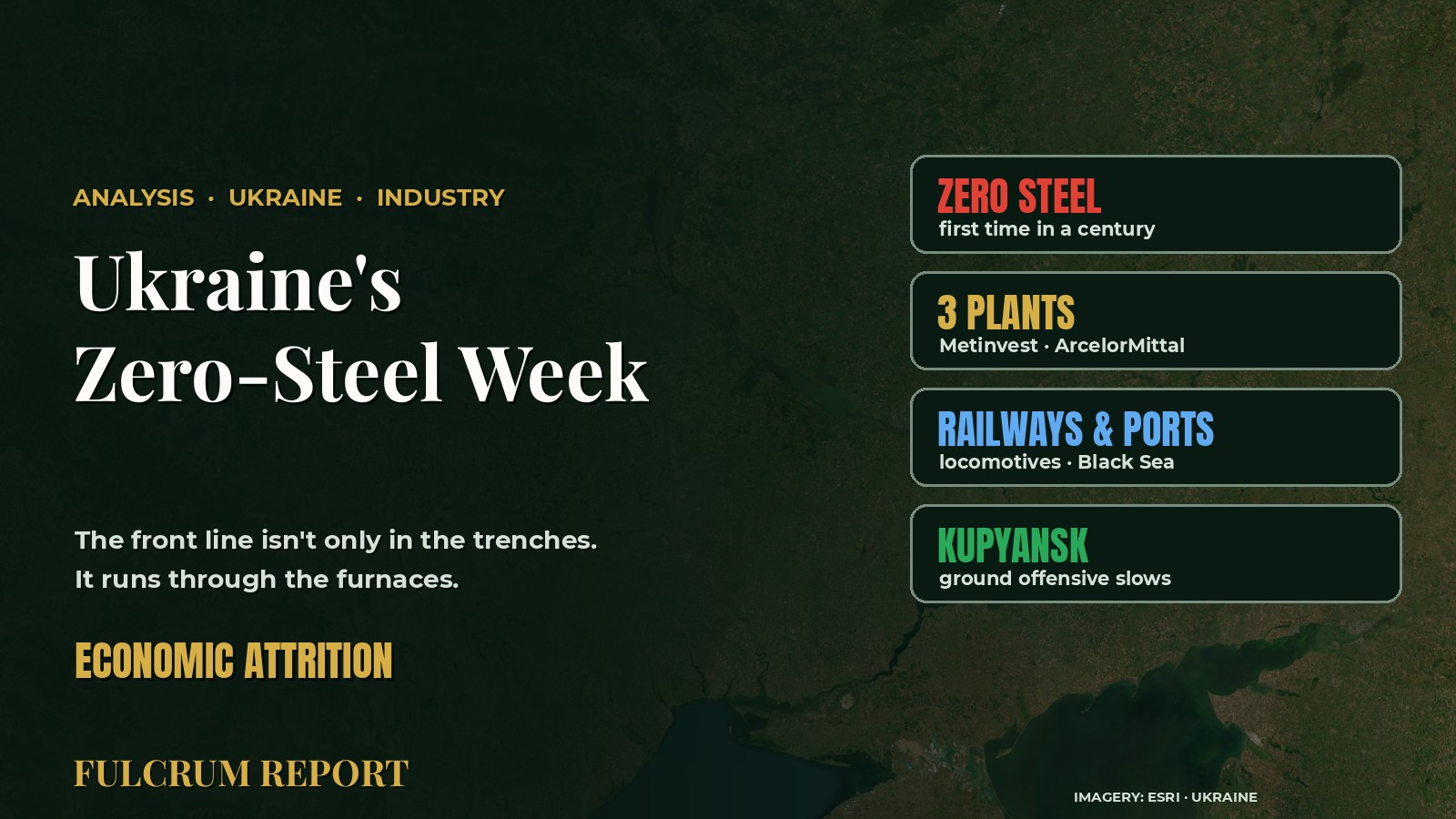
Here's a sentence I never expected to write: for one week, Ukraine made no steel at all. As reported, that hasn't happened in about a century. The 1930s famine, the Second World War, the Soviet collapse and the 2022 invasion all hit the industry hard. None of them brought output to zero.
Russia did. That's worth slowing down on, because it says a lot about how this war is being fought right now.
What actually happened
According to reports, Russian missile and drone strikes disabled the country's three remaining major steel plants, run by Metinvest and ArcelorMittal. I say "remaining" on purpose. Ukraine had already lost its two big Mariupol mills, Azovstal and Illich, in 2022. Before the full-scale invasion it produced roughly 21 million tonnes of steel a year. Since then it has been working from a much smaller base, and now that base has been knocked offline too, at least for a while.
The steel plants weren't the only targets. Railways, locomotives and the Black Sea ports have also been hit, again as reported. Meanwhile, on the ground, Russia's offensive around Kupyansk has slowed.
Put those two facts side by side and you get the real story. The front barely moves. What's behind the front is getting hammered.
A few honest caveats
I'd treat the "zero" with some care. It's a weekly figure, and plants can restart once power, gas and equipment come back. A week at zero doesn't mean the industry is gone for good. Steel plants also use enormous amounts of electricity, so part of this story is about the grid as much as the furnaces. And wartime production numbers aren't always complete or published on time.
Still, the direction matters more than the exact number. A sector that used to anchor the economy is being pushed toward a standstill, deliberately.
This is an old idea
Military thinkers have a name for it: strategic bombing. If you can't win at the front, you go after the economy that keeps the front supplied. The Italian theorist Giulio Douhet argued in the 1920s that air power could break a country by hitting its industry and its cities, so armies wouldn't have to grind it out in the mud.
The Second World War put that theory to a brutal test. Afterwards, the US Strategic Bombing Survey went through the results in detail, and what it found was mixed. Attacks on Germany's oil supply and transport network did real damage and helped bring about the collapse late in the war. Attacks meant to break civilian morale mostly didn't work. Factories were often repaired or moved, and some kinds of production actually rose under bombing.
Decades later, Robert Pape made a related argument in Bombing to Win (1996). Punishing civilians rarely forces a government to give in. Denial tends to work better: making it physically impossible for the other side to keep fighting the way it wants to.
Why steel, specifically
Steel makes a good target for that kind of campaign because so much depends on it. It feeds the railways that move troops and grain. It feeds weapons and shells. It feeds the reconstruction of everything that has been destroyed. And it feeds exports, which bring in foreign currency for a country that badly needs it. Before the war, metals were among Ukraine's biggest export earners.
So hitting steel isn't just hitting one industry. It's hitting the material that holds the rest of the economy and the war effort together.
The strikes on railways and ports read the same way. Railways carry steel, coal and ore. Ports ship steel abroad. Taken together, the targets look like a system, not a random list.
Attrition, aimed at the furnaces
What I think we're watching is attrition, just not the kind people usually picture. The usual picture is two armies trading men and equipment until one side runs out. This version goes after the industrial base behind the army. The bet is that economies break before armies do.
It's a cold bet, and it isn't obviously wrong. Soldiers can hold a trench for a long time. A country whose plants are dark, whose trains can't run and whose exports are drying up has a harder time paying those soldiers and keeping them supplied.
Where the bet could fail
History gives some reasons for doubt. Bombing campaigns have a long record of underestimating how adaptable economies are. People repair, move production, find substitutes and get help from outside. Ukraine isn't fighting alone. A lot of its weapons come from partners, which makes its own steel output less decisive than it would be for a country building everything itself. Air defenses, spare parts for the grid and imported steel can all soften the blow.
Then there's Russia's own economy, which is under strain from sanctions and the cost of the war. Attrition cuts both ways. The real question is who runs out of room first.
I don't know the answer, and I'm wary of anyone who says they do. But the zero-steel week makes one thing clear. The front line isn't only in the trenches. It runs through the furnaces.
Further reading: Giulio Douhet, The Command of the Air (1921); United States Strategic Bombing Survey, Summary Report (European War) (1945); Robert A. Pape, Bombing to Win: Air Power and Coercion in War (1996).

About the author
Fulcrum Report
Independent Middle East analyst holding a PhD in Political Science. Fulcrum Report offers rigorous, framework-driven coverage of politics and geopolitics across the Levant and the wider region — analysis without agenda.
Related reading
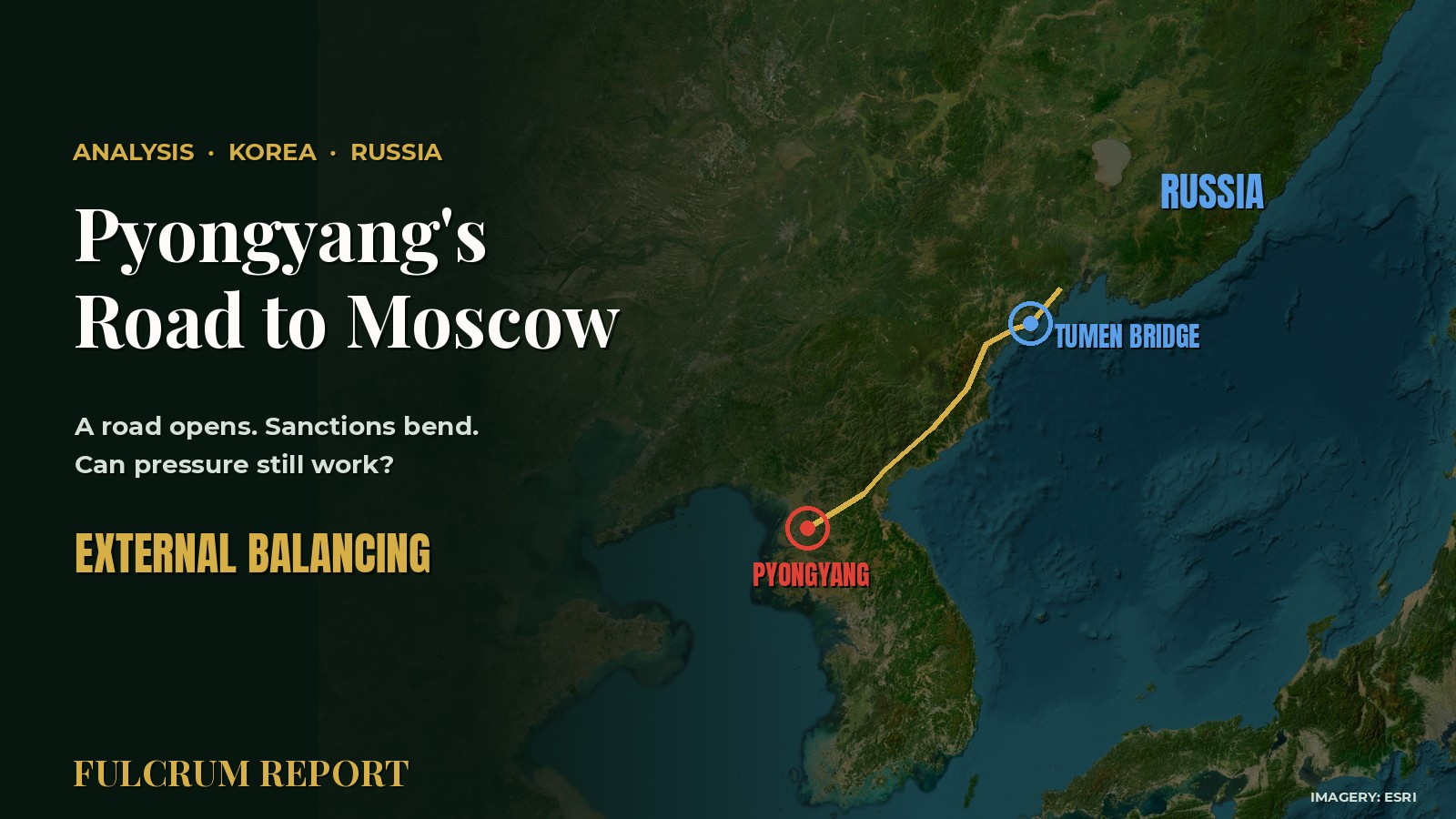
Pyongyang's Road to Moscow: Can Sanctions Still Work?
A second enrichment facility is reportedly going up at Yongbyon, and the Tumen River road bridge to Russia reportedly opened on September 8. When a major power offers a way around sanctions, how much pressure is left? An explainer on external balancing.
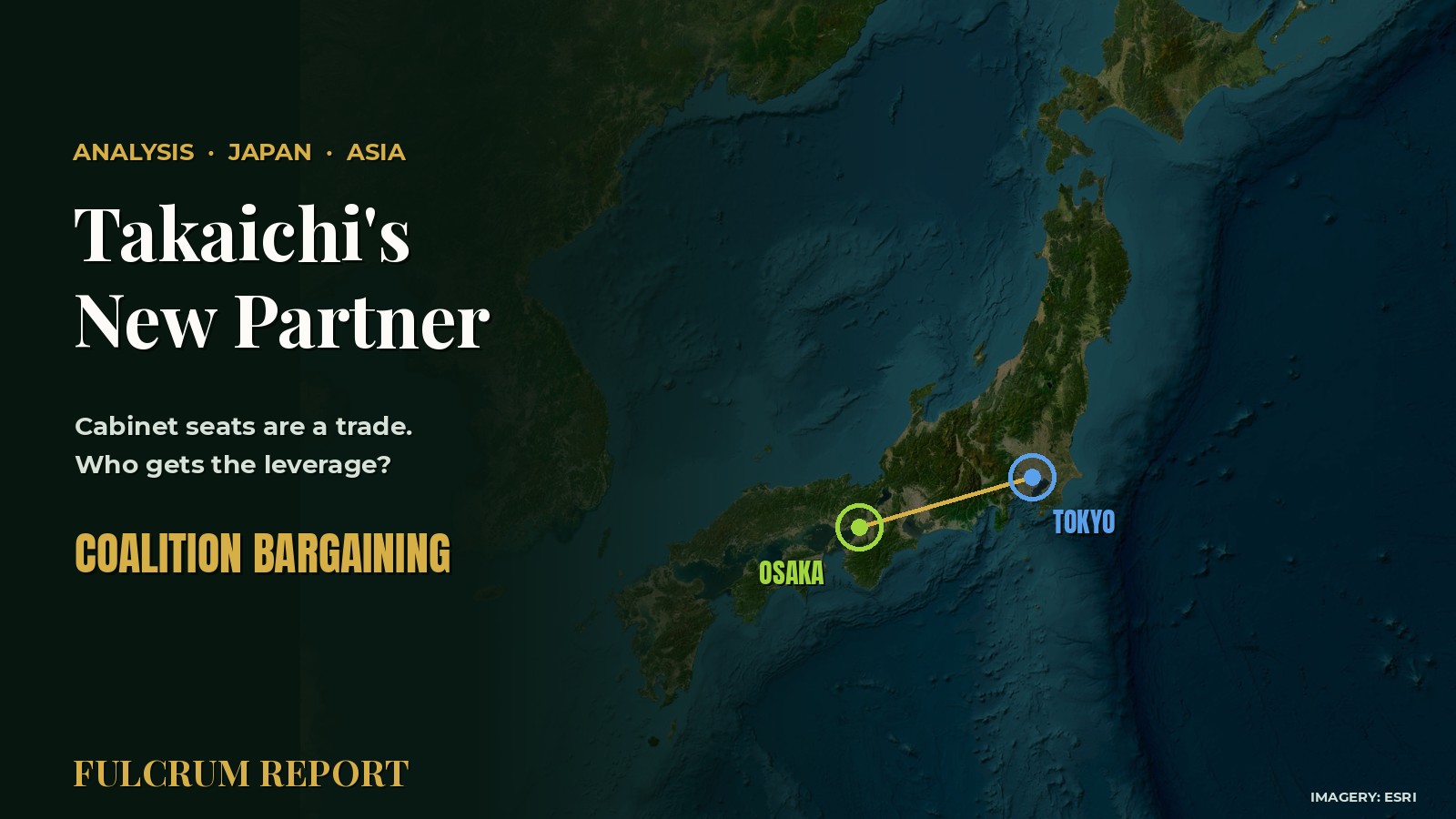
Takaichi's New Partner: Why Cabinet Seats Are a Trade
Sanae Takaichi reportedly reshuffled her cabinet on September 16 and 17, bringing in the Japan Innovation Party (Ishin) for the first time. Her camp holds two-thirds of the lower house but lacks an upper-house majority. A look at coalition bargaining and who gets the leverage.
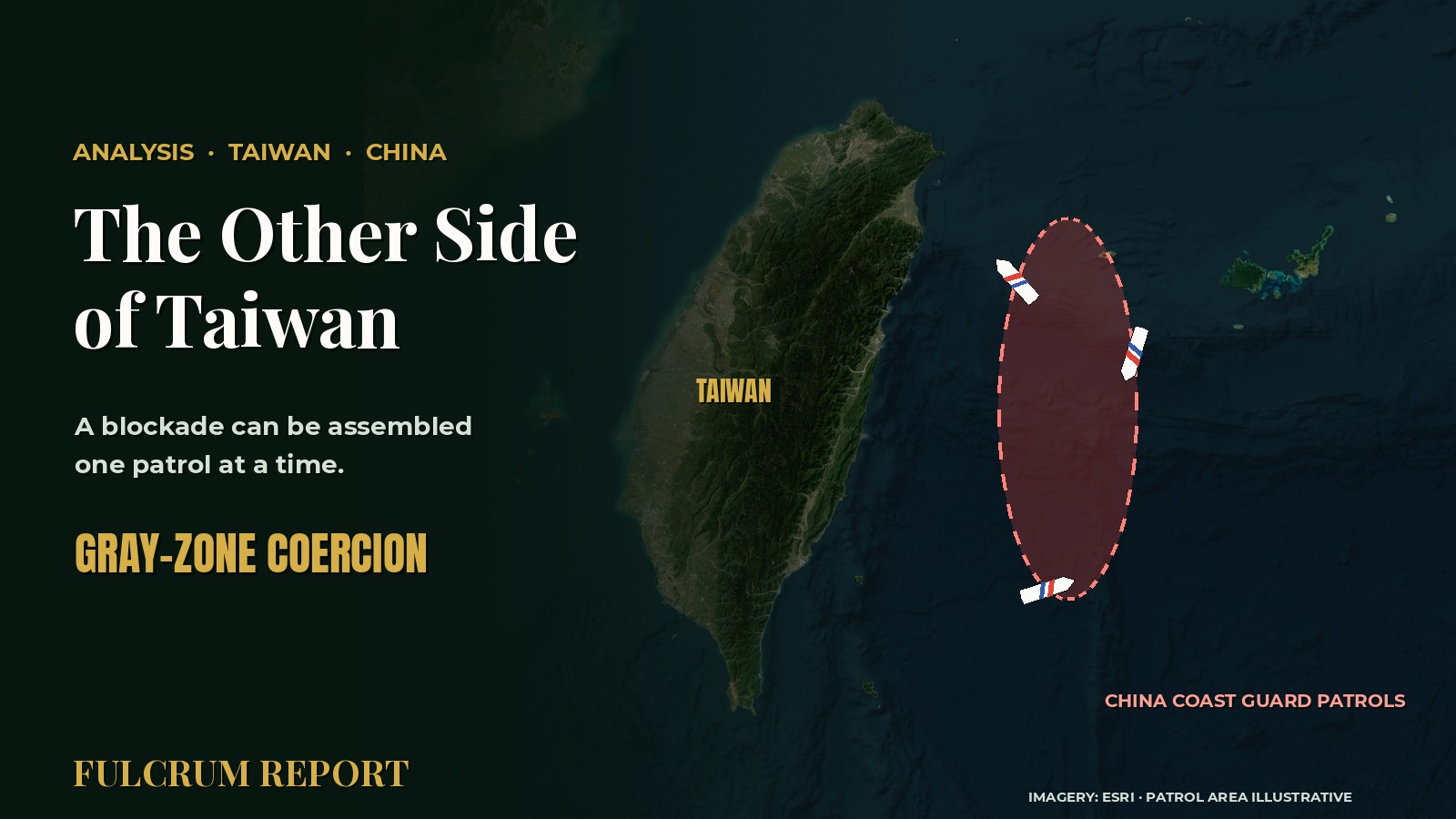
The Other Side of Taiwan: How a Blockade Gets Built Without Being Declared
China's Coast Guard has reportedly set up a regular presence east of Taiwan, framed as law enforcement, while a $14 billion U.S. arms package is pending. A look at gray-zone coercion, salami tactics and escalation control.