The World Is Bigger Than Five
Erdoğan’s UN line is a status claim backed by geography. Ankara isn’t choosing a side. It’s building a position everyone has to go through.
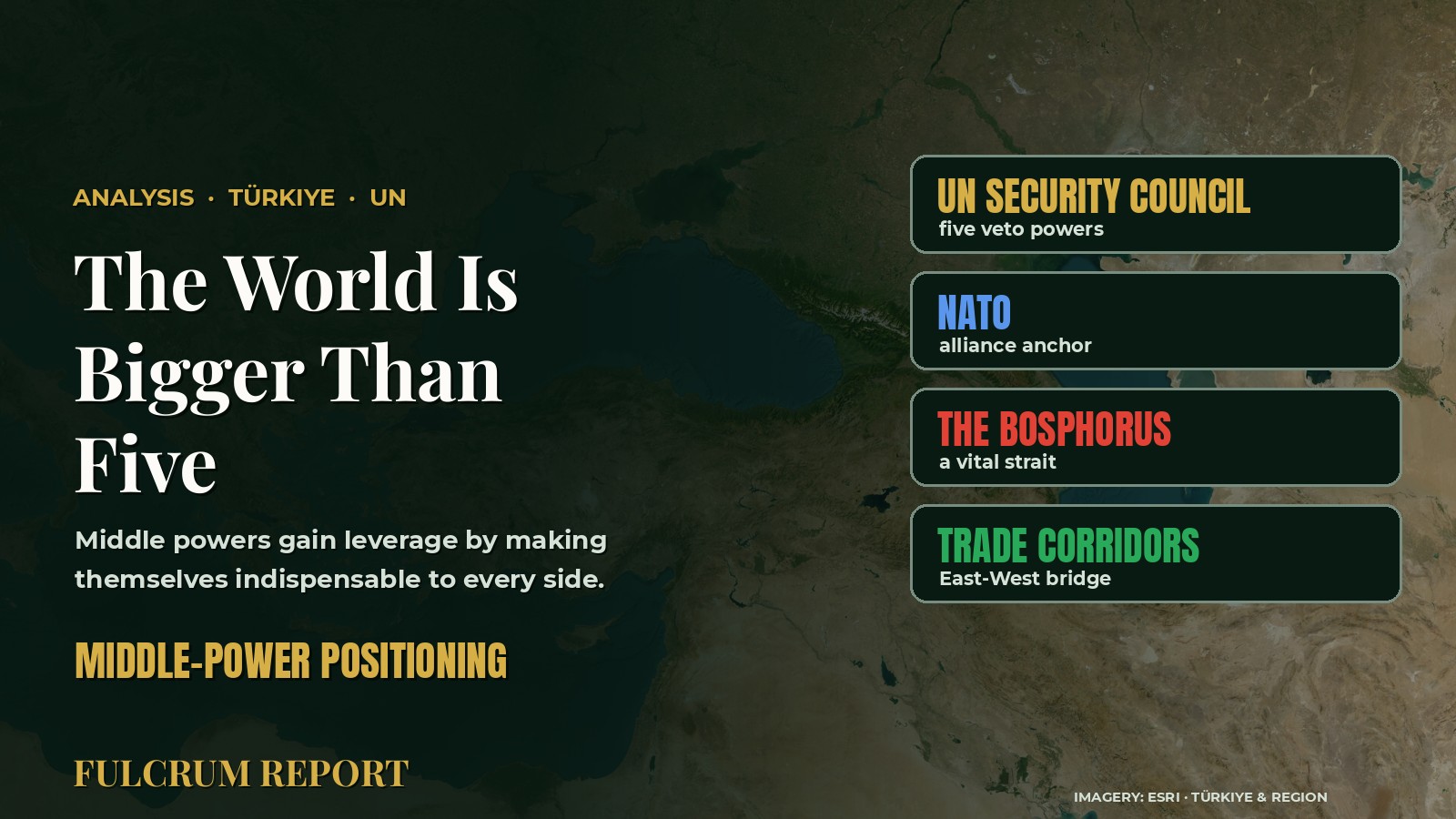
"The world is bigger than five." Erdoğan has been saying some version of that line at the United Nations for more than a decade, and I used to read it as a slogan. Lately I read it differently. I think it tells you a lot about how Ankara sees its place in the world, and why it keeps getting what it wants from people who don't always like it.
The five he means are the permanent members of the UN Security Council: the United States, the United Kingdom, France, Russia and China. They're the only countries with a veto. Out of 193 UN members, five can block anything the Council tries to do.
What he said this time
At this year's General Assembly, Erdoğan again called for ending the Security Council veto, as reported. That part wasn't new. What stood out was everything around it.
He accused Israel of a "genocidal mindset," and the Israeli delegation walked out, as reported. He said European security is "unthinkable without Türkiye." And he used the platform to promote two trade routes: the Middle Corridor, which runs from China through Central Asia, across the Caspian and the Caucasus, and into Turkey, and the Development Road, a planned road and rail link from the Grand Faw port in southern Iraq up to the Turkish border.
On the surface that's four different messages to four different audiences. A reform pitch to the Global South. A hard line on Israel for Arab and Muslim publics. A reminder to Europe. A sales pitch to anyone moving goods between Asia and Europe. I don't think they're separate at all.
One country, several camps
Look at where Turkey actually sits. It has been in NATO since 1952 and has the alliance's second-largest army. It signed the Mecca pact. It controls the Bosphorus and the Dardanelles, the only way in and out of the Black Sea. It's a land bridge for trade between Europe, the Gulf and Asia. And it's close enough to Syria, the Caucasus and the Black Sea that it can shape conflicts it isn't formally part of.
That's an unusual collection. Most countries pick a camp and live inside it. Turkey is in several and fully committed to none.
The idea behind it
Political scientists call this middle-power positioning. The term goes back a long way, but the version I find most useful comes from Andrew Cooper, Richard Higgott and Kim Richard Nossal. In their 1993 book on middle power diplomacy, they argued that you can spot a middle power less by its size than by its behavior. It looks for niches, builds coalitions, and acts as a broker or a bridge between bigger players.
Robert Keohane made a related point back in 1969. He separated system-determining states, the great powers, from what he called system-affecting states. Those can't run the system on their own, but they can change how it works if they act cleverly.
Turkey fits the second category almost perfectly. It can't set the rules the way Washington or Beijing can. But every major bloc needs something from it. The West needs it for security on NATO's southern flank. Russia needs it for trade and energy, and for the straits. The Gulf states see it as an investment partner. China sees it as part of a transit route. Because each of them needs something from Ankara, none of them can easily ignore it.
The trick is turning access into influence. Being on the map isn't enough. You have to make sure the routes, the bases and the deals run through you, and then use that.
Status is part of the strategy
It's tempting to dismiss the UN speech as grandstanding. I think that misses something. Deborah Larson and Alexei Shevchenko have written a lot about status-seeking in international politics, and one of their points is that recognition isn't just vanity. States that want a bigger role often push to have it acknowledged, because acknowledged status makes the next ask easier.
So when Erdoğan says the world is bigger than five, the message isn't only that the veto powers have too much authority. It's that countries like Turkey now have enough leverage to demand a larger share of it. The speech is the status claim. The corridors and the NATO line are the receipts.
Where it gets harder
I don't want to oversell this. Standing in several camps has real costs.
Allies get frustrated. Turkey's relations with Washington and Brussels have gone through long rough patches, and NATO partners haven't forgotten its purchase of the Russian S-400 system. Being useful to everyone also means being fully trusted by no one.
The corridors aren't finished either. The Middle Corridor has bottlenecks at the Caspian crossings, and the Development Road is still a plan that depends on security and financing in Iraq. Leverage based on routes only works if goods actually move along them.
And the veto isn't going anywhere soon. Changing the UN Charter needs the five permanent members to agree, which means the people who'd lose the veto would have to vote it away. Turkey knows that. I suspect the point isn't to win the vote. It's to be seen leading the argument.
What I'd watch
Whether any real money and construction show up behind the Development Road. How the Middle Corridor handles freight volumes if routes through Russia stay difficult. How Ankara balances its NATO commitments against its ties with Moscow and the Gulf. And whether other middle powers, from Brazil to India to Indonesia, start lining up behind the same reform argument.
This is analysis, not a prediction. My reading is simple. Ankara isn't choosing a side. It's building a position everyone has to go through.
So I'll ask what I asked on the reel. Should the veto go? Yes or no? Tell me in the comments, and follow @fulcrumreport for analysis without agenda.
About the author
Fulcrum Report
Independent Middle East analyst holding a PhD in Political Science. Fulcrum Report offers rigorous, framework-driven coverage of politics and geopolitics across the Levant and the wider region — analysis without agenda.
Related reading
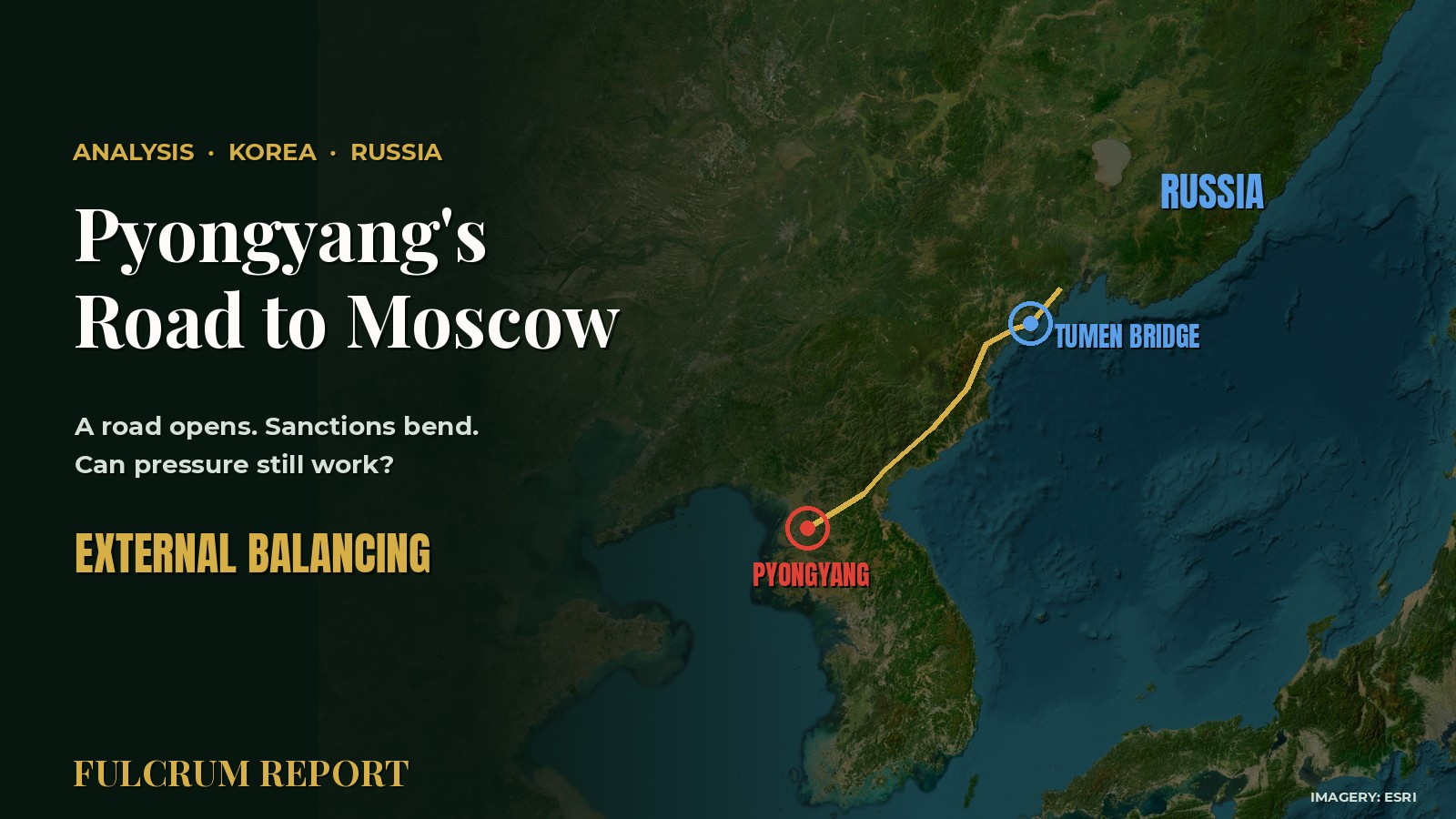
Pyongyang's Road to Moscow: Can Sanctions Still Work?
A second enrichment facility is reportedly going up at Yongbyon, and the Tumen River road bridge to Russia reportedly opened on September 8. When a major power offers a way around sanctions, how much pressure is left? An explainer on external balancing.
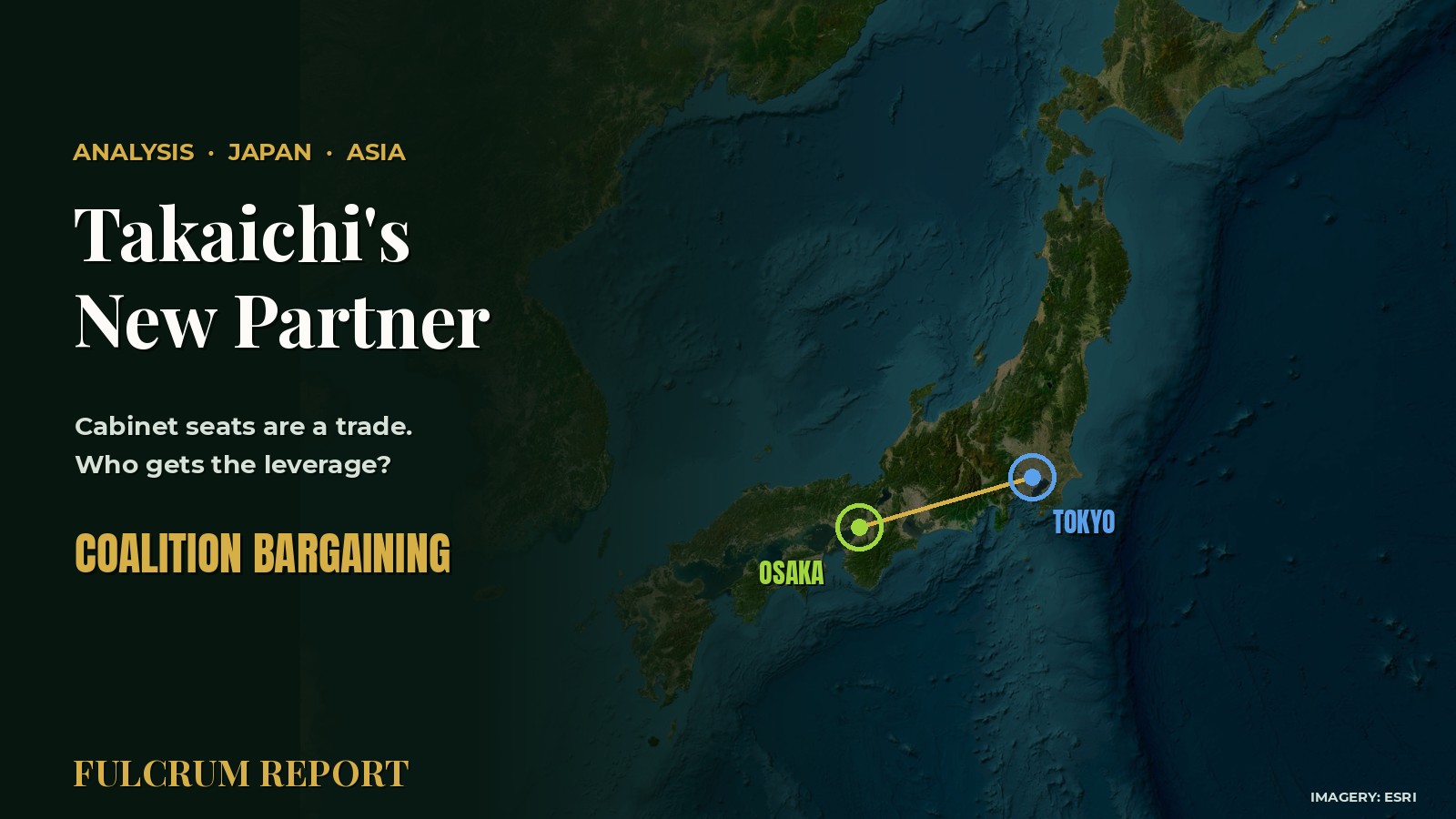
Takaichi's New Partner: Why Cabinet Seats Are a Trade
Sanae Takaichi reportedly reshuffled her cabinet on September 16 and 17, bringing in the Japan Innovation Party (Ishin) for the first time. Her camp holds two-thirds of the lower house but lacks an upper-house majority. A look at coalition bargaining and who gets the leverage.
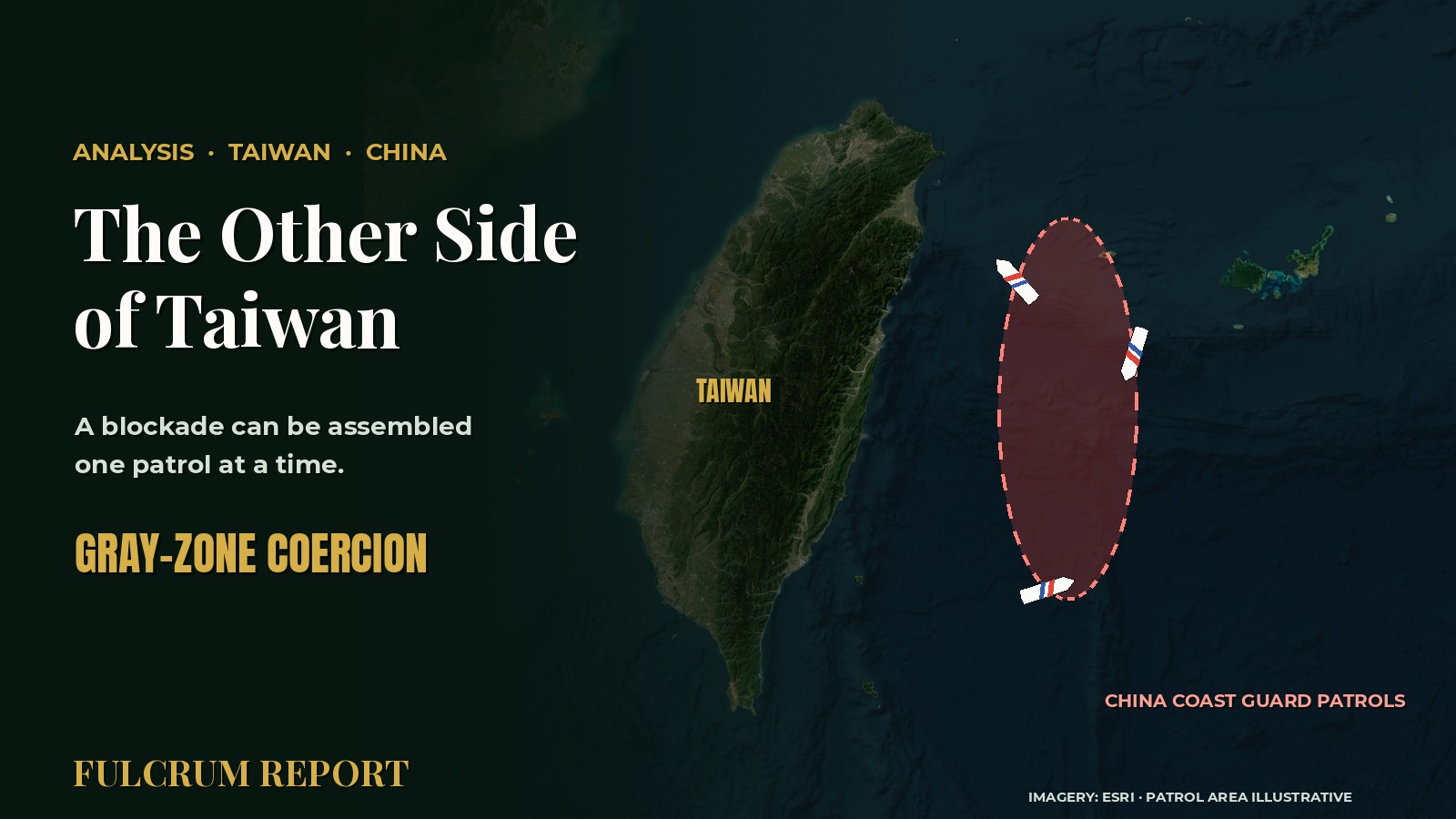
The Other Side of Taiwan: How a Blockade Gets Built Without Being Declared
China's Coast Guard has reportedly set up a regular presence east of Taiwan, framed as law enforcement, while a $14 billion U.S. arms package is pending. A look at gray-zone coercion, salami tactics and escalation control.